


The reassuring truth is that in most cases, bad breath in the first one to two weeks after tonsillectomy is a normal and expected part of healing.
At Melbourne ENT in St Kilda East, Victoria, ENT surgeons Dr Stephen Kleid and Dr Simon Braham regularly perform tonsillectomy for adults and children. They understand that the recovery period can feel unsettling, especially when symptoms such as bad breath are not talked about as often as pain or bleeding. This article is written for patients and families in Melbourne and surrounding areas and offers general information about bad breath after tonsil surgery, why it occurs, when it is normal, and when it may need further assessment. It does not replace personalised medical advice from your own doctor or specialist.
Understanding Tonsil Surgery and Why It Affects Breath
What Are The Tonsils?
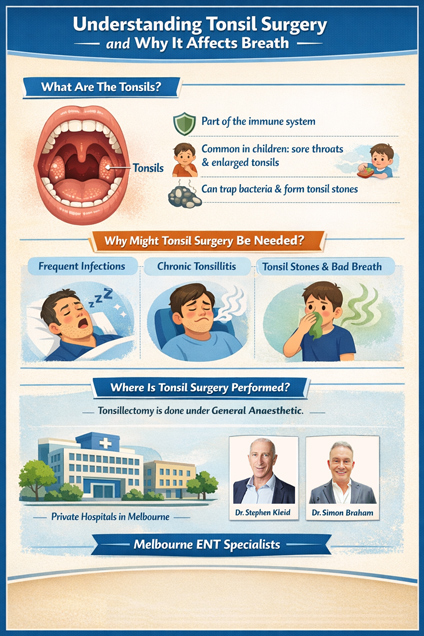
The tonsils are two small, oval areas of lymphoid tissue that sit on each side at the back of the throat. They form part of the immune system and help to recognise germs that enter through the mouth and nose. In childhood they are often more active, which is one reason why children commonly have sore throats and enlarged tonsils. In many people the tonsils cause very few problems and gradually shrink with age.
In others, the tonsils can become a source of trouble. Repeated infections can leave them enlarged, scarred, or deeply pitted. Food particles and bacteria can become trapped within the folds, forming tonsil stones and causing a persistent unpleasant odour. Even with excellent dental hygiene and routine dental care, this tonsil related bad breath can continue for years, which is why some patients eventually ask an ENT surgeon whether removal is an option.
Why Might Adults And Children In Melbourne Need Tonsil Surgery?
Tonsillectomy is the operation that removes the tonsils from the back of the throat. Adults and children in Melbourne are usually advised to consider tonsil surgery when the tonsils are significantly affecting their health or quality of life. Common reasons include repeated episodes of tonsillitis, where sore throats, fevers, and antibiotic courses keep returning, or chronic tonsillitis, where the throat never quite settles and remains uncomfortable or inflamed.
Another group of patients experience ongoing tonsil stones and bad breath that affects social confidence, school life, work, or close relationships. Some people have enlarged tonsils that contribute to noisy snoring, disrupted sleep, or obstructive sleep apnoea. In these situations, ENT surgeons such as Dr Stephen Kleid and Dr Simon Braham at Melbourne ENT assess the overall pattern of symptoms, previous treatments, and the impact on day to day life to decide whether tonsillectomy is likely to be helpful.
Where Is Tonsil Surgery Usually Performed?
Tonsillectomy is performed under a general anaesthetic in an accredited hospital. Patients under the care of Melbourne ENT typically have surgery at private hospitals in Melbourne and nearby areas, chosen in discussion with the surgeon and the patient. Both Dr Kleid and Dr Braham have long experience in ENT and head and neck surgery, including work at major Victorian hospitals such as the Royal Melbourne Hospital and the Royal Victorian Eye and Ear Hospital during their training and consultant careers. This experience supports their work at Melbourne ENT and gives patients confidence that their surgeon is familiar with both routine and complex ENT conditions.
Why Does Bad Breath Happen After Tonsil Surgery?
The Healing Process In The Throat
When the tonsils are removed, two raw surfaces are left where the tonsils once sat. The body immediately begins a controlled healing process. A protective layer forms over these surfaces within days. When you look into the mirror, this often appears as a white, yellow, or cream coating. Many patients and parents mistake this for pus or a dangerous infection, but in the early stages it is usually a normal fibrin and tissue layer that protects the underlying wound.
Over the following days, this layer may look thicker or patchier before it gradually breaks down. Underneath, new mucosal lining forms and eventually replaces the original tonsil tissue. This stage can look dramatic and can be associated with an unpleasant smell, but it is an important and necessary part of the healing journey after tonsillectomy.
How This Leads To Bad Breath
Bad breath after tonsil surgery arises from several overlapping factors. The healing tissue on the tonsil beds produces secretions that can have a strong odour. Small amounts of blood, sloughed tissue, and saliva linger at the back of the throat, especially when swallowing is sore and less frequent than usual. At the same time, many people find it difficult to eat normally or brush their teeth thoroughly in the first week, simply because the mouth and throat are painful.
This change in routine allows oral bacteria to thrive on the tongue, teeth, and healing tissues, which intensifies the smell. Pain medicine and reduced fluid intake can also dry the mouth. Saliva has a natural cleansing effect, so when there is less of it, odours become more noticeable. The combination of healing surfaces, less frequent swallowing, temporary changes in diet and oral hygiene, and a drier mouth makes bad breath a very common and expected symptom after tonsillectomy.
Pre-Existing Tonsil Problems And Breath
It is important to distinguish between the bad breath that some patients experience for years because of their tonsils and the temporary bad breath that occurs after surgery. Many people who attend Melbourne ENT report long standing halitosis related to tonsil stones or chronic tonsillitis. Even with excellent tooth brushing, flossing, and dental care, they notice a persistent smell or taste that has affected their social confidence or close relationships.
Once the tonsils are removed, it is normal for breath to worsen temporarily during healing. However, as the throat recovers fully over the following weeks, many patients notice that their breath is significantly better compared with how it was before surgery. Although every individual is different and no outcome can be guaranteed, long term improvement in tonsil related bad breath is a common goal of surgery and is discussed carefully during consultations with Dr Stephen Kleid and Dr Simon Braham.
What Is “Normal” Bad Breath After Tonsil Surgery?
Typical Time Course
Bad breath often becomes noticeable within a day or two after tonsillectomy and may peak during the first week. At this stage, the protective coating over the tonsil beds is well established, swallowing is still painful, and saliva flow may be reduced. Many patients, and parents in the case of children, describe the odour as metallic, rotten, or sour and worry that something must be wrong.
Around the end of the first week, the smell may remain strong but should gradually begin to improve. As the healing layer starts to break up and small pink areas of new lining appear, the character of the breath often starts to change. By around ten to fourteen days after surgery, the coating is usually much thinner or gone, and for most people, breath is significantly fresher. Some adults, especially those with more severe disease before surgery, may take a little longer to settle. In general, a pattern of slow improvement over the second week is considered reassuring.
Other Normal Symptoms That Can Appear With Bad Breath
Bad breath tends to appear as part of a cluster of expected recovery symptoms rather than in isolation. Sore throat is almost universal after tonsillectomy, and it can be quite severe. Pain often spreads to the ears because of shared nerve pathways, which can be confusing if people assume they have developed an ear infection. Difficulty swallowing, particularly when attempting rough, spicy, or acidic foods, is very common and can last for several days.
The white or cream coloured coating at the back of the throat is another normal finding and often appears more obvious as the days go by. Many patients feel tired, have disrupted sleep, or experience changes in their voice while the throat is healing. Children may be irritable, have reduced appetite, and need extra support to maintain fluid intake. These symptoms, combined with bad breath in the early period, usually reflect normal healing rather than a complication.
Reassurance From An ENT Perspective
From the perspective of ENT surgeons such as Dr Stephen Kleid and Dr Simon Braham, who have managed many tonsillectomy patients across Melbourne and Victoria, bad breath in the first one to two weeks is an almost universal experience. They view it as a routine part of the healing process. On its own, without other concerning signs, it is rarely a reason to suspect infection or serious problems.
At Melbourne ENT, these expectations are usually discussed before surgery so patients and families feel prepared. Knowing in advance that breath will likely smell unpleasant, and understanding why, can make the experience less alarming. If you are ever unsure whether what you are experiencing is within the range of normal, your GP or ENT specialist can examine your throat and provide reassurance.
When Bad Breath Might Be a Warning Sign
Symptoms That Should Prompt Review By A Doctor
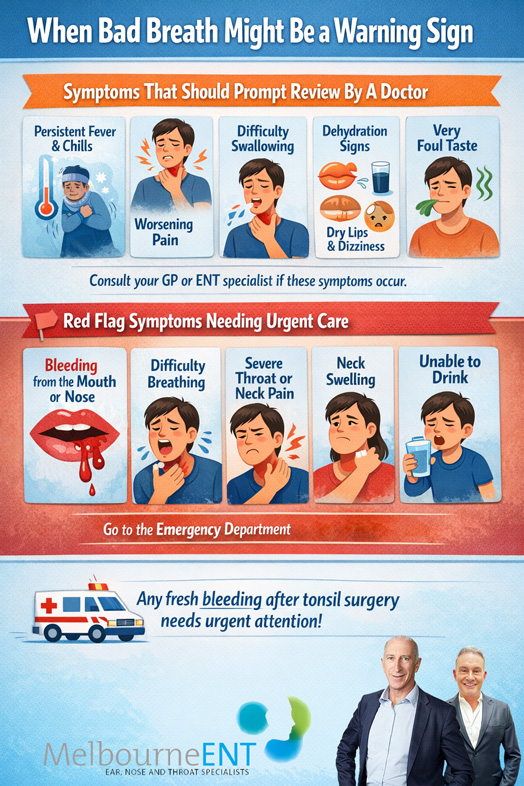
Although bad breath alone is common and usually harmless during early recovery, there are times when it can appear alongside other symptoms that need medical attention. If you notice bad breath together with a persistent fever, shaking chills, or a feeling of being generally unwell, this may indicate that there is an infection rather than simple healing. A pattern of pain that was beginning to settle but then suddenly worsens again can also be a warning sign.
Difficulty swallowing that stops you from drinking enough fluids, or signs of dehydration such as dizziness, very dark urine, or dry lips and tongue, are important to address. Some people describe a very foul taste that worsens instead of slowly improving during the second week. In these situations, it is sensible to speak with your general practitioner, the hospital where the tonsillectomy took place, or the rooms of Melbourne ENT to arrange an assessment. A physical examination is the best way to decide whether specific treatment is needed.
Red Flag Symptoms Needing Urgent Care
Certain symptoms after tonsillectomy are considered emergencies and require immediate attention in an emergency department. The most important of these is fresh, bright red bleeding from the mouth or nose. This may appear as blood in the saliva, repeated spitting of blood, or clots in the mouth. Any fresh bleeding after tonsil surgery should be treated as urgent, even if it seems to stop and start.
Other red flag symptoms include difficulty breathing, noisy breathing at rest, a sudden severe increase in throat or neck pain, or visible swelling of the neck. Inability to drink at all, especially in young children, can lead quickly to dehydration and should not be ignored. Patients in Melbourne and regional Victoria are advised to follow the emergency instructions given in their hospital discharge information and to attend the nearest emergency department or call emergency services if these warning signs occur.
Who To Contact If You Are Worried
If you are ever uncertain whether your symptoms are normal, it is always appropriate to seek professional advice. Many people will first consult their local GP, who can check the throat, take your temperature, and review your overall condition. The hospital where your surgery was performed may also provide postoperative contact information for concerns that arise soon after discharge.
During usual business hours, patients of Melbourne ENT can contact the rooms of Dr Stephen Kleid and Dr Simon Braham to discuss non urgent postoperative questions and arrange a review if needed. The team understands that recovery can be emotionally and physically challenging and encourages patients and parents to reach out whenever doubts arise rather than staying at home and worrying silently.
Practical Ways to Support Healing and Reduce Bad Breath
Hydration And Diet
Keeping up fluid intake is one of the simplest and most effective ways to support healing and reduce bad breath. Drinking small amounts regularly helps keep the mouth and throat moist and washes away debris and bacteria. Some people prefer cool or icy fluids because they feel soothing, while others tolerate lukewarm drinks better. Children often do better with frequent sips from a cup or bottle, or small icy treats, rather than being asked to finish a large glass in one go.
Diet can also influence how your breath smells and how comfortable your throat feels. Once your surgeon or hospital team has said it is safe, soft and easy to swallow foods such as yoghurt, pureed fruit, mashed vegetables, well cooked pasta, or scrambled eggs are usually easier to manage. Eating stimulates saliva production and gently moves the throat, which can help the healing surfaces to mature. Recovery is not a time for strict dieting and it is reasonable to focus on whatever nutritious foods you can manage comfortably.
Gentle Mouth Care
Good oral hygiene can make a noticeable difference to both comfort and odour. Brushing the teeth gently twice a day with a soft toothbrush helps reduce plaque and bacteria in the mouth. Some people are able to carefully clean the front of the tongue as pain settles, which can also improve breath. It is important to avoid vigorous brushing near the back of the tongue or throat so that the healing tissues are not disturbed.
The use of mouth rinses should always follow your surgeon’s instructions. Some patients are advised to use gentle salt water rinses after a few days, while others are told to avoid gargling early on. Strong alcohol based mouthwashes can sting and dry the tissues, so they are often not recommended in the immediate postoperative period. Always follow the written and verbal advice given to you at the time of surgery or by your ENT surgeon at Melbourne ENT.
Pain Relief And Rest
Pain relief is central to a good recovery. When pain is well controlled using the medications prescribed by your surgeon or recommended by the hospital, you will find it easier to drink, eat, and keep your mouth clean. Adults in Melbourne should allow themselves enough time away from work to rest and recover properly, and children will need days at home away from school or childcare. Pushing yourself back to full activity too quickly can increase discomfort and make it harder to keep up with food and fluids.
Rest gives the body the chance to direct its energy toward healing. It is very common to feel more tired than usual and to need extra sleep in the days after tonsillectomy. Light activity, such as walking around the house, is generally encouraged, but heavy lifting, high intensity exercise, and contact sports are usually restricted until your doctor confirms that it is safe to resume them.
Lifestyle Factors To Avoid
Some lifestyle factors can irritate the throat and prolong the healing process. Smoking and vaping are especially problematic, as they dry and inflame the lining of the mouth and throat, increase the risk of infection, and can worsen postoperative pain. Ideally these should be avoided before and after surgery. If you smoke, your tonsillectomy may be a good opportunity to talk to your GP about support for quitting.
Alcohol can also be irritating and dehydrating in the early stages of recovery, and very spicy, crunchy, or acidic foods can cause sharp pain at the back of the throat. It is usually best to reintroduce these gradually only after your throat is more comfortable and your ENT surgeon or hospital team has said that you can return to a normal diet.
Support from Melbourne ENT During Tonsil Surgery Recovery
Pre Operative Planning And Expectations
Before surgery, Dr Stephen Kleid and Dr Simon Braham take time to understand your symptoms and goals. They ask about the frequency and severity of throat infections, whether you have tonsil stones or long term bad breath, and whether you experience snoring or disturbed sleep. They also review your general health and any other conditions that might affect your suitability for surgery.
During this pre operative period at Melbourne ENT, you will have the opportunity to ask questions about the operation, including how it is performed and what to expect afterward. The surgeons explain that pain, difficulty swallowing, and bad breath are expected in the early stages. Knowing this ahead of time allows you to plan time away from work or school, arrange help at home if needed, and prepare emotionally for the recovery phase.
Clear Written And Verbal Instructions
Patients of Melbourne ENT receive clear instructions about what to expect and how to care for themselves or their child after surgery. This usually covers pain medication schedules, suitable foods and drinks, activity restrictions, and normal changes in the appearance of the throat and breath. It also explains which symptoms require urgent medical attention and which can be safely monitored at home.
Families from St Kilda East, other Melbourne suburbs, and regional Victoria often find that having both written and verbal guidance helps everyone feel more secure and informed. These instructions provide a point of reference in the days after discharge when new questions arise and it is easy to forget what was said in hospital.
Follow Up Care And Communication
Follow up is an important part of safe surgical care. After tonsillectomy, a review appointment at Melbourne ENT allows Dr Stephen Kleid or Dr Simon Braham to check that the throat has healed well, ensure that bad breath and pain have settled, and address any lingering questions. At this visit, they may also discuss the longer term benefits of surgery, such as fewer infections, improved sleep, or a reduction in chronic tonsil related odour.
Clear communication between the specialist, hospital, and GP supports continuity and helps make sure that ongoing issues such as persistent bad breath or sleep disturbance are identified early and managed appropriately.
Medicare Coverage for Tonsil Surgery
In Australia, tonsillectomy is generally considered a medically necessary procedure when it is undertaken to treat significant health problems such as recurrent tonsillitis, chronic tonsillar disease, or obstructive sleep apnoea. When your general practitioner or another specialist provides a valid referral to an ENT surgeon, Medicare usually offers a rebate for both the initial consultation and the tonsillectomy procedure itself. This rebate covers part of the surgeon’s fee.
For patients who hold appropriate private hospital insurance, some or all of the hospital and theatre fees may also be covered, depending on the policy and level of cover. There can still be out of pocket costs, often called a gap, which vary between individuals and funds. At Melbourne ENT, patients are given information about likely fees before proceeding with surgery. The practice staff can provide Medicare item numbers and guidance so that you can check details with your health fund and understand your specific situation. Because Medicare rebates and private health insurance policies differ between patients, it is always best to discuss your own circumstances directly with the practice and your insurer.
Who Might Benefit from Seeing Melbourne ENT About Bad Breath and Tonsils?
Adults
Adults may seek help from an ENT specialist when throat and tonsil problems start to interfere with daily life. Recurrent tonsillitis can lead to time off work, repeated courses of antibiotics, and persistent fatigue. Ongoing tonsil stones and bad breath can cause embarrassment or reluctance to socialise closely. Snoring and sleep apnoea associated with enlarged tonsils can affect both the patient and their partner by disrupting sleep.
At Melbourne ENT, Dr Stephen Kleid and Dr Simon Braham evaluate each adult individually. They consider the frequency of infections, the severity of symptoms, previous treatments, and any other medical conditions. Together with the patient, they weigh the potential benefits and risks of surgery and discuss whether tonsillectomy is likely to improve symptoms such as chronic bad breath and recurrent infections.
Children And Teenagers
Children and teenagers often experience recurrent tonsil problems that affect their schooling and general wellbeing. Repeated sore throats can mean many days away from school and ongoing courses of antibiotics. Enlarged tonsils may cause noisy breathing at night, restless sleep, and daytime tiredness or behavioural changes. Older children and adolescents may also develop tonsil stones and feel self conscious about bad breath, especially in social situations.
Melbourne ENT has extensive experience treating paediatric patients from Melbourne and surrounding areas. Dr Stephen Kleid and Dr Simon Braham aim to make consultations child friendly and to involve parents closely in decision making. They explain the reasons for recommending or not recommending surgery and outline what recovery will look like for a child or teenager, including how long bad breath and throat discomfort are likely to last.
Persistent Bad Breath After Full Recovery
Occasionally, a person may find that months after tonsillectomy they still have troublesome bad breath. In these cases, it is important to broaden the focus beyond the tonsils. Dental issues such as gum disease, tooth decay, or ill fitting restorations can be major contributors to halitosis. Chronic sinus disease, nasal congestion, dry mouth, reflux, and some digestive or metabolic conditions can also play a role.
A review with an ENT specialist at Melbourne ENT can help determine whether there are any remaining ENT factors, such as nasal or sinus disease, contributing to the problem. Where appropriate, Dr Stephen Kleid or Dr Simon Braham may recommend further dental evaluation or investigation by your GP or another specialist. The aim is to ensure that all potential causes of ongoing bad breath are considered and managed in a coordinated way.

FAQs About Bad Breath After Tonsil Surgery
Can the smell after tonsil surgery change from day to day, and is that a concern?
The smell can certainly change from day to day during recovery, and this is very common. Some days it may be particularly strong, especially if you have eaten less, brushed less, or your mouth feels dry. On other days, the odour may seem milder. These fluctuations usually reflect natural changes in the healing tissue and in the amount of saliva and oral bacteria present. As long as the overall pattern is that things slowly improve over one to two weeks and there is no high fever, severe worsening pain, or bleeding, changing intensity of smell is not usually a cause for concern. If the odour becomes steadily worse and you feel increasingly unwell, you should contact your doctor or the team at Melbourne ENT for advice.
If only one side of my throat smells bad, does that mean something is wrong on that side?
It is quite common for one side of the throat to feel different or to seem smellier than the other after tonsillectomy. The two tonsils are rarely identical to begin with, and one side may have had more disease, deeper pits, or more scarring, which can make the healing process slightly slower on that side. This does not necessarily mean there is an infection or complication. What matters is the overall picture. If one side becomes significantly more painful, swollen, or starts to bleed, or if you are worried by a sudden change, you should have it checked by your GP or ENT surgeon, such as Dr Stephen Kleid or Dr Simon Braham.
Could strong bad breath after tonsil surgery mean that some tonsil tissue was left behind?
Strong bad breath in the first week or two after surgery almost always comes from the healing surfaces rather than from leftover tonsil tissue. ENT surgeons are trained to remove the tonsils completely, and small remnants, if present, would not usually cause intense odour so soon after surgery. The temporary smell is much more likely to be related to the normal coating on the tonsil beds, dried secretions, and changes in oral hygiene. If, months after surgery, your symptoms feel very similar to how they did before the operation, a review at Melbourne ENT is sensible. During that visit, your surgeon can examine the throat and explain whether any residual tissue or another cause may be relevant.
Why does food taste different while my breath smells bad after tonsil surgery?
Changes in taste are very common after tonsil surgery and often appear at the same time as bad breath. The nerves that help with taste run close to the area where the tonsils are removed, and they can be temporarily affected by the operation or by postoperative swelling. The protective layer over the healing surfaces can also produce a bitter or metallic taste that lingers, especially when the mouth is dry. Pain medicines and reduced food intake may further alter the way flavours are perceived. For most people, taste gradually returns to normal as the coating lifts and the tissues settle. If taste changes continue long after the throat has healed, this can be discussed at a follow up appointment with your ENT specialist.
Is it safe to kiss or be close to people while I still have bad breath after tonsil surgery?
Most everyday close contact is safe during recovery as long as you feel generally well and do not have a contagious infection such as influenza or a severe cold. The bad breath associated with tonsil surgery is linked to your own healing tissue and oral bacteria, not to an infection that others are likely to catch from you. However, deep or prolonged kissing can be uncomfortable in the early stages because it involves more movement of the tongue and throat. Many people prefer to wait until pain has settled and they feel more comfortable before resuming intimate contact. If you develop fever or feel very unwell, it is wise to avoid close contact until you have been assessed and advised by a doctor.
Can stress or anxiety make my bad breath feel worse during recovery?
Stress and anxiety do not create the odour, but they can make you more aware of it and more distressed by it. When people are anxious, they often focus closely on physical sensations and may check their breath repeatedly, which amplifies their concern. Stress can also reduce saliva flow, leading to a drier mouth, which makes any existing odour more noticeable. At Melbourne ENT, patients are encouraged to talk about their worries before surgery so they know what is normal and what is not. Simple measures such as staying hydrated, using relaxation techniques, distracting yourself with light activities, and seeking reassurance from trusted family members can help you cope while your throat heals.
What if friends or colleagues notice my breath when I go back to work or school after tonsil surgery?
It is understandable to feel self conscious about returning to normal activities while your breath is still improving. In practice, by the time most people go back to work, study, or school, the odour is already fading. Regular tooth brushing, gentle tongue cleaning if it is comfortable, frequent sips of water, and, if your surgeon has approved it, the occasional use of sugar free gum or mints can help you feel more confident. Other people are often more focused on their own tasks than on small changes in someone else’s breath. If you genuinely feel that your recovery is unusually slow or that the smell is still very strong several weeks later, it is sensible to arrange a review with an ENT surgeon at Melbourne ENT to make sure healing is complete and there are no other causes to consider.
Medical References
- Tonsillectomy / Mayo Clinic / https://www.mayoclinic.org/tests-procedures/tonsillectomy/about/pac-20395141
- Bad breath – Symptoms and causes / Mayo Clinic / https://www.mayoclinic.org/diseases-conditions/bad-breath/symptoms-causes/syc-20350922
- Halitosis / NCBI Bookshelf – StatPearls / https://www.ncbi.nlm.nih.gov/books/NBK534859/
- Routine Histopreparations After Tonsillectomy, Tonsillotomy / PMC – NIH / https://pmc.ncbi.nlm.nih.gov/articles/PMC12897595/
- Complications Following Lingual Tonsillectomy: Analysis / PMC – NIH / https://pmc.ncbi.nlm.nih.gov/articles/PMC12753122/
- Long-term complications after tonsil surgery / PMC – NIH / https://pmc.ncbi.nlm.nih.gov/articles/PMC10749945/
- Rare and fatal complications of tonsillectomy / PMC – NIH / https://pmc.ncbi.nlm.nih.gov/articles/PMC9340339/
Moving Forward if You Are Worried About Bad Breath After Tonsil Surgery
Bad breath after tonsil surgery is almost always temporary, even though it can feel very confronting at the time. Understanding that the smell comes from normal healing surfaces, reduced swallowing, and short term changes in oral hygiene can make the experience easier to accept. Paying attention to hydration, gentle mouth care, pain control, and rest will support the healing process and usually helps the odour improve steadily over one to two weeks.
At the same time, it is important to stay alert for warning signs such as bleeding, high fever, severe worsening pain, or difficulty drinking, and to seek prompt medical help if these occur. For patients and families across Melbourne and surrounding regions, support from an experienced ENT team can make the whole journey, from decision making to recovery, feel safer and more manageable.
If you are concerned about long term tonsil problems, chronic bad breath, or symptoms after a recent tonsillectomy, you are encouraged to speak with your general practitioner and consider a referral to Melbourne ENT in St Kilda East. To learn more about tonsil surgery and recovery with Melbourne ENT, or to arrange an appointment with Dr Stephen Kleid or Dr Simon Braham, you can phone the rooms or visit the website.
Further Reading
- Read more about Adenotonsillectomy Melbourne
- Read more about Tonsil Surgery for Kids in Melbourne
- Read more about Adult Tonsil Surgery Melbourne
- Read Melbourne ENT’s Blog on What is Coblation Tonsillectomy ? – Cold-Ablative Tonsillectomy in Melbourne
- Read Melbourne ENT’s Blog on Cold Ablation Techniques for Tonsils
Download Tonsillectomy Journey with Dr Braham

Endoscopic Airway Assessment for Snoring: What ENT Surgeons Look For
Snoring is often spoken about casually, but for many people, it becomes a persistent concern…
Does My Child Need Tonsils and Adenoids Removed Together?
Parents often start asking about tonsils and adenoids after weeks or months of disrupted sleep,…
Do Tonsils Grow Back After Tonsillectomy?
Tonsillectomy is often spoken about as though it is the final chapter in a long…

Possible Risks and Effects of Chronic Mouth Breathing
Breathing through the nose is something many people do without thinking. When it is working…

Bronchial or Nasal Surgery for Snoring – Which Is Right for You
Is nasal or throat surgery better for snoring? The most appropriate treatment depends on where…
Breathing Problems in Kids – Is It Sinus or Something Else
What causes breathing problems in kids? Breathing problems in children are often caused by a…