

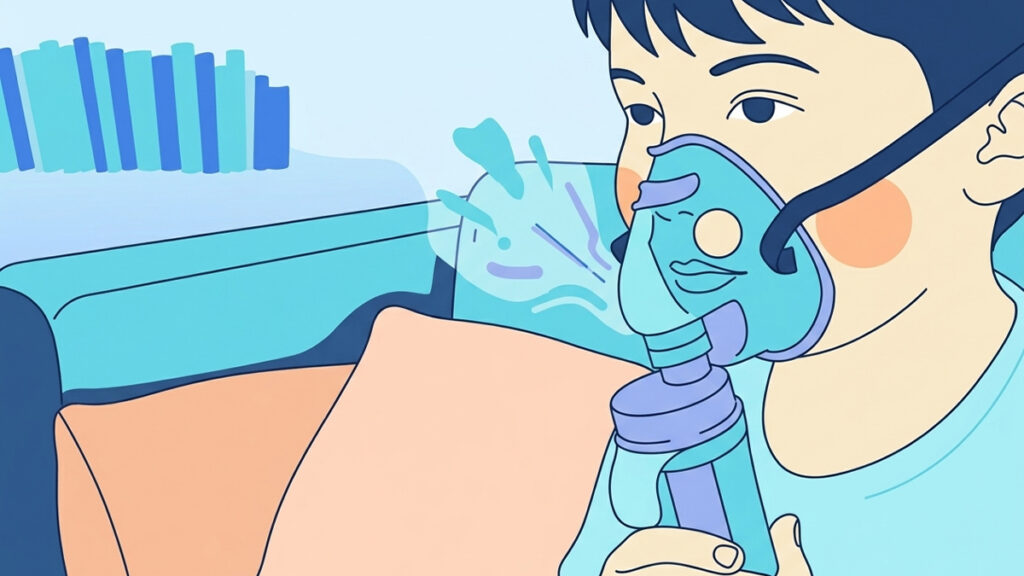
What causes breathing problems in kids?
Breathing problems in children are often caused by a combination of factors rather than a single issue. Common causes include enlarged adenoids, enlarged tonsils, allergic rhinitis, nasal inflammation, and sleep-disordered breathing. Sinus disease may play a role in some cases, but is not always the primary cause.
When a child always seems blocked up, breathes through the mouth, snores at night, or sounds as though they have a lingering cold, many parents assume the problem must be related to the sinuses. That is a very common and understandable starting point. Nasal blockage, noisy breathing and that constantly “stuffy” sound are often described as sinus trouble in everyday conversation, even when the cause lies elsewhere.
From an ENT perspective, breathing problems in kids are often more layered than they first appear. The sinuses can sometimes be involved, but they are only one part of the picture. In many children, the more likely causes include enlarged adenoids, enlarged tonsils, allergic rhinitis, ongoing nasal inflammation, or sleep disordered breathing. Some children have more than one contributing factor, which is why symptoms can persist and why families may feel unsure about what is really driving the problem.
At Melbourne ENT in St Kilda East, Victoria, this is a familiar discussion. Dr Simon Braham, ENT and Head & Neck Surgeon, sees children whose symptoms have often been labelled as sinus-related, only for further assessment to suggest that the issue may be coming from the adenoids, tonsils, allergy, or the way the airway behaves during sleep. A careful ENT review can help clarify what is happening and support a treatment plan that reflects the child’s symptoms, age, general health and day-to-day difficulties.
The most useful question is not simply whether a child has “sinus”. It is why that child is finding it difficult to breathe comfortably through the nose, and whether the problem is affecting sleep, behaviour, concentration or wellbeing. Once the focus shifts from the label to the child’s actual symptoms, the path forward often becomes clearer.
Why Parents Often Describe It As Sinus Trouble
Parents are usually doing their best to describe a pattern they have been living with for weeks or months. A child may seem constantly congested, may have a blocked-sounding voice, may breathe loudly at night, or may always sleep with the mouth open. In family life, all of these signs can easily be grouped together and described as sinus trouble.
The difficulty is that the term is broad and often imprecise. The sinuses are only one part of the upper airway. A child can sound blocked because there is swelling inside the nose, because enlarged adenoids are reducing airflow behind the nose, because tonsils are contributing to airway narrowing during sleep, or because allergy is causing persistent inflammation. A child can also have poor-quality sleep related to airway obstruction, even when the family’s main complaint is simply that the nose never seems clear.
This is why the same symptom can have different explanations. What sounds like a sinus issue may actually be a problem with the space behind the nose. What appears to be repeated congestion may be allergic rhinitis. What seems to be an ordinary blocked nose may be most noticeable at night because the real issue is sleep disordered breathing.
This broader view matters because treatment depends on the cause. If the diagnosis is assumed too early, families can spend a long time trying to manage the wrong problem. That can be frustrating for parents and uncomfortable for the child, particularly when the symptoms begin to affect sleep, school or everyday routine.
What Breathing Problems in Kids Can Look Like
Breathing problems in kids do not always present dramatically. In many cases, they develop gradually and become part of everyday life. A child who has breathed through the mouth for a long time may act as though that is normal. A child who snores most nights may not realise that sleep is unsettled. Often the signs are first noticed by parents, carers or teachers rather than by the child.
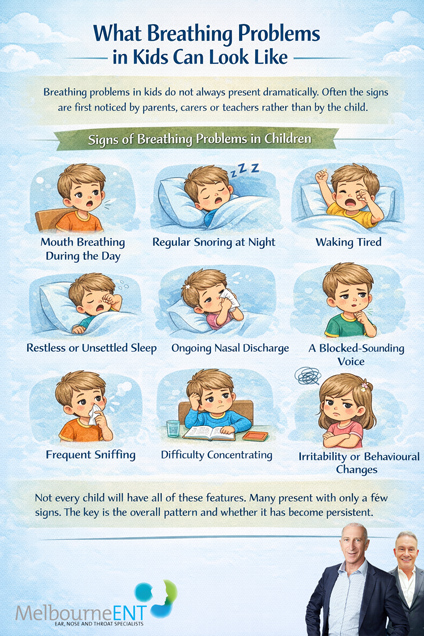
Some children sound blocked in the nose all the time. Their speech may have a hyponasal quality, as though the nose is permanently congested. Others have ongoing sniffing, a runny nose that seems to persist, or repeated episodes of sounding as though they have a cold. Some children seem to wake unrefreshed, are difficult to rouse in the morning, or look tired despite spending enough time in bed.
Night-time symptoms can be especially important. Parents may notice snoring, mouth breathing, noisy sleep, frequent waking, tossing and turning, or unusual sleeping positions that suggest the child is trying to find a more comfortable way to breathe. In some children, breathing may briefly pause during sleep, or there may be gasping sounds that understandably worry parents.
Daytime effects can be more subtle. Poor sleep can contribute to irritability, emotional ups and downs, reduced concentration, a flat mood, or difficulty managing the school day. Some children seem constantly tired. Others may appear restless or unsettled rather than sleepy. When these changes occur alongside chronic nasal blockage or snoring, it becomes important to consider the airway more carefully.
Parents often describe a child who seems “always blocked”, but there are usually more clues once the pattern is explored. These may include:
- mouth breathing during the day
- regular snoring at night
- restless or unsettled sleep
- waking tired
- ongoing nasal discharge
- a blocked-sounding voice
- frequent sniffing
- difficulty concentrating
- irritability or behavioural changes
- recurrent ear, nose or throat problems
Not every child will have all of these features. Many present with only a few signs. The key is the overall pattern and whether it has become persistent.
When The Sinuses Are Not The Main Problem
One of the most common explanations for ongoing nasal obstruction in children is enlarged adenoids. The adenoids sit at the back of the nose, in a place that parents cannot see during a routine look in the mouth. When they become enlarged, they can reduce airflow through the nasal passage and make a child sound blocked up all the time.
This can create a recognisable pattern. The child may breathe through the mouth during the day, snore at night, sound as though the nose is blocked, and sleep less well than expected. Because the child appears congested, families often assume the issue must be the sinuses. In reality, the obstruction may be coming from tissue behind the nose rather than from the sinus spaces themselves.
Tonsils can also contribute, particularly when the child’s main difficulty is at night. Enlarged tonsils do not block the nose directly, but they can narrow the throat and affect airflow during sleep. A child with large tonsils may snore loudly, sleep restlessly, or have pauses in breathing. In these situations, parents may focus on the blocked-sounding breathing, but the more important issue may be a narrowed airway in the throat.
This is one reason ENT assessment can be so helpful. The symptoms may sound similar from the outside, but the likely cause may be very different. Understanding where the obstruction is coming from can guide more appropriate treatment and can help families understand why a child has not improved with simple measures.
It is also important to remember that young children do not always have the words to explain what they are experiencing. They may not say that breathing feels difficult. They may simply adapt. They may sleep with the mouth open, talk with a blocked-sounding voice, or become increasingly unsettled without being able to describe why. The symptoms can be easy to normalise when they have been present for a long time.
The Role of Adenoids In Younger Children
Adenoids are particularly relevant in younger children because they can play a major part in ongoing nasal obstruction. They sit in a small but important space behind the nose, and when they are enlarged they can have a significant effect on airflow. The result is often mouth breathing, chronic congestion, snoring, disturbed sleep and the sense that the child always sounds blocked up.
Parents are often surprised by how much influence the adenoids can have. Because they are not visible during a simple look at the throat, they can be easy to overlook. Yet they may explain symptoms that have been present for months or even years.
In some children, enlarged adenoids are also linked with recurrent ear problems because of their position near the openings of the Eustachian tubes. A child may therefore present with a mixture of nasal blockage, ear symptoms, poor sleep and noisy breathing. This overlap reinforces the importance of considering the upper airway as a whole rather than assuming that every blocked nose is a sinus problem.
At Melbourne ENT, this distinction is clinically useful because it helps shape the discussion around management. If the main issue is behind the nose, the approach may be different from that used for allergy-driven inflammation or true chronic sinus disease.
Families often notice certain recurring features when adenoids are part of the picture. A child may:
- sleep with the mouth open
- snore most nights
- sound “nasal” or blocked in the voice
- breathe noisily through the nose
- have repeated ear concerns
- seems tired despite a full night in bed
These signs do not confirm enlarged adenoids on their own, but they can point the assessment in a useful direction.
Allergy Can Play a Major Part
Allergic rhinitis is another common cause of breathing problems in kids and can be one of the easier conditions to misread. When the inside of the nose is persistently inflamed, the child may sound congested almost all the time. There may be clear nasal discharge, frequent sniffing, an itchy nose, rubbing of the nose, watery eyes, mouth breathing, or reduced sleep quality.
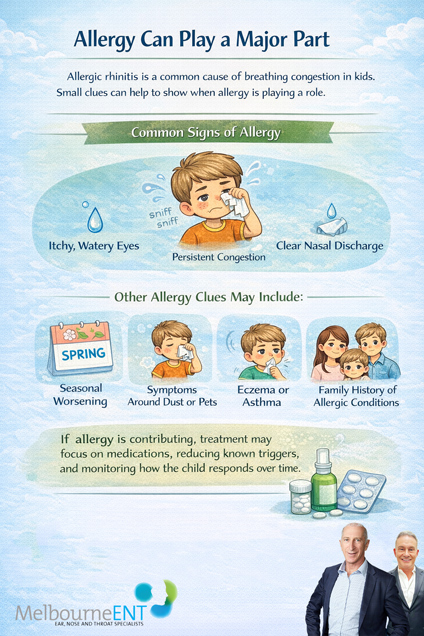
Because these symptoms can go on for long periods, families may feel that the child is always unwell. In some cases, it can seem as though one cold follows another. The real issue, however, may be ongoing inflammation rather than repeated infection. A child who is not particularly sick but is always blocked in the nose may fit this pattern.
Allergy can also sit alongside other problems. Some children have both allergic rhinitis and enlarged adenoids. Others have allergy plus a tendency to snore when the nose is inflamed. This can make the overall picture more complicated and can explain why symptoms seem to flare and settle without ever completely resolving.
From a patient-centred point of view, this is an important part of the conversation. Parents often feel relieved when they learn that a blocked nose does not automatically point towards surgery. If inflammation or allergy is a major contributor, treatment may focus on medical support, reducing exposure to triggers where possible, and monitoring how the child responds over time.
There are often small clues that suggest allergy might be contributing. These can include seasonal worsening, symptoms around dust or pets, itchy eyes, eczema, asthma, or a family history of allergic conditions. None of these signs should be viewed in isolation, but together they can help explain why a child seems persistently congested without looking overtly unwell.
When It Really Is Sinus Related
Although many childhood breathing problems are not primarily due to the sinuses, sinus disease can still occur. It is simply important not to assume it is the default explanation every time a child sounds blocked up.
In some children, there may be prolonged nasal discharge, pressure symptoms in older children, repeated episodes that take a long time to settle, or a pattern suggesting ongoing inflammation involving the nose and sinuses. Even then, it is often necessary to consider the broader airway. The child may still have adenoid enlargement, allergy or another contributing factor that is keeping the symptoms going.
This is why the term “sinus” can be both useful and misleading. It may describe part of the experience, but it does not necessarily identify the real source of the problem. A child may have sinus-related symptoms, but the management plan still needs to look beyond the sinuses alone.
Families often find this distinction reassuring. It moves the conversation away from guesswork and towards understanding the child’s specific pattern. That in turn supports more appropriate next steps, whether those involve observation, medical treatment, or further review.
Why Sleep Symptoms Deserve Close Attention
One of the most important parts of assessing breathing problems in kids is looking at what happens during sleep. Families often seek help because a child sounds blocked in the nose, but the deeper concern may be that the child is not sleeping well.
Regular snoring in children should not be brushed aside too quickly. While occasional snoring during a cold is common, snoring most nights, noisy breathing during sleep, gasping, or observed pauses in breathing can suggest sleep disordered breathing or obstructive sleep apnoea. These patterns deserve thoughtful assessment because they can affect more than the night-time period alone.
Poor sleep can influence mood, concentration, behaviour and daytime energy. Some children become irritable, emotionally reactive or difficult to settle. Others seem withdrawn, tired, or less able to focus at school. Occasionally, parents describe a child who seems to have changed over time, becoming more unsettled or less resilient, without initially connecting this to breathing at night.
For Melbourne ENT, this is a key part of the assessment. Dr Simon Braham’s clinical experience includes children with snoring, airway-related symptoms and sleep disturbance, which means the discussion is not limited to the nose alone. The quality of the child’s breathing during sleep can be just as important as the appearance of congestion during the day.
Parents may wish to pay attention to night-time signs such as:
- loud snoring
- restless sleep
- sweating during sleep
- unusual sleeping positions
- mouth breathing overnight
- pauses in breathing
- waking frequently
- seeming unrefreshed in the morning
A single unsettled night does not usually tell the whole story. What matters most is whether these features are happening regularly and whether they are affecting how the child functions during the day.
What an ENT Assessment Is Trying To Clarify
Parents sometimes worry that seeing an ENT surgeon means surgery is being considered straight away. In reality, the first aim of assessment is understanding the source of the symptoms. Before any treatment is discussed, it is important to work out what is most likely causing the child’s difficulty.
That usually begins with a detailed history. How long has the child been blocked up? Is the problem constant or does it come and go? Is there snoring every night, or only during colds? Does the child wake often? Are there any pauses in breathing? Does the child have a history of allergy, asthma, eczema, ear infections or recurrent sore throats? Has the child tried nasal sprays or other treatments already?
The examination then adds another layer of information. Depending on the child’s age and symptoms, attention may be given to the nose, throat, tonsils, ears, speech quality, breathing pattern and general airway appearance. Sometimes the likely cause becomes reasonably clear from the consultation. In other cases, symptoms overlap and the picture needs to be considered more carefully. Often a flexible fiberoptic endoscopy is necessary to directly inspect the sinus and adenoid tissue to confirm the diagnosis.
This stepwise approach is important for both families and clinicians. It supports balanced decision-making and helps avoid over-simplifying the problem. It also reflects a careful style of care, where treatment is based on the child’s actual pattern of symptoms rather than on assumptions.
For many parents, one of the most helpful parts of the consultation is simply having the symptoms organised into a clearer framework. Once they understand whether the main issue appears to be inflammation, obstruction, sleep-related airway narrowing, or a mixture of factors, the problem often feels less confusing and more manageable.
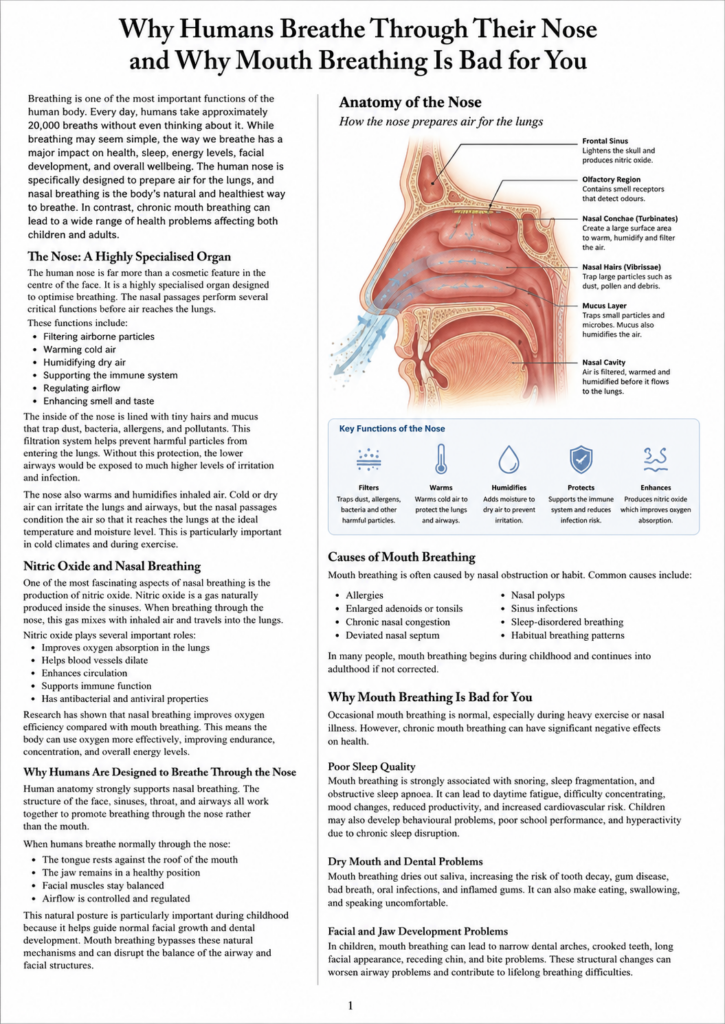
Download The Benefits of Breathing Through Your Nose Brochure
Treatment Depends On The Cause
There is no single treatment for breathing problems in kids because the reasons for the blockage vary. A child with inflammation inside the nose may need a different approach from a child whose adenoids are physically reducing airflow. A child whose main issue is enlarged tonsils and poor sleep may need a different plan again.
Some children improve with medical treatment. Saline rinses or sprays, treatment aimed at reducing nasal inflammation, and support for allergy management may all have a role when the main problem is mucosal swelling rather than fixed obstruction. For some children, time and observation are also appropriate, particularly when symptoms are linked to recurring viral illnesses and are not having a major effect on sleep or daily functioning.
Other children may need more active intervention. If enlarged adenoids are significantly affecting nasal breathing, adenoidectomy may be considered. If enlarged tonsils are contributing to poor sleep or airway obstruction, tonsillectomy, sometimes together with adenoid surgery, may be discussed. In a smaller group of children, chronic rhinosinusitis may require further treatment, although sinus surgery is not the routine answer for every child with ongoing congestion.
In practical terms, treatment discussions often fall into a few broad categories:
- observation and monitoring
- medical treatment for inflammation or allergy
- support for nasal hygiene and airflow
- review of sleep-related symptoms
- surgical treatment when a clear structural cause is affecting breathing or sleep
What matters is that treatment supports the actual cause of the symptoms. Families generally find decision-making easier when they understand why a particular option is being raised and how it relates to the child’s individual pattern.
When Specialist Review May Be Helpful
Not every child with a blocked nose needs to see an ENT surgeon. Children commonly have colds, and many episodes of congestion settle with time. The concern becomes greater when the symptoms are persistent, recurrent, or beginning to affect sleep, behaviour, school performance or family life.
A specialist review may be worth considering when a child breathes through the mouth most of the time, snores regularly, has restless sleep, seems to pause in breathing at night, remains blocked in the nose for long periods, or has symptoms that do not settle with initial treatment. Review may also be useful when the diagnosis remains unclear and families feel they are going in circles.
For parents, one of the most helpful outcomes of specialist assessment is often clarity. They may have been told different things along the way, or they may simply feel unsure about whether the problem is “just sinus” or something more. A clearer explanation can guide next steps and can reduce the uncertainty that often builds when symptoms persist for months.

Breathing Problems in Kids FAQs
Can a child have “sinus” symptoms even if the sinuses are not the main problem?
Yes. Many children who sound congested or blocked are actually dealing with enlarged adenoids, allergy, or another cause of nasal obstruction rather than primary sinus disease. That is why the overall pattern of breathing, sleep and nasal symptoms matters.
Why does a child seem worse at night than during the day?
When a child lies flat, airway narrowing can become more noticeable, especially if enlarged tonsils or adenoids are involved. This can make snoring, mouth breathing and restless sleep more obvious overnight.
Can mouth breathing change how a child sounds when speaking?
It can. Some children develop a blocked or nasal quality to the voice when airflow through the nose is reduced, particularly if adenoids are enlarged or the nose is persistently inflamed.
Is it possible for a child to sleep poorly without fully waking up?
Yes. A child may have disturbed sleep due to noisy breathing or partial airway obstruction without clearly waking or calling out. Parents often notice tossing, unusual sleep positions, snoring or daytime tiredness before the child complains.
Why do some children always sound as though they have a cold when they are otherwise well?
Ongoing nasal inflammation, allergy or adenoid enlargement can create a long-term blocked or sniffly sound even when there is no active infection. This is one reason persistent symptoms are not always caused by repeated colds.
Can breathing problems in kids affect behaviour as well as sleep?
They can. When sleep quality is reduced over time, some children become irritable, flat, unsettled or less able to concentrate during the day. These changes can be subtle and may not immediately seem related to the airway.
If one sibling had adenoids or tonsils removed, does that mean another child will need the same treatment?
Not necessarily. Children in the same family can have similar symptoms for different reasons, so treatment should still be based on the individual child’s pattern and assessment findings.
Can a child have more than one cause for nasal blockage at the same time?
Yes. A child may have allergy as well as enlarged adenoids, or nasal inflammation together with tonsil-related sleep issues. This overlap is common and is one reason symptoms can seem persistent or confusing.
Why might a child seem tired but not actually look sleepy?
Children do not always show tiredness in an obvious way. Some become more active, more emotional or harder to settle rather than appearing quiet or drowsy, which can make poor sleep harder to recognise.
When parents say a child has sinus trouble, what is an ENT surgeon usually trying to work out first?
The first priority is usually identifying where the obstruction or inflammation is coming from. That may involve the nose, adenoids, tonsils, sleep airway, or a combination of factors rather than the sinuses alone.
Medical References:
- A Clinical Approach of Allergic Rhinitis in Children — Children (Basel), 2023.
https://www.mdpi.com/2227-9067/10/9/1571 - Allergic Rhinitis: A Clinical and Pathophysiological Overview — Frontiers in Medicine, 2022.
https://pmc.ncbi.nlm.nih.gov/articles/PMC9021509 - Appropriate Allergic Rhinitis Medications Can Reduce Systemic Steroid Requirement and Prevent Rhinosinusitis — Journal of Clinical Medicine, 2024.
https://pmc.ncbi.nlm.nih.gov/articles/PMC11595140

A Measured Approach For Melbourne Families
At Melbourne ENT in St Kilda East, families are often looking for exactly that kind of clarity. They want to understand why a child is snoring, why the nose always seems blocked, or why sleep has become unsettled. They also want advice that is tailored to the child rather than based on a generic label.
Dr Simon Braham, ENT and Head & Neck Surgeon, sees children with nasal obstruction, adenoid and tonsil concerns, snoring and sleep-related breathing problems. That clinical experience is valuable because breathing problems in kids are often not one-dimensional. A child may have allergic inflammation as well as enlarged adenoids. Another may have prominent tonsillar obstruction with only mild daytime nasal symptoms. Careful assessment helps sort out which features are most relevant.
This kind of patient-centred care does not rely on dramatic claims. It relies on careful listening, thoughtful examination and a management plan that reflects the child’s needs and the family’s concerns. For many families in Melbourne and surrounding areas, that balanced approach is exactly what makes a confusing problem feel more manageable.
Looking Beyond The Word “Sinus”
When a child struggles to breathe through the nose, it is natural for parents to think of sinus trouble first. Sometimes the sinuses are involved. Very often, though, the more likely contributors are enlarged adenoids, enlarged tonsils, allergic rhinitis, chronic nasal inflammation, or sleep-disordered breathing. These conditions can overlap and can create a pattern that is frustrating for families to interpret on their own.
The most helpful approach is to step back and look at the whole picture. How is the child breathing during the day? What happens at night? Is there mouth breathing, snoring, reduced sleep quality, irritability, or ongoing congestion that never seems to fully settle? Is the problem likely to be related to inflammation, obstruction, sleep, or a combination of factors?
That broader perspective often leads to a more useful answer. For families, it can also bring some relief. Once the likely cause becomes clearer, treatment decisions usually make more sense.
For children with ongoing nasal blockage, snoring, mouth breathing or unsettled sleep, Melbourne ENT offers specialist assessment in St Kilda East, Victoria. Dr Simon Braham’s role as an ENT and Head & Neck Surgeon includes evaluating children with breathing and airway concerns, with care guided by the individual child’s symptoms and needs. In many cases, the first step is recognising that breathing problems in kids are not always about the sinuses at all.
Further Reading
- Read more about Chronic Rhinosinusitis Melbourne
- Read Melbourne ENT’s Blog on Techniques for Nasal Irrigation in Melbourne (Sinus Rinsing)
- Read Melbourne ENT’s Blog on Difficult Breathing? – Understanding Nasal Congestion and Its Causes