
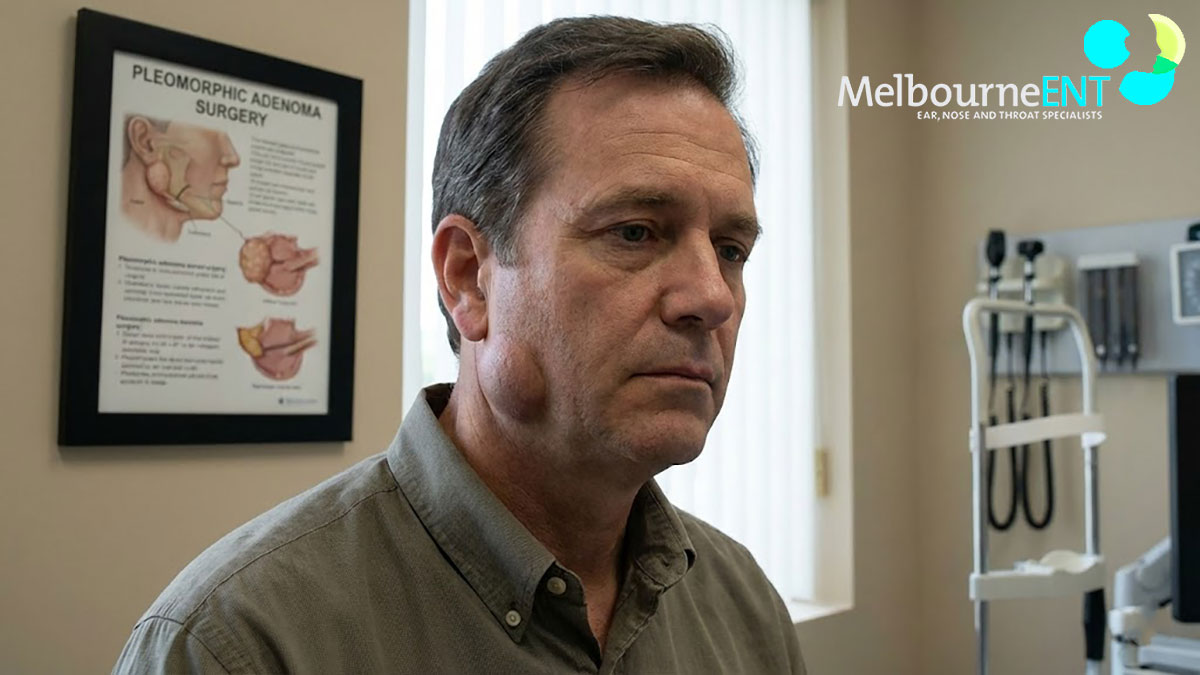
Pleomorphic adenoma is the most common benign tumour of the salivary glands. It often appears as a slow-growing, painless lump near the jaw, in front of the ear, or beneath the jawline.
At Melbourne ENT in St Kilda East, pleomorphic adenoma and other salivary gland tumours are assessed and managed by Dr Stephen Kleid (MBBS, FRACS), ENT and Head & Neck Surgeon.
This page provides general information about pleomorphic adenoma surgery, including assessment, treatment options, how surgery is performed, and possible risks and recovery. It is not a substitute for personalised medical advice.
Understanding Pleomorphic Adenoma And Salivary Gland Tumours
✓ What Is Pleomorphic Adenoma? (Plain English Explanation)
A pleomorphic adenoma is a benign (non-cancerous) tumour that forms in the salivary glands.
- “Pleomorphic” means the cells can have a variety of shapes under the microscope.
- “Adenoma” means the tumour arises from glandular tissue.
These tumours usually:
- grow slowly over months or years
- feel like a firm, smooth or rubbery lump under the skin
- are often painless at first
Although pleomorphic adenomas are benign, they may continue to grow. Over many years, a small proportion can change in a way that becomes cancerous, which is one of the reasons surgery is commonly discussed.
✓ Medical Overview – A Benign Salivary Gland Tumour
Salivary glands produce saliva to help with chewing, swallowing and protecting the teeth and lining of the mouth. Pleomorphic adenomas:
- arise from cells within the salivary gland tissue
- are benign, so they do not usually spread through the body like cancer
- can still cause problems by enlarging and pressing on nearby structures
- have a low but real risk of malignant transformation if left for many years
Microscopically, these tumours may have small extensions (like fingers) beyond the visible lump, which is why careful surgical removal is important.
✓ Which Salivary Glands Can Be Affected?
Pleomorphic adenomas can develop in any salivary gland, but most commonly occur in:
- Parotid glands – in front of and below the ear (the most common site)
- Submandibular glands – under the jawline
- Minor salivary glands – small glands in the lips, cheeks, palate and lining of the mouth and throat
The gland involved and the exact position of the tumour will guide the type of surgery recommended.
Symptoms, Signs And Who Might Benefit From Pleomorphic Adenoma Surgery
✓ Common Symptoms – Lump, Swelling Or Change In Facial Contour
The most typical symptom is a painless lump that may be noticed:
- in front of or beneath the ear
- along the lower jawline
- under the chin
- inside the mouth (for minor salivary gland tumours)
Over time, the lump may increase in size and change the shape or contour of the face or neck. Some people notice a feeling of fullness or tightness rather than pain.
✓ Red Flag Symptoms – Pain, Rapid Growth Or Facial Weakness
Certain features may be more concerning and warrant prompt medical review, such as:
- rapid enlargement of the lump
- pain in or around the area
- weakness or drooping of part of the face
- difficulty opening the mouth, chewing or swallowing
These symptoms do not always mean cancer, but they should be assessed quickly by your GP and, if needed, a specialist.
✓ Who Might Be Considered For Pleomorphic Adenoma Surgery In Melbourne
You may be considered for surgery if:
- imaging and/or fine needle aspiration (FNA) suggest pleomorphic adenoma
- the lump is growing, uncomfortable or cosmetically concerning
- there is a desire to confirm the diagnosis and reduce the chance of future problems
The decision is individual and takes into account your overall health, the tumour’s location and size, and your preferences after discussing the potential benefits and risks.
Non-Surgical Management And When Surgery Is Recommended
✓ Observation And Monitoring Of Some Salivary Gland Lumps
In selected situations, careful observation may be considered, particularly if:
- the lump is very small and not changing
- the diagnosis is uncertain and further investigations are planned
- there are medical conditions that make surgery higher risk
- you prefer to delay surgery after understanding the pros and cons
Observation usually involves regular clinical review and imaging. For confirmed pleomorphic adenomas, however, surgery is commonly recommended at some stage.
✓ Why Surgery Is Often Recommended For Pleomorphic Adenoma
Surgery is generally advised because pleomorphic adenomas can:
- continue to grow, sometimes becoming quite large
- become more difficult to remove if left for many years
- rarely undergo malignant transformation (change into a cancerous tumour)
Removing the tumour allows a pathologist to examine it fully and confirm the diagnosis.
✓ Balancing Benefits And Risks When Deciding On Surgery
The decision to proceed with surgery should weigh:
- potential benefits – tumour removal, diagnosis confirmation, reducing long-term risks
- potential risks – such as facial nerve weakness, numbness, scarring and other complications
Your surgeon will explain these factors in detail so you can make an informed decision that is right for you.
Who May And May Not Be Suitable For Pleomorphic Adenoma Surgery
✓ General Health, Age And Other Medical Conditions
Before recommending surgery, your surgeon and anaesthetist will consider your:
- overall health and fitness
- heart and lung function
- diabetes or other chronic conditions
- medications, especially blood thinners
- previous head and neck surgery or radiotherapy
Many otherwise well adults with pleomorphic adenoma are suitable for surgery, although the plan may be tailored to your needs.
✓ Factors That May Increase Surgical Risk
Certain factors can increase the risk of complications, for example:
- smoking or heavy alcohol intake
- poorly controlled blood pressure or diabetes
- bleeding or clotting disorders
- complex anatomy or scarring from prior surgery
These do not always prevent surgery, but may require additional preparation, discussion and planning.
✓ When Surgery May Not Be Recommended Or May Be Delayed
Surgery may be postponed or not recommended if:
- serious medical issues make anaesthesia unsafe
- further tests are needed to clarify the diagnosis
- you choose not to proceed after understanding the risks and alternatives
These decisions are made case by case in consultation with you, your GP and other treating doctors.
Consultation And Pre-Operative Assessment At Melbourne ENT
✓ Referral From Your GP Or Other Specialist
Most patients are referred to Melbourne ENT by their GP, dentist or another specialist after a salivary gland lump is detected. A valid referral is usually required to claim Medicare rebates for your specialist consultation.
✓ What To Expect At Your First Consultation With Dr Stephen Kleid
At your appointment, Dr Stephen Kleid (MBBS, FRACS) will:
- take a detailed medical history
- ask about how and when the lump was noticed, and any changes over time
- discuss symptoms such as pain, facial weakness, swallowing difficulties or weight loss
- review any existing scans, ultrasound or pathology reports
A thorough head and neck examination will then be performed.
✓ Head And Neck Examination And Assessment Of The Salivary Glands
The examination usually includes:
- feeling (palpating) the lump and surrounding tissues
- checking for other neck lumps or enlarged lymph nodes
- assessing facial muscle movement and symmetry
- examining the mouth, throat and tongue, and sometimes the nasal passages
This helps identify which gland is involved and whether there are any features of concern.
✓ Ultrasound, CT, MRI And Fine Needle Aspiration (FNA)
Further investigations may be arranged to refine the diagnosis, such as:
- Ultrasound – often the first imaging test for salivary gland lumps
- CT or MRI (Dr Kleid prefers MRI) – to define the size, position and relationship to nearby structures
- Fine needle aspiration (FNA) – a thin needle is used to collect cells for examination by a pathologist
Together, these tests support the diagnosis of pleomorphic adenoma or another type of salivary gland tumour.
✓ Planning Pleomorphic Adenoma Surgery With Your ENT And Head & Neck Surgeon
If surgery is recommended, your surgeon will discuss:
- the type of operation required (e.g. parotidectomy, submandibular gland removal)
- potential risks and complications
- expected hospital stay and recovery
- approximate timing and location of surgery
You will have the opportunity to ask questions and consider your options before deciding.
How Pleomorphic Adenoma (Salivary Gland Tumour) Surgery Is Performed
✓ Parotidectomy For Parotid Gland Pleomorphic Adenoma
When a pleomorphic adenoma is in the parotid gland, surgery is known as a parotidectomy. In broad terms, this involves:
- an incision usually in front of the ear, curving down into a natural neck crease
- careful identification and preservation of the facial nerve, which controls facial movement
- removal of the part of the parotid gland that contains the tumour, often with a margin of normal tissue
Depending on the location and depth of the tumour, the procedure may be a superficial parotidectomy (removal of the outer portion) or a more extensive operation if required.
✓ Surgery For Submandibular And Minor Salivary Gland Tumours
For pleomorphic adenomas in the submandibular gland (under the jaw):
- an incision is generally made just below the jawline in the upper neck
- the entire affected gland, including the tumour, is removed
For minor salivary gland tumours, surgery may involve removing the tumour with a margin of surrounding tissue from the lip, palate, cheek or other parts of the mouth or throat.
✓ Incisions, Scars And Protection Of The Facial Nerve (Broad Overview)
Your surgeon will plan incisions to blend, where possible, with natural skin creases or hidden areas. However, some scarring is unavoidable with any surgery, and the appearance varies between individuals.
Protecting the facial nerve and its branches is a key priority in parotid surgery. In some cases, specialised nerve monitoring equipment may be used to assist in identifying and preserving the nerve. Despite meticulous care, nerve irritation or injury can still occur.
✓ What Happens On The Day Of Surgery And Timing Of The Operation
On the day of surgery:
- you will meet the anaesthetist, who will confirm your medical history and anaesthetic plan
- the surgical team will check your consent, side and site of surgery
- the operation usually takes several hours, depending on the complexity
Afterwards, you will wake up in the recovery area, then return to the ward or day surgery unit for monitoring.
Anaesthesia And Hospital Stay For Pleomorphic Adenoma Surgery
✓ Type Of Anaesthesia Used For Salivary Gland Surgery
Pleomorphic adenoma surgery is performed under general anaesthesia, so you are fully asleep and unaware during the procedure. The anaesthetist will discuss:
- fasting and medication instructions
- how your pain will be managed afterwards
- any particular anaesthetic considerations based on your health
✓ Day Surgery Versus Overnight Hospital Stay In Melbourne
The length of stay depends on the type and extent of surgery and your overall health:
- some smaller or less complex procedures may be day-stay
- many parotidectomies and submandibular gland operations involve one or more nights in hospital
Your surgeon and anaesthetist will advise what is likely in your situation.
✓ Pain Relief, Drains And Early Post-Operative Care In Hospital
After surgery you may have:
- a drain coming from the wound to remove blood or fluid
- a dressing or bandage over the incision
- regular pain relief, initially through a drip and then as tablets
Nursing staff will check your observations, wound, drain output, facial movement and comfort, and will help you start moving around when it is safe.
Recovery After Pleomorphic Adenoma Surgery – Timeline And Expectations
Recovery varies between individuals and depends on the type of surgery and your general health. The timeframes below are general guides only.
✓ First Few Days And First Week – Pain, Swelling And Bruising
In the first week you may experience:
- pain or discomfort around the incision
- swelling and bruising of the cheek, jaw or neck
- a feeling of tightness or numbness near the wound
Pain is usually managed with prescribed medicines and then milder pain relief as needed. You will be given instructions on wound care, sleeping position and activities to avoid.
Some patients work from home after the first few days.
✓ Longer-Term Healing Over 1–3 Months – Scar Settling And Sensation Changes
Over 1–3 months:
- the scar often becomes softer and less noticeable, although some redness can persist longer
- areas of numbness or altered sensation may gradually improve, but can occasionally be long-lasting
- most people resume their usual day-to-day activities
Your surgeon may recommend scar care, such as moisturiser, gentle massage and sun protection, once the wound has healed.
✓ Returning To Work, Driving And Exercise – General Timeframes
- Driving – usually when you can comfortably turn your head and are not taking strong pain medicines that impair alertness
- Work – office or desk-based jobs may be possible within a few days; more physical jobs may require a week or two.
- Exercise – gentle walking is often encouraged early; heavier lifting, high-impact exercise and contact sports should be delayed until your surgeon advises they are safe
Your specific timeframe will be discussed at follow-up.
✓ Follow-Up Appointments And Long-Term Monitoring
Follow-up is important to:
- review wound healing and facial nerve function
- discuss pathology results
- monitor for any signs of recurrence or other concerns
Your surgeon will recommend how often you should attend for review.
Risks, Possible Complications And Limitations Of Pleomorphic Adenoma Surgery
Any operation carries potential risks. Not everyone will experience these, but it is important to be aware of them.
✓ Facial Nerve Weakness Or Paralysis (Temporary And Permanent)
The facial nerve runs through the parotid gland and controls movement of the face. Risks include:
- temporary weakness of part or all of the face on the operated side
- in some cases, permanent weakness or paralysis of certain muscles
This can affect smiling, eye closure, forehead movement and facial symmetry. Temporary weakness often improves over weeks or months, but full recovery cannot be guaranteed.
✓ Numbness, Saliva Leak (Sialocele) And Frey’s Syndrome
Other possible complications include:
- numbness or altered sensation around the ear, cheek, jaw or neck
- sialocele – a collection of saliva under the skin, which may need drainage or other treatment
- Frey’s syndrome – sweating, flushing or warmth over the cheek while eating, due to nerve regrowth
These may be temporary or, in some cases, longer-term.
✓ Bleeding, Haematoma, Infection And Scarring
As with most surgery, there is a risk of:
- bleeding during or after the operation
- haematoma – a collection of blood under the skin
- infection at the wound site
- scarring, which can vary in appearance between individuals
Additional procedures, dressings or antibiotics may be required if these events occur.
✓ Recurrence Of Pleomorphic Adenoma And The Possibility Of Further Surgery
Even with careful surgery, pleomorphic adenoma can occasionally recur, particularly if microscopic tumour cells remain. Recurrent tumours can be more complex to manage and may require further operations or additional treatments.
✓ Limitations Of Surgery – What Pleomorphic Adenoma Surgery Can And Cannot Achieve
Pleomorphic adenoma surgery is aimed at:
- removing the tumour as safely and completely as possible
- protecting important structures, especially the facial nerve
However, surgery cannot guarantee:
- a particular cosmetic result
- complete absence of scarring
- that the tumour will never return
✓ Important Information About Results, Risks And Individual Differences
- Results differ between individuals – recovery, scar appearance and nerve function can vary significantly.
- All surgery carries risks, including those listed here and others your surgeon may discuss with you.
- The information on this page is general in nature and does not replace a consultation. You should seek personalised medical advice from your GP or a qualified specialist before deciding on treatment.
How Pleomorphic Adenoma Surgery Fits With Other Head And Neck Procedures
✓ Pleomorphic Adenoma Surgery And Neck Dissection When Cancer Is Suspected
If there is concern that a tumour may be cancerous or lymph nodes are involved, your surgeon may discuss additional procedures such as neck dissection to remove lymph nodes. This is not usually necessary for benign pleomorphic adenoma but may be considered in selected cases.
✓ Relationship To Other Salivary Gland And Thyroid Surgery
Pleomorphic adenoma surgery may sometimes be considered alongside:
- other salivary gland operations
- thyroid or parathyroid surgery
- broader head and neck tumour surgery
Your specialist will explain whether any additional procedures are appropriate for your situation.
✓ When Pleomorphic Adenoma Surgery Is Performed Separately From Other ENT Operations
In many patients, pleomorphic adenoma surgery is performed as a stand-alone procedure, rather than combined with other ENT operations such as tonsillectomy, septoplasty or sinus surgery. This allows the team to focus on the salivary gland and surrounding nerves.
✓ Coordinating Multiple Procedures – Individualised Planning And Timing
If more than one procedure is needed, they may be staged over time. The timing and combination of operations are tailored to your diagnosis, health and preferences.
Costs, Medicare And Private Health Insurance – General Information
✓ Consultation Fees And The Role Of A GP Referral
A GP referral is usually required to:
- access Medicare rebates for consultations
- provide important background information and test results
Consultation fees and Medicare rebates will be explained by the clinic when you book or attend your appointment.
✓ Medicare Rebates For Consultations And Eligible Procedures
Pleomorphic adenoma surgery attracts a Medicare item number, meaning Medicare pays part of the surgeon’s fee. There may also be rebates for anaesthetic and hospital services, depending on the circumstances.
✓ Private Health Insurance, Hospital Cover And Possible Gaps
If you have private hospital insurance, your out-of-pocket costs depend on:
- your level of hospital cover
- the hospital where surgery is performed
- any excess or co-payments set by your fund
It is important to confirm details with your health fund so you understand what is covered.
✓ Written Estimates Of Out-Of-Pocket Costs Before Surgery
You will receive a written estimate of likely fees for:
- the surgeon
- the anaesthetist
- hospital or day surgery charges
These are estimates; actual costs can vary if additional procedures are required or surgery is more complex than anticipated.
✓ Other Funding Options (For Example, WorkCover Or DVA Where Applicable)
In some situations, costs may be partly or fully covered through organisations such as WorkCover or Department of Veterans’ Affairs (DVA). If this may apply to you, please bring relevant documentation to your appointment.
Why Choose Melbourne ENT And Dr Stephen Kleid For Pleomorphic Adenoma Surgery
✓ About Dr Stephen Kleid – ENT And Head & Neck Surgeon (MBBS, FRACS)
Dr Stephen Kleid is an ENT and Head & Neck Surgeon who:
- graduated in Medicine from Melbourne University (MBBS)
- is a Fellow of the Royal Australasian College of Surgeons (FRACS)
- has undertaken extensive surgical training at major Melbourne hospitals
- completed a Fellowship In ENT/Head And Neck Tumours at the University of Florida
- Has probably performed more parotidectomy operations than any other surgeon Australia.
He has long-standing experience in surgery for head and neck tumours, including salivary gland conditions such as pleomorphic adenoma.
✓ Experience With Salivary Gland And Head & Neck Tumour Surgery
Dr Kleid’s practice includes:
- surgery for parotid and other salivary gland tumours
- management of thyroid and parotid tumours
- surgery for throat and mouth cancers
His work combines oncological (tumour-related) surgery with broader ENT care.
✓ Collaborative Care With Your GP And Other Specialists
Melbourne ENT works in close collaboration with:
- your GP
- radiologists, pathologists and other specialists
- multidisciplinary team at Peter MacCallum Cancer Centre, when needed for complex head and neck conditions
This team-based approach supports coordinated care from assessment through to treatment and follow-up.
✓ Focus On Clear Information, Realistic Expectations And Shared Decision-Making
At Melbourne ENT, the emphasis is on:
- providing clear, balanced information about benefits and risks
- discussing reasonable expectations and possible outcomes
- encouraging shared decision-making, so you can make informed choices
No guarantees of results are made, and surgery is only recommended when considered clinically appropriate.
When To Seek Urgent Medical Help After Pleomorphic Adenoma Surgery
After surgery, you should contact the hospital or your surgeon urgently, or seek emergency medical care, if you experience:
- sudden bleeding or rapidly increasing swelling at the surgical site
- severe pain not relieved by prescribed medicines
- fever, redness, warmth or discharge at the wound suggesting infection
- new or worsening facial weakness, difficulty closing the eye or asymmetry
- difficulty breathing or swallowing
You will receive written post-operative instructions, including contact numbers, before you leave hospital.
Melbourne ENT Location – Pleomorphic Adenoma Surgery In St Kilda East
Melbourne ENT is located in St Kilda East, and East Melbourne.
Details about parking, public transport and accessibility can be obtained when you book or from the clinic’s website.
FAQs About Pleomorphic Adenoma Surgery
Is “Peleo Morphic Adenoma” The Same As Pleomorphic Adenoma?
Yes. “Peleo morphic” is usually a spelling variation or error. The correct term is pleomorphic adenoma, which refers to a benign salivary gland tumour.
Is Pleomorphic Adenoma Cancerous Or Life-Threatening?
Pleomorphic adenoma is benign, meaning it is not cancer in its usual form. However, it can continue to grow and, over many years, a small proportion can undergo changes that become cancerous. Your specialist will discuss how this applies in your case.
Does Every Pleomorphic Adenoma Need Surgery?
Surgery is commonly recommended for confirmed pleomorphic adenomas, but the decision is individual. In some people, particularly if there are significant medical issues or uncertainty about the diagnosis, a period of observation may be considered.
How Painful Is Pleomorphic Adenoma Or Parotid Surgery?
Mild pain and discomfort are expected after surgery, especially in the first few days. Pain medicines are used to keep you as comfortable as possible. Many people find the pain improves over the first week, although experiences vary.
How Long Will I Need Off Work After Pleomorphic Adenoma Surgery?
It depends on the type of work you do and how you recover. People with desk-based jobs may be able to return in around 1 week, while physical or heavy manual work may require a longer break. Your surgeon will provide guidance for your situation.
Will I Have A Visible Scar After Parotid Or Salivary Gland Surgery?
All surgery leaves a scar. Incisions are planned to follow natural creases where possible, but the final appearance depends on your skin type, healing and the extent of surgery. Scars often fade over time but do not disappear completely.
What Are The Chances Of Facial Nerve Weakness After Surgery?
Because the facial nerve runs through the parotid gland, there is always some risk of weakness. In many cases, if weakness occurs, it is temporary and improves over weeks or months, but permanent weakness can occur. Your individual risk will be discussed at consultation.
Can A Pleomorphic Adenoma Come Back After It Is Removed?
Recurrence is uncommon, but it can happen, particularly if microscopic tumour tissue remains. Recurrent tumours may be more complex to treat. Careful surgical technique aims to reduce this risk but cannot eliminate it entirely.
Will I Need Radiotherapy Or Other Treatment As Well As Surgery?
For most benign pleomorphic adenomas, surgery alone is usually sufficient. If pathology shows more aggressive features or a different type of tumour, your surgeon may discuss additional treatments with you and, if needed, other specialists.
When Can I Drive And Exercise After Pleomorphic Adenoma Surgery?
You should avoid driving while taking strong pain medicines or if you cannot comfortably turn your head. Gentle walking is often possible early on, but more vigorous exercise should wait until your surgeon advises it is safe. Time-frames vary between individuals.
Do I Need A GP Referral To See Dr Stephen Kleid At Melbourne ENT?
A GP referral is recommended and usually required to access Medicare rebates. Your GP can also provide important background information, including previous test results.
How Do I Arrange An Appointment If I Have A Salivary Gland Lump?
If you notice a persistent lump near your jaw, ear or neck, it is best to see your GP first. They can assess the lump, arrange initial tests and refer you to Melbourne ENT and Dr Stephen Kleid if specialist assessment is appropriate.
Next Steps – Arranging An Assessment For A Salivary Gland Lump
If you have been told you have a pleomorphic adenoma, or you have noticed a lump near your jaw, ear or neck:
- See Your GP to discuss your symptoms and medical history.
- Your GP can arrange initial tests such as ultrasound and, if appropriate, provide a referral to Melbourne ENT.
- With a referral, you can book a consultation with Dr Stephen Kleid, ENT & Head & Neck Surgeon, at Melbourne ENT in St Kilda East, or East Melbourne
- Call 03 9038-1630
At your consultation, you can discuss:
- whether a pleomorphic adenoma or another condition is likely
- whether surgery, observation or another approach may be recommended
- the potential benefits, risks and alternatives relevant to your situation
Further Reading
- Read more about Head And Neck Cancer Surgery
- Read more about Thyroid Cancer Surgery Melbourne
- Read more about What is Sialadenitis? (Inflamed Salivary Glands)