


Tonsillectomy is often spoken about as though it is the final chapter in a long history of throat problems. For many patients, it does reduce the issues that led to surgery in the first place. Recurrent throat infections may settle. Sleep may improve. Breathing at night may become quieter and less disrupted. Even so, some adults and parents are surprised when symptoms return months or years later. A child may begin snoring again. An adult may notice bad breath, throat irritation, or tissue that seems visible at the back of the throat. It is usually at that point that the same question comes up. Can tonsils grow back after tonsillectomy?
At Melbourne ENT, this concern is sometimes raised during consultation with Dr Simon Braham, who sees both adults and children with throat, airway, and sleep-related concerns. In many cases, the answer is more complex than a simple yes or no. After a standard tonsillectomy, the tonsils are usually removed and do not return as fully formed structures. However, a small amount of residual tonsil tissue may occasionally remain and become more noticeable over time. There are also many situations where symptoms that seem related to the tonsils are actually coming from another part of the throat, nose, or airway.
That is why the issue needs to be assessed carefully. Rather than assuming the tonsils have simply returned, Melbourne ENT focuses on understanding the symptoms, the patient’s history, and the findings on examination. Dr Simon Braham assesses adults and children with concerns involving the throat, breathing, sleep quality, and related ENT conditions. The aim is to clarify what may be causing the symptoms and whether further treatment needs to be discussed.
Why This Question Comes Up So Often
The idea that tonsils have “grown back” can be worrying. For a parent, it may feel as though a child is back where they started. For an adult, it can be frustrating to think that symptoms once treated by surgery may have returned years later.
Part of the reason this question is so common is that the symptoms themselves are not always specific. Sore throats, snoring, poor sleep, visible tissue at the back of the throat, swallowing discomfort, and bad breath can all make people think of the tonsils. In reality, those symptoms can have a number of possible causes.
Patients often expect the throat to look completely smooth after surgery. When they later notice uneven tissue, scarring, or fullness in the area, it can seem obvious that the tonsils have returned. The throat, however, is a more complex area than many people realise. Normal healing changes, nearby lymphoid tissue, and the anatomy of the tonsil bed can all affect how the throat looks after surgery.
This is one reason Dr Simon Braham and Melbourne ENT place importance on proper examination rather than assumptions based on symptoms or appearance alone.
What the Tonsils Actually Are
The tonsils are areas of lymphoid tissue located at the back of the throat. They form part of the immune system and are often more active in childhood. This is one reason children’s tonsils can sometimes appear quite large even when they are not infected.
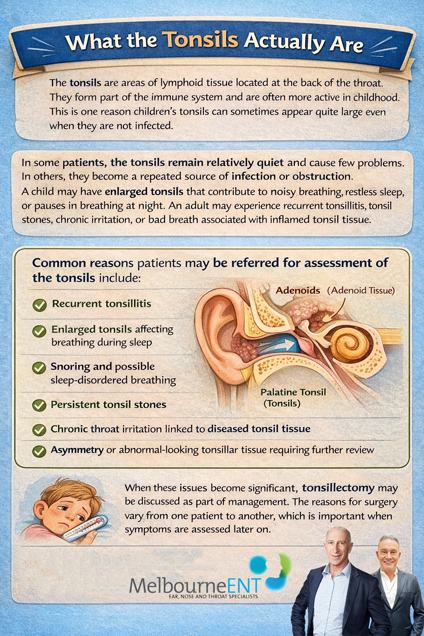
In some patients, the tonsils remain relatively quiet and cause few problems. In others, they become a repeated source of infection or obstruction. A child may have enlarged tonsils that contribute to noisy breathing, restless sleep, or pauses in breathing at night. An adult may experience recurrent tonsillitis, tonsil stones, chronic irritation, or bad breath associated with inflamed tonsil tissue.
When these issues become significant, tonsillectomy may be discussed as part of management. The reasons for surgery vary from one patient to another, which is important when symptoms are assessed later on.
Common reasons patients may be referred for assessment of the tonsils include:
- recurrent tonsillitis
- enlarged tonsils affecting breathing during sleep
- snoring and possible sleep-disordered breathing
- persistent tonsil stones
- chronic throat irritation linked to diseased tonsil tissue
- asymmetry or abnormal-looking tonsillar tissue requiring further review
Not every patient with one of these concerns needs surgery. The decision depends on the pattern of symptoms, examination findings, and the overall clinical picture.
Can Tonsils Really Grow Back?
This is where language matters. In everyday conversation, people often say the tonsils have “grown back” when they can see tissue in the throat after a previous operation. From a clinical point of view, what is often happening is slightly different.
After a complete tonsillectomy, the tonsils do not usually grow back in the sense of reforming as full tonsils. However, a small amount of residual tonsil tissue can occasionally remain. If that tissue later becomes enlarged or more prominent, it may look as though the tonsils have returned.
There are several reasons this may happen:
- a small amount of tissue may have remained after surgery
- nearby lymphoid tissue may become more noticeable over time
- inflammation may make residual tissue look fuller
- the throat may be mistaken for having regrowth when the issue is actually scar tissue or another structure nearby
This is not the most common explanation for symptoms after tonsillectomy, but it is possible.
It is also worth noting that different surgical techniques can affect this discussion. In a standard tonsillectomy, the aim is removal of the tonsil tissue. In some partial techniques, a thin layer of tissue may remain. In those cases, visible tissue later on may be easier to understand, because there was always some tissue left behind.
That does not mean the surgery was inappropriate. It simply means the long-term appearance of the throat may differ depending on the technique used and the patient’s own healing response.
Why Symptoms May Return Even When the Tonsils Have Not
One of the most important parts of this discussion is recognising that throat symptoms after tonsillectomy do not always point back to the tonsils.
A child may still get sore throats because viral infections are common. An adult may have ongoing throat irritation because of reflux, allergies, post-nasal drip, or dryness. Snoring may return because of nasal blockage, adenoidal tissue, palate-related issues, weight changes, or other airway factors.
This is often the source of confusion. The symptoms feel familiar, so patients understandably assume the cause must also be familiar. That is not always the case.
Some of the more common reasons for ongoing or returning throat-related symptoms after tonsillectomy include:
- viral or bacterial throat infections unrelated to tonsil tissue
- reflux affecting the throat
- post-nasal drip
- allergic inflammation
- mouth breathing
- dry air or environmental irritation
- nasal obstruction
- sleep-disordered breathing involving other parts of the airway
- adenoidal tissue, especially in children
- tonsil stones in residual tissue, if a small remnant is present
Because there are so many possibilities, Melbourne ENT assesses the throat in the wider context of ENT health rather than assuming every symptom has a tonsillar cause. This broader approach is a key part of how Dr Simon Braham evaluates persistent or returning throat concerns.
What Parents May Notice in Children
Children often present differently from adults. They may not describe throat symptoms clearly, so parents are usually the first to notice that something is not quite right.
A child who has previously had a tonsillectomy may come back to attention because of:
- loud snoring
- restless sleep
- repeated waking
- breathing through the mouth
- pauses in breathing during sleep
- daytime tiredness
- poor concentration
- irritability
- recurrent sore throats
- swallowing difficulty
- ongoing bad breath
Parents can find this especially confusing if the child had obvious improvement after surgery and then later developed similar symptoms again. In these situations, the question is not simply whether tissue is visible in the throat. The more important issue is whether the child’s airway, sleep, or throat health is being affected now.
At Melbourne ENT, assessment of children takes these broader factors into account. Dr Simon Braham considers the history, the pattern of symptoms, and the examination findings as part of an overall ENT review. This helps distinguish between residual tonsil tissue, nasal or adenoidal issues, and other possible causes of sleep and throat symptoms.
What Adults May Notice
Adults often present with a different group of concerns. Rather than obvious sleep-related symptoms, they may be more likely to notice persistent irritation or changes in the appearance of the throat.
Common concerns in adults include:
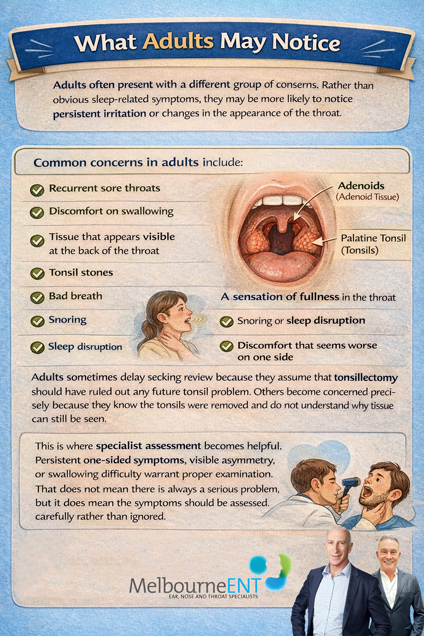
- recurrent sore throats
- discomfort on swallowing
- tissue that appears visible at the back of the throat
- tonsil stones
- bad breath
- a sensation of fullness in the throat
- snoring
- sleep disruption
- discomfort that seems worse on one side
Adults sometimes delay seeking review because they assume that tonsillectomy should have ruled out any future tonsil problem. Others become concerned precisely because they know the tonsils were removed and do not understand why tissue can still be seen.
This is where specialist assessment becomes helpful. Persistent one-sided symptoms, visible asymmetry, or swallowing difficulty warrant proper examination. That does not mean there is always a serious problem, but it does mean the symptoms should be assessed carefully rather than ignored.
Melbourne ENT sees adults with throat, sleep, and airway concerns and approaches these symptoms in a structured way. Dr Simon Braham looks not only at the throat itself but also at nasal function, breathing patterns, and related head and neck findings.
Why the Throat Can Look Different After Surgery
Many patients expect the throat to look completely flat after tonsillectomy. In practice, healing is not always that simple. The tonsil beds can heal with small changes in contour, scar tissue, or surrounding fullness. Nearby tissue can also become more obvious once the main tonsils are gone.
This matters because appearance alone can be misleading.
What may look like regrowth could actually be:
- residual tonsil tissue
- scar tissue
- normal variation in the tonsil bed
- nearby lymphoid tissue
- mucosal folds in the throat
- inflammation from another cause
That is why self-diagnosis is often difficult. Patients and parents are not expected to work this out on their own. A consultation is useful not simply because it provides a label, but because it places the finding in context. Tissue that looks unusual to a patient may be entirely expected after previous surgery. In other cases, symptoms and examination findings may suggest a need for closer review.
How Melbourne ENT Assesses the Problem
At Melbourne ENT, the starting point is the patient’s current experience. The consultation is guided by what symptoms are present now, how long they have been occurring, and how much they affect daily life.
A detailed history may include:
- when the tonsillectomy took place
- why the original surgery was performed
- whether symptoms improved after surgery
- when the current symptoms began
- whether the main concern is infection, sleep, snoring, swallowing, stones, or discomfort
- whether symptoms are constant or intermittent
- whether there are any one-sided symptoms or visible changes
For children, the discussion may include sleep quality, mouth breathing, behaviour, attention, and recurrent infections. For adults, it may include reflux symptoms, nasal obstruction, sleep quality, and the presence of bad breath or throat debris.
Examination then helps determine whether residual tissue is present and whether another source of symptoms may be contributing. The value of a specialist review lies in this broader perspective. Melbourne ENT does not look at the tonsils in isolation. The nose, airway, and other head and neck structures may all be relevant. This is part of the careful clinical process used by Dr Simon Braham when assessing recurring throat symptoms after tonsillectomy.
Does Visible Tissue Always Need Treatment?
No. One of the most important points for patients and parents is that visible tissue after tonsillectomy does not automatically mean treatment is required.
A small remnant of tonsil tissue may be present without causing any significant symptoms. In that situation, it may simply be noted and monitored. Treatment decisions are usually based on symptoms and clinical findings rather than appearance alone.
Further discussion may be needed when visible or residual tissue is associated with:
- recurrent infection
- obstruction of the airway
- snoring or disturbed sleep
- repeated tonsil stones
- persistent bad breath linked to trapped debris
- discomfort on swallowing
- ongoing inflammation
- asymmetry that requires closer review
This measured approach is important. The presence of tissue does not mean surgery is automatically necessary, and Melbourne ENT does not present further treatment as a default response. Instead, management is based on whether the finding is clinically relevant in the individual patient.
When Further Surgery May Be Discussed
Revision surgery is less common than primary tonsillectomy. It is not required in every case where tissue is visible, and it is considered selectively.
Where further surgery is discussed, the decision depends on several factors, including the reason treatment is being considered, the severity of symptoms, the impact on daily life, and the examination findings. In some patients, symptoms may be better explained by another issue such as nasal blockage or reflux. In others, residual tonsil tissue may appear to be playing a more direct role.
The conversation about treatment should include:
- the likely cause of symptoms
- whether the tissue is contributing to infection or obstruction
- alternatives to further surgery where relevant
- the limitations of treatment
- the risks associated with any procedure
- the expected recovery process for that patient
As with any operation, suitability needs to be assessed on a case-by-case basis. That point remains important in patient education because it keeps the focus on informed discussion rather than assumptions.

Tonsillectomy FAQs
Can a child still snore even if the tonsils were the main reason for surgery?
Yes, snoring can still occur after tonsillectomy because the tonsils are only one part of the airway. Nasal blockage, adenoidal tissue, palate shape, and other sleep-related factors can also contribute.
Why does the throat sometimes look uneven years after tonsillectomy?
The tonsil area does not always heal into a completely flat surface. Small contour changes, scar tissue, and nearby lymphoid tissue can all make the throat look uneven without indicating a problem.
Can tonsil stones happen after tonsillectomy?
They can occasionally occur if a small amount of residual tonsil tissue remains. In other cases, debris may collect in nearby throat tissue and be mistaken for tonsil stones.
Is one-sided throat discomfort after tonsillectomy always related to scar tissue?
Not always. One-sided symptoms can have several causes and should be assessed properly, particularly if they persist or are associated with swallowing difficulty.
Why do some patients feel like something is stuck in the throat after surgery, even years later?
That sensation can come from residual tissue, dryness, reflux, post-nasal drip, or throat sensitivity rather than the tonsils themselves. The feeling is real, but the cause is not always obvious without examination.
Can allergies make it seem as though the tonsils have come back?
Allergies can inflame the nose and throat and may make nearby tissue look fuller or more irritated. This can create the impression of regrowth even when the tonsils are not the main issue.
Does age affect whether residual tonsil tissue becomes noticeable?
It can. In children, lymphoid tissue remains more active, so a small remnant may become more visible over time than it would in many adults.
Can a patient need a second tonsil operation years after the first one?
It is uncommon, but it can be discussed in selected cases if residual tissue is contributing to ongoing infection, obstruction, or other clinically relevant symptoms. A decision like this depends on the current symptoms and examination findings rather than the passage of time alone.
Why might a patient still get sore throats after tonsillectomy?
Tonsillectomy can reduce selected tonsil-related problems, but it does not prevent every future throat infection or irritation. Viral illnesses, reflux, allergies, and post-nasal drip can still affect the throat after surgery.
Can previous tonsillectomy make it harder to work out what is causing symptoms now?
Yes, because both patients and parents may assume the tonsils can no longer be involved at all. In practice, symptoms after tonsillectomy may relate to residual tissue, another ENT issue, or a different part of the airway entirely.
Medical References:
- Intracapsular Tonsillectomy Using Plasma Ablation Versus Total Tonsillectomy: A Systematic Literature Review and Meta-Analysis. The Laryngoscope.
https://pmc.ncbi.nlm.nih.gov/articles/PMC10046729/ - Postoperative Bleeding and Associated Utilization Following Tonsillectomy in Children: A Systematic Review and Meta-Analysis. Otolaryngology–Head and Neck Surgery.
https://pmc.ncbi.nlm.nih.gov/articles/PMC5639328/ - Comparative Effectiveness of Partial Versus Total Tonsillectomy in Children: A Systematic Review. Otolaryngology–Head and Neck Surgery.
https://pmc.ncbi.nlm.nih.gov/articles/PMC5639321/
What Patients and Parents Often Want to Know
Although every consultation is different, the same concerns often arise when symptoms continue after tonsillectomy.
Patients and parents commonly want to know:
- whether the tonsils have actually come back
- why symptoms can return after surgery
- whether visible tissue is normal
- whether another operation will be needed
- whether snoring means the original problem has returned
- whether recurrent sore throats mean the surgery did not work
- whether other conditions could be affecting the throat or airway
These are reasonable questions. They reflect the fact that tonsillectomy is often thought of in very simple terms, while the throat and airway are rarely simple in practice.
Melbourne ENT addresses these concerns by focusing on explanation as well as examination. Patients usually want to understand not just what is seen, but what it means. That may involve clarifying that tissue is present but not clinically significant, or that the symptoms appear more likely to be related to another part of the upper airway. This is a discussion Dr Simon Braham has regularly with adults and parents seeking clarity about ongoing throat symptoms.
The Main Takeaway
For most patients, tonsils do not simply grow back after a standard tonsillectomy in the way people often imagine. However, a small amount of residual tissue can occasionally remain and later become more noticeable. Symptoms after tonsillectomy can also come from a number of other causes, including infections, reflux, allergies, nasal blockage, and other airway issues.
That is why recurring symptoms should be assessed in context. The most important question is not only whether tissue can be seen, but whether the patient is experiencing ongoing infection, disturbed sleep, breathing difficulty, bad breath, discomfort, or other problems that affect daily life.
At Melbourne ENT in St Kilda East, Dr Simon Braham sees adults and children with tonsil-related concerns, throat symptoms, sleep-related breathing issues, and other ENT conditions. Assessment is based on clinical history, examination, and discussion of the possible causes of symptoms in the individual patient.
When sore throats, snoring, sleep disruption, swallowing discomfort, bad breath, or concern about visible tissue continue after a previous tonsillectomy, specialist review can help clarify what may be contributing to the problem. Patients wishing to arrange an appointment with Dr Simon Braham at Melbourne ENT can visit the contact page of the website.
Further Reading
- Read more about Adenoidectomy Melbourne
- Read more about Adenotonsillectomy Melbourne
- Read more about Adult Tonsil Surgery Melbourne
- Read Melbourne ENT’s Blog on Cold Ablation Techniques for Tonsils
- Read Melbourne ENT’s Blog on What is Coblation Tonsillectomy ? – Cold-Ablative Tonsillectomy in Melbourne
- Read Melbourne ENT’s Blog on Using the NOSE Scale Score to assess Nasal Obstruction
Does My Child Need Tonsils and Adenoids Removed Together?
Parents often start asking about tonsils and adenoids after weeks or months of disrupted sleep,…
Do Tonsils Grow Back After Tonsillectomy?
Tonsillectomy is often spoken about as though it is the final chapter in a long…

Best Foods for Recovery After Tonsil Surgery
After tonsil surgery, eating and drinking can feel very different to usual. A sore throat,…