

After tonsil surgery, eating and drinking can feel very different to usual. A sore throat, painful swallowing and a lower appetite are common concerns in the early recovery period. For some patients, even simple tasks such as drinking water or eating a small meal may take more effort than expected. For parents, one of the main concerns is often whether their child is drinking enough. For adults, the question is often how to keep meals simple and manageable while the throat settles. At Melbourne ENT, Dr Simon Braham, ENT and Head & Neck Surgeon, provides patients with guidance before and after tonsil surgery so they know what to expect during recovery and when to seek further advice.
At Melbourne ENT, recovery advice forms part of the information given before and after surgery. Patients are commonly given guidance about eating, drinking and what to expect in the days after the procedure. This article focuses on practical food and drink ideas that may be easier to tolerate during the recovery period. It does not replace the instructions given by the treating surgeon, hospital or day procedure unit. Where a patient has had surgery under the care of Dr Simon Braham, the advice provided directly by him and the treating facility should always take priority over general information.
There is no single food that suits every patient after tonsil surgery. Tonsil surgery recovery can vary from person to person, and food choices often need to be adjusted according to comfort, age, appetite and the stage of healing. In general, many patients find that softer foods and regular fluids are easier to manage in the first several days. For some, cold or cool foods feel more comfortable. Others prefer foods that are closer to room temperature or gently warmed. The most suitable option is usually the one that the patient can tolerate without too much discomfort while maintaining fluid intake. This is one reason Dr Simon Braham and Melbourne ENT place importance on clear post-operative advice that patients can apply at home.
This advice applies to both adults and children recovering from tonsil surgery, although individual experiences and food preferences may vary.
Why Eating Can Be Difficult After Tonsil Surgery
After the tonsils are removed, the throat heals over time. During that period, swallowing may feel sore or awkward. Some patients also notice tiredness, reduced appetite, a different taste in the mouth or discomfort that seems to travel towards the ears. These symptoms can make normal meals feel less appealing than usual.
This is one reason simple recovery advice can be helpful. When patients know that eating may be slower, smaller and less predictable for a few days, they are often better placed to plan ahead. A calm and practical approach usually works better than trying to return to a full normal diet straight away. In clinical practice, Dr Simon Braham sees both adults and children, and that kind of practical preparation can be useful for both groups.
For many households, the tonsil surgery recovery period is easier when a few suitable foods are already available at home. This can reduce the pressure of having to prepare full meals when the patient is tired or uncomfortable.
Why Fluids Matter
In the early recovery period, fluids are often a key focus. Some patients find it easier to drink small amounts regularly rather than trying to eat proper meals straight away. Regular sips of water, and other fluids that are comfortable to swallow, may be easier to manage than large amounts at once. Keeping up fluids is commonly recommended after tonsil surgery, and many post-operative instructions place a strong emphasis on drinking during the first few days.
That does not mean food is unimportant. Food can help patients maintain energy during recovery. However, in the very early stage, small amounts of fluid and soft food often feel more realistic than full meals. Many patients do better when they take a gradual approach. At Melbourne ENT, Dr Simon Braham discusses recovery as a process that usually benefits from planning, patience and attention to day-to-day comfort.
What Types Of Food Are Often Easier To Tolerate
Although recovery varies, certain features tend to make food easier for many patients during the first part of recovery.
Foods are often easier to manage when they are:
- soft rather than crunchy
- moist rather than dry
- mild rather than spicy
- cool, room temperature or gently warm rather than very hot
- simple to prepare and easy to eat in small amounts
Texture can matter just as much as the type of food itself. A soft bowl of porridge may be easier to swallow than toast. Smooth yoghurt may feel more comfortable than dry biscuits. Well-cooked pasta may be easier to manage than a crusty sandwich.
This does not mean every meal needs to look the same. It simply means that softer and gentler options are often more practical in the first several days. Patients under the care of Dr Simon Braham are usually encouraged to think in practical terms about what feels manageable, rather than trying to force a return to usual meals too soon.
Food And Drink Ideas For The First Day or Two
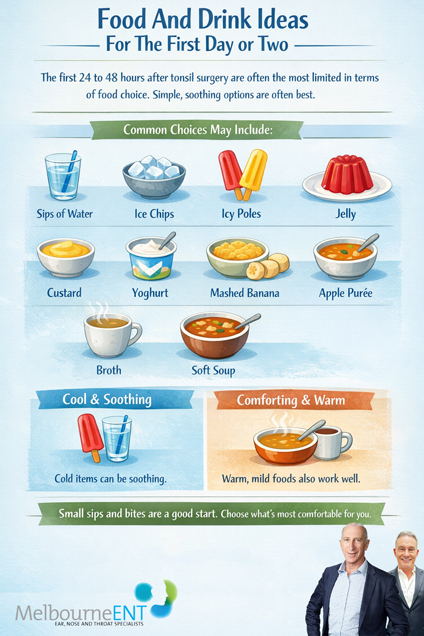
The first 24 to 48 hours after tonsil surgery are often the most limited in terms of food choice. Patients may feel sleepy, uncomfortable or not especially hungry. At this stage, many people prefer very simple options.
Common choices may include:
- water in small regular sips
- ice chips
- ice blocks or icy poles
- jelly
- custard
- yoghurt
- mashed banana
- smooth apple purée
- broth
- soup that is not too hot and does not contain large chunks
Some patients prefer cold items because they find them soothing. Others are more comfortable with room-temperature drinks or lukewarm soup. There is no need to force one approach if another feels better. The main aim is to keep eating and drinking as manageable as possible.
Small amounts can still be useful. In the first day or two, a patient may only want a few spoonfuls or a few sips at a time. That can still be a reasonable start. For patients seeing Dr Simon Braham at Melbourne ENT, having these simple options ready at home may make the early recovery period easier to manage.
Moving Into The Rest of The First Week
As the first week progresses, some patients begin to tolerate a little more variety. Others may still prefer very soft foods for several days. Recovery is not always steady from one day to the next. A patient may manage more one day, then feel sorer again the next. A gradual and flexible approach is usually more practical than expecting the same pattern every day.
Once the patient feels ready, slightly more substantial foods may include:
- mashed potato
- soft pasta
- noodles
- porridge
- well-cooked rice
- scrambled eggs
- very soft vegetables
- tender flaky fish
- soft stewed fruit
- smoothies that are not too acidic
These foods are often chosen because they are softer and easier to swallow than dry, crunchy or heavily textured meals. Some patients also find that moist foods are easier than anything dry or crumbly. This kind of gradual progression is commonly discussed in post-operative advice from Dr Simon Braham and Melbourne ENT.
Food Ideas For Adults
Adults recovering from tonsil surgery often want food that is simple, low effort and easy to keep in the house before the procedure. Planning ahead can make the recovery period more manageable, especially when energy levels are lower than usual.
Useful food ideas for adults may include:
- plain or flavoured yoghurt
- custard
- oats or porridge
- scrambled eggs
- mashed pumpkin or mashed potato
- soft noodles in mild broth
- smooth soups
- risotto cooked until soft
- soft pasta with a mild sauce
- soft fruit such as banana or stewed pear
Some adults prefer to prepare meals in advance, particularly for the first few days. Others rely on very simple foods and fluids until appetite improves. Both approaches can be reasonable. The most practical option is often the one that is easy to prepare and comfortable to swallow. Dr Simon Braham sees adult patients for tonsil concerns at Melbourne ENT, and this kind of preparation can be particularly helpful for adults who are planning their recovery at home.
Food Ideas For Children
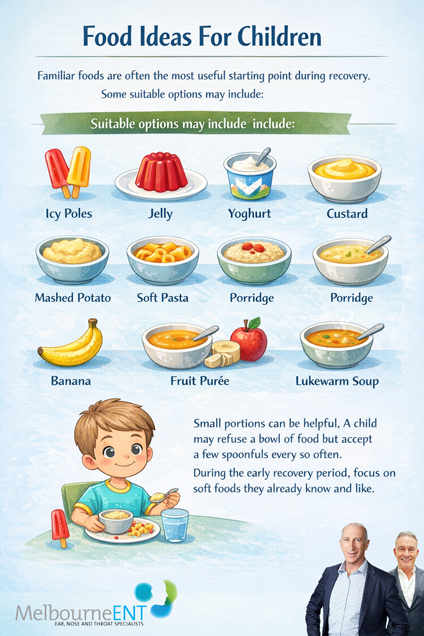
Children may approach recovery differently from adults. Some will accept only a narrow range of foods for a few days. Others may want cold foods only. Some may refuse larger meals but accept frequent small snacks or drinks. For parents, this can feel frustrating, especially when they are trying to encourage food and fluids at the same time.
For children, familiar foods are often the most useful starting point. Suitable options may include:
- icy poles
- jelly
- yoghurt
- custard
- mashed potato
- soft pasta
- porridge
- banana
- smooth fruit purée
- lukewarm soup
Small portions can be helpful. A child may refuse a bowl of food but accept a few spoonfuls every so often. During the early recovery period, that may be more realistic than expecting a normal meal. In many cases, the focus stays on regular drinks and soft foods that the child already knows and accepts.
At Melbourne ENT, Dr Simon Braham treats both adults and children, and this is relevant when families are preparing for the practical side of recovery. Children often respond better to calm, familiar options than to pressure around food.
Foods That May Be Harder To Tolerate
Some foods and drinks are more likely to feel uncomfortable in the early stages after tonsil surgery. Patients are often more comfortable avoiding these until swallowing becomes easier.
Foods and drinks that may be harder to tolerate include:
- chips, crackers and popcorn
- toast and crusty bread
- spicy meals
- very hot drinks
- acidic drinks such as orange juice
- dry or chewy meats
- heavily seasoned takeaway foods
The issue is often comfort rather than the food category alone. Dry, rough or strongly flavoured foods may be harder on a sore throat. As recovery progresses, some patients gradually return to these foods without difficulty, but in the early stage gentler choices are often easier.
Why Texture Matters
When choosing food after tonsil surgery, texture is often one of the most important things to consider. The same general food type may be easy in one form and difficult in another.
For example:
- pasta may be easier if it is soft and served with a smooth sauce
- eggs may be easier if they are softly scrambled rather than fried dry
- vegetables may be easier if they are mashed or cooked until very soft
- rice may be easier when it is well cooked and moist
By contrast, foods that seem plain may still be uncomfortable if they are dry, crusty or crumbly. This is why patients often do better when they think about how a food feels in the mouth and throat, not just whether it sounds mild. Dr Simon Braham often sees patients who benefit from this kind of practical planning, particularly when meals are prepared with texture in mind.
Keeping Meals Simple Without Making Them Repetitive
Recovery food can feel repetitive quite quickly. Patients often cycle through the same few foods because those are the easiest to tolerate. Even so, some small variation can make eating feel less monotonous.
A few simple ways to vary meals may include:
- rotating between yoghurt, custard and soft fruit
- alternating porridge with soft scrambled eggs
- using different mild soups
- serving mashed vegetables instead of the same starch at every meal
- trying soft pasta with a gentle sauce once swallowing becomes easier
The aim is not to create a complicated meal plan. It is simply to make the recovery period more manageable and a little less tedious where possible.
The Value of a Gradual Approach
Many patients find that it helps to think about recovery food in stages rather than trying to get back to normal eating at once.
A gradual approach may look like this:
- starting with regular fluids and very soft foods
- moving on to more filling soft meals as tolerated
- returning to more usual meals slowly once swallowing becomes easier
This kind of progression is often easier to manage than setting strict rules. It also leaves room for individual variation. Adults and children do not always recover in the same way, and even the same patient may not feel the same from one day to the next. At Melbourne ENT, Dr Simon Braham gives advice in the context of the individual patient, because recovery after tonsil surgery is not exactly the same for everyone.
When Eating And Drinking Become a Concern
Some difficulty with swallowing is expected after tonsil surgery, but there are times when further medical advice is important. Patients and families should follow the instructions given by the treating team, particularly if there are concerns about poor fluid intake, ongoing vomiting, bleeding or marked lethargy.
Signs that may need attention can include:
- difficulty taking enough fluid
- very dry mouth
- reduced urination
- unusual sleepiness or weakness
- repeated vomiting
- bleeding from the mouth or throat
Food suggestions can support day-to-day recovery, but they do not replace medical advice when recovery is not progressing as expected. Patients treated by Dr Simon Braham should follow the post-operative instructions provided by him and the treating facility.
How This Advice Fits Within Post-operative Care
At Melbourne ENT, food and drink advice is part of broader post-operative guidance given around tonsil surgery. Patients are commonly advised about what to expect after the procedure, how to approach eating and drinking, and when to seek medical review. Dr Simon Braham is an ENT and Head & Neck Surgeon who consults in St Kilda East, Victoria, and the clinic sees both adults and children for ENT conditions and surgery.
This article is intended as general educational information only. It is not a substitute for individual medical advice. Recovery instructions may differ depending on the patient, the hospital, the procedure and the treating surgeon.

Recovery After Tonsil Surgery FAQs
Why can ear pain happen after tonsil surgery when the ears have not been operated on?
Ear pain after tonsil surgery is quite common because the throat and ears share some of the same nerve pathways. This means throat pain can be felt in the ears, even though the ears themselves are normal.
Why does the throat sometimes look white or yellow during recovery?
A white or yellow coating can form over the healing area after tonsil surgery and is often part of the normal recovery process. It does not always mean there is an infection, although patients should still follow their surgeon’s advice if they are worried.
Why can the pain feel worse several days after surgery rather than straight away?
Recovery after tonsil surgery is not always steady, and some patients notice more discomfort around the middle of the first week. This can happen as the healing tissues change and the throat becomes more sensitive during that stage.
Is it normal for food preferences to change for a few days after tonsil surgery?
Yes, some patients temporarily prefer cold foods, softer textures or very plain meals during recovery. Appetite and taste can feel a little different for a short time while the throat is healing.
Can talking too much make the throat feel worse after tonsil surgery?
For some patients, a lot of talking can add to throat discomfort, particularly in the early days after surgery. Short conversations are usually manageable, but rest and hydration often help if the throat feels more irritated.
Why does swallowing saliva sometimes hurt more than swallowing food or drink?
Saliva is swallowed frequently throughout the day, so patients often become very aware of the movement after surgery. Some people also find that a dry throat makes saliva feel more uncomfortable than softer foods or cool fluids.
Can recovery feel different in adults compared with children?
Yes, adults often find tonsil surgery recovery more uncomfortable and longer lasting than children do. This is one reason adults may benefit from planning meals, fluids and time at home before the procedure.
Why is morning pain sometimes worse after tonsil surgery?
The throat can feel drier after a night of sleep, especially if the patient has been breathing through the mouth. This may make the first few swallows in the morning feel more uncomfortable until fluids are taken.
Can patients become tired more easily even if they are eating a little?
Yes, feeling flat or tired is common in the recovery period, particularly when food intake is reduced and sleep has been disrupted. Rest, fluids and gradual return to normal eating can all play a role in day-to-day recovery.
Why do some patients feel worried even when recovery is going as expected?
Tonsil surgery recovery can feel unfamiliar, especially when the throat looks different and eating becomes difficult. Clear post-operative advice can help patients and families understand what is common and when it is important to seek medical review.
Medical References:
- PROSPECT guideline for tonsillectomy: systematic review and procedure-specific postoperative pain management recommendations. Anaesthesia.
https://pmc.ncbi.nlm.nih.gov/articles/PMC8247026/ - Clinical Practice Guideline: Tonsillectomy in Children (Update). Otolaryngology–Head and Neck Surgery.
https://aao-hnsfjournals.onlinelibrary.wiley.com/doi/epdf/10.1177/0194599818807917 - Treatment of recurrent acute tonsillitis: a systematic review and clinical practice recommendations. Frontiers in Surgery.
https://www.frontiersin.org/journals/surgery/articles/10.3389/fsurg.2023.1221932/full
A Practical Summary For Patients And Families
During the recovery period after t
onsil surgery, many patients find it easier to focus on a few simple principles:
- drink regularly in small amounts
- choose soft and moist foods
- avoid foods that feel rough, very hot or strongly flavoured
- return to more usual meals gradually
- follow the specific advice given by the treating surgeon or hospital
For some patients, recovery food is mostly yoghurt, custard and fluids for a few days. For others, it quickly expands to porridge, eggs, pasta and soup. Both experiences can fall within a normal range. The most suitable approach is usually the one that matches the patient’s comfort and stage of recovery.
For Melbourne patients and families, practical preparation can make the first week after tonsil surgery easier to manage. Having a few soft foods and suitable drinks ready at home may reduce stress and make eating feel more achievable while the throat settles. At Melbourne ENT, Dr Simon Braham provides assessment, treatment planning and post-operative guidance for patients undergoing tonsil surgery, with advice tailored to the individual and the procedure performed.
Further Reading
- Read more about Tonsil Surgery for Kids in Melbourne
- Read more about Tonsillectomy Melbourne
- Read more about Adenotonsillectomy Melbourne
- Read Melbourne ENT’s Blog on Tonsillitis Myths: Why Ice Cream Is Not The Treatment
- Read Melbourne ENT’s Blog on Cold Ablation Techniques for Tonsils
- Read Melbourne ENT’s Blog on What is Coblation Tonsillectomy ? – Cold-Ablative Tonsillectomy in Melbourne