

Children often experience ear, nose and throat (ENT) problems as they grow. Most are minor and improve with time, but some can affect breathing, hearing, sleep, speech development and overall wellbeing.
At Melbourne ENT, Dr Simon Braham provides specialist assessment and treatment for a wide range of Paediatric ENT conditions. While many childhood ENT issues can be managed without surgery, some children benefit from procedures that help restore normal breathing, improve hearing, reduce recurrent infections or address structural problems affecting the airway.
Every child is different. The decision to proceed with surgery depends on the nature of the condition, the severity of symptoms and the impact on daily life. Following a comprehensive assessment, Dr Braham will discuss the diagnosis, treatment options and whether surgery may be appropriate.
Why ENT Problems Matter in Children
Children rely heavily on healthy ears, nose and throat function during important stages of growth and development.
A child who cannot hear clearly may struggle with speech development, communication and classroom learning. Persistent nasal blockage can affect breathing, concentration and sleep quality. Enlarged tonsils and adenoids may contribute to snoring, restless sleep or obstructive sleep apnoea.
Many parents assume these symptoms are simply a normal part of childhood. While some conditions do improve naturally, others may persist and continue to affect a child’s quality of life.
Identifying the underlying cause is often the first step towards effective treatment.

Common Conditions Treated by a Paediatric ENT Surgeon
– Enlarged Tonsils and Adenoids
The tonsils sit at the back of the throat, while the adenoids are located behind the nose. These tissues play a role in the immune system, particularly during early childhood.
In some children, the tonsils and adenoids become enlarged and begin to obstruct airflow.
This may cause:
- Loud snoring
- Mouth breathing
- Restless sleep
- Difficulty breathing through the nose
- Pauses in breathing during sleep
- Daytime tiredness or irritability
When enlarged tonsils or adenoids significantly affect breathing or sleep, surgical treatment may be considered.
– Recurrent Tonsillitis

Some children experience repeated episodes of tonsillitis throughout the year.
Symptoms may include:
- Sore throat
- Fever
- Difficulty swallowing
- Enlarged lymph nodes
- Missed school days
- Frequent antibiotic use
For children with persistent or severe recurrent infections, tonsillectomy may reduce the frequency of future episodes.
– Glue Ear
Glue ear, also known as otitis media with effusion, occurs when fluid accumulates behind the eardrum.
Unlike an acute ear infection, glue ear often develops without pain or obvious symptoms. Parents may first notice hearing difficulties, inattentiveness or speech concerns.
Children with glue ear may:
- Frequently ask for repetition
- Turn up the television volume
- Struggle in noisy environments
- Experience delayed speech development
- Appear distracted or inattentive
Persistent glue ear may be treated with grommet insertion to improve middle ear ventilation and hearing.
– Recurrent Ear Infections
Ear infections are extremely common during childhood. While most resolve with medical treatment, some children experience repeated infections that affect hearing, comfort and overall wellbeing.
An ENT assessment can help determine whether underlying anatomical or middle ear issues are contributing to the problem.

– Chronic Nasal Obstruction
Children should be able to breathe comfortably through their nose.
Persistent nasal blockage may result from:
- Enlarged adenoids
- Chronic inflammation
- Allergies
- Structural abnormalities
- Nasal airway narrowing
Ongoing obstruction can contribute to mouth breathing, sleep disturbance and reduced quality of life.
– Sleep-Disordered Breathing
Sleep-disordered breathing describes a spectrum of conditions ranging from simple snoring to obstructive sleep apnoea.
Parents may observe:
- Loud snoring
- Restless sleep
- Frequent waking
- Pauses in breathing
- Unusual sleeping positions
- Daytime fatigue
- Concentration difficulties
Because sleep plays an important role in physical and cognitive development, breathing problems during sleep should not be ignored.

– Blood noses – Epistaxis
Blood noses are very common in children but if the blood noses interfere with the child’s quality of life school attendance or causes anemia, they should be seen by an ENT surgeon to see if a cautery procedure is appropriate
– Broken noses in children
Broken noses in children need to be assessed in a timely manner to try and prevent any long term breathing or cosmetic problems. We recommend assessment within 5 days.
– Voice disorders in children
Voice disorders in children are common and often assessed by speech therapists at school. Frequently an ENT assessment is sort for a flexible endoscopy to aid in the diagnosis and treatment
When Should Your Child See an ENT Specialist?
Many childhood ENT problems are resolved without intervention, but specialist assessment may be worthwhile if symptoms are persistent, worsening or affecting daily activities.
Signs that may warrant evaluation include:
- Snoring most nights
- Chronic mouth breathing
- Frequent sore throats
- Recurrent ear infections
- Hearing concerns
- Delayed speech development
- Persistent nasal blockage
- Noisy breathing
- Restless sleep
- Recurrent sinus infections
These symptoms do not necessarily mean surgery is required, but they may indicate an underlying ENT condition that should be investigated.
Assessment and Diagnosis
The most important part of treatment is establishing an accurate diagnosis.
Many ENT conditions produce similar symptoms. For example, a child who snores may have enlarged tonsils, enlarged adenoids, nasal obstruction or a combination of factors.
Similarly, hearing difficulties may arise from glue ear, recurrent infections or other ear conditions.
During consultation, Dr Braham performs a detailed assessment that may include:
- Review of symptoms
- Medical history
- Sleep history
- Hearing concerns
- Previous treatments
- Physical examination
Additional investigations may sometimes be recommended.
These can include:
- Hearing tests
- Tympanometry
- Nasal endoscopy
- Sleep studies
- Imaging when appropriate
Not every child requires additional testing. Investigations are tailored to the individual clinical situation.
Common Children’s ENT Procedures
✓ Tonsillectomy
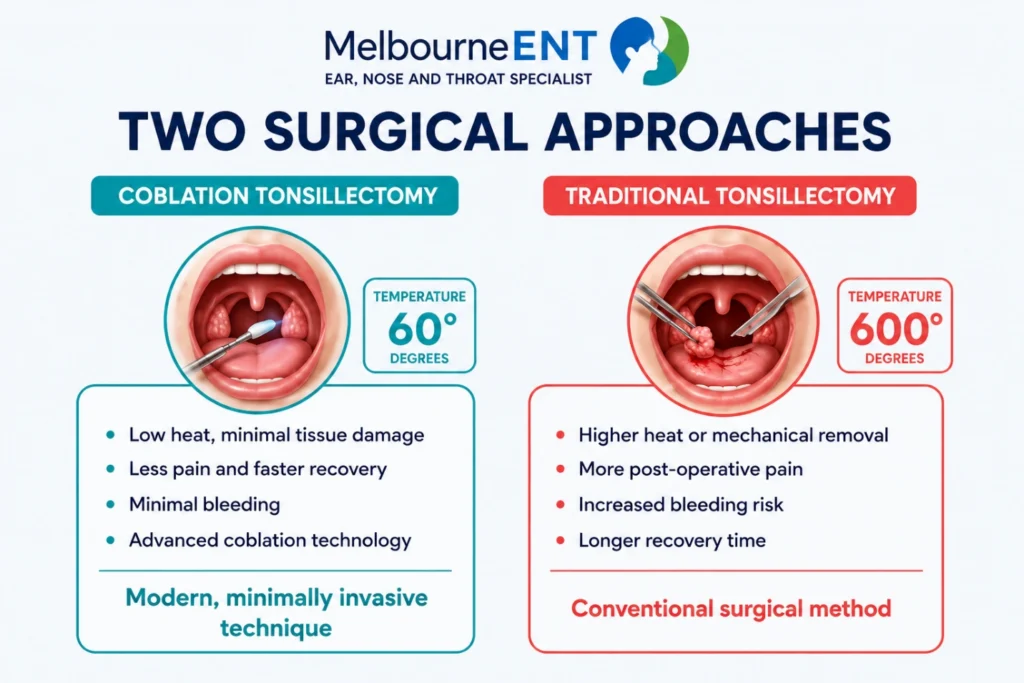
A tonsillectomy involves removal of the tonsils. It may be recommended for children experiencing recurrent tonsillitis or significant airway obstruction caused by enlarged tonsils.
At Melbourne ENT, tonsillectomy may be performed using coblation, depending on the child’s individual circumstances and the surgeon’s clinical judgement. Coblation uses controlled radiofrequency energy together with saline to remove tonsil tissue at lower temperatures than some traditional techniques.
Coblation tonsillectomy is used in paediatric ENT surgery because it allows precise removal of tonsil tissue while aiming to minimise heat-related effects on nearby tissues. As with all surgical techniques, suitability depends on the child’s anatomy, symptoms, medical history and the reason surgery is being considered.
Tonsillectomy is one of the most performed Paediatric ENT procedures. In appropriately selected children, it may help improve breathing, sleep quality and infection-related symptoms. However, outcomes vary, and all surgery carries risks, including pain, bleeding, infection, anaesthetic risks and the possibility of further treatment being required.
Dr Braham will discuss the reasons for surgery, the technique being considered, expected recovery, potential benefits and possible risks during consultation so parents can make an informed decision about their child’s care.
✓ Adenoidectomy
An adenoidectomy involves removal of enlarged adenoids located behind the nose.
The procedure may be considered when enlarged adenoids contribute to:
- Nasal obstruction
- Mouth breathing
- Snoring
- Sleep-disordered breathing
- Recurrent ear problems
Adenoidectomy is frequently performed alongside other ENT procedures when clinically indicated.

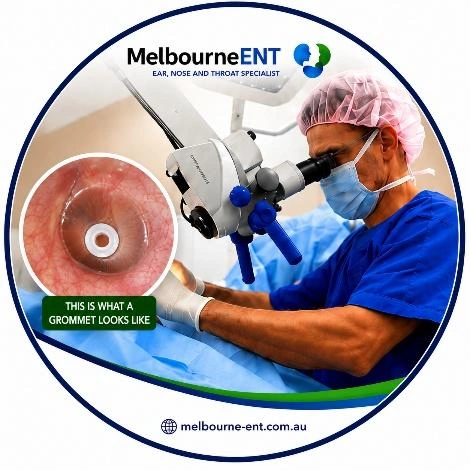
✓ Grommet Insertion
Grommets are tiny ventilation tubes inserted into the eardrum.
They help equalise pressure within the middle ear and allow fluid to drain more effectively.
Grommet insertion is commonly performed for persistent glue ear or selected cases of recurrent ear infections.
✓ Nasal/FESS Surgery
Some children experience nasal obstruction due to structural or inflammatory conditions affecting the nasal airway.
Selected nasal procedures may be considered when symptoms are significant and other treatment approaches have been unsuccessful.
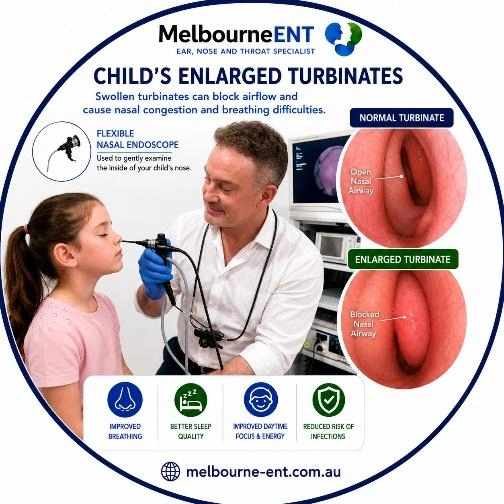
✓ Nasal Cautery
Nasal cautery is a procedure generally done in the treatment room under local anaesthetic to try and seal the vessels responsible for the blood noses

✓ Broken Noses
Broken noses in children are performed under a light general anaesthetic as a day procedure

✓ Voice Disorders
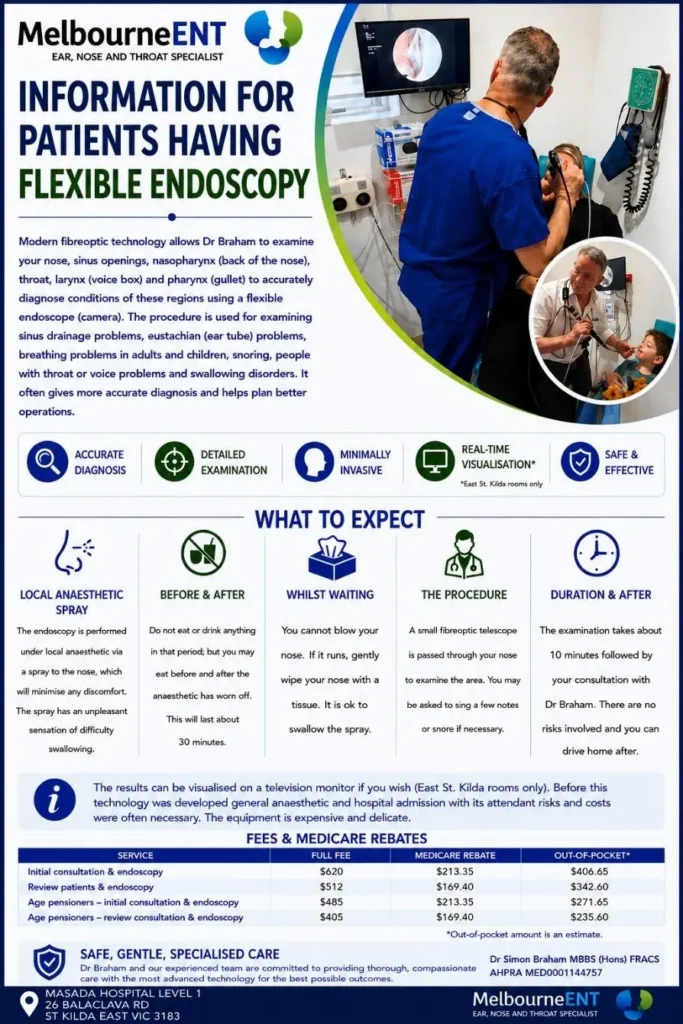
To assess voice disorders in children a Flexible endoscopy is usually done awake in the rooms to assess your child voice disorder if this is not possible, we can do this under a light general anesthetic

✓ Flexible Endoscopy

Is commonly done for voice, nasal ,snoring and throat assessment
These procedures are carefully planned following detailed assessment and investigation.
What Are the Potential Benefits of Surgery?
The goals of surgery depend on the condition being treated.
Potential benefits may include:
- Improved breathing
- Better nasal airflow
- Reduced snoring
- Improved sleep quality
- Better hearing
- Fewer infections
- Improved middle ear function
- Enhanced quality of life
For some children, the most noticeable improvement is simply being able to sleep and breathe more comfortably.
Others may benefit from clearer hearing, improved communication or fewer interruptions to school and everyday activities.
Outcomes vary according to the underlying condition, the procedure performed and individual patient factors.
Understanding the Risks
All surgical procedures involve potential risks and complications.
General risks may include:
- Bleeding
- Infection
- Pain
- Swelling
- Adverse medication reactions
- Anaesthetic complications
Certain procedures also carry specific risks.
For example, tonsillectomy carries a recognised risk of post-operative bleeding, while grommets may occasionally require replacement if middle ear problems persist.
Although complications are uncommon, it is important that parents understand both the potential benefits and limitations of treatment.
These issues are discussed in detail during consultation so families can make informed decisions about care.
Recovery After Children’s ENT Surgery
Recovery after ENT varies depending on the procedure performed and the individual child.
Most children recover well following paediatric ENT surgery.
Immediately after surgery, temporary symptoms may include:
- Mild discomfort
- Sore throat
- Fatigue
- Reduced appetite
- Nasal congestion
Parents receive detailed post-operative instructions to support recovery at home.
This may include guidance regarding:
- Pain management
- Fluid intake
- Diet
- Activity restrictions
- Follow-up appointments
Many procedures are performed as day surgery, allowing children to return home the same day. Some patients may require overnight observation depending on their age, medical history and the procedure performed.
Children can usually return to school, childcare and normal activities once recovery is progressing appropriately and medical advice permits.

FAQs About Children’s ENT Surgery
Is snoring normal in children?
Occasional snoring during a cold is common. Persistent snoring, however, may indicate airway obstruction, enlarged tonsils, enlarged adenoids or another sleep-related breathing issue.
Can hearing problems affect speech development?
Hearing plays an important role in language acquisition and communication. Persistent hearing difficulties may affect speech and language development in some children.
Will my child automatically need surgery?
No. Many ENT conditions can be managed with observation, monitoring or medical treatment. Surgery is only considered when it is likely to provide meaningful benefit based on the diagnosis and severity of symptoms. Where tonsil surgery is recommended, Dr Braham may discuss whether coblation tonsillectomy is appropriate for your child’s circumstances.
Can tonsillectomy be performed using coblation?
Yes. In some children, tonsillectomy may be performed using coblation. Coblation uses controlled radiofrequency energy with saline to remove tonsil tissue at lower temperatures than some traditional techniques. The most suitable approach depends on the child’s symptoms, anatomy, medical history and the reason surgery is being considered. Dr Braham will discuss the technique, expected recovery, potential benefits and possible risks during consultation.
Why might a sleep study be recommended?
A sleep study can provide valuable information about breathing patterns during sleep and may help assess the severity of sleep-disordered breathing or obstructive sleep apnoea.
Can multiple ENT problems be assessed at the same appointment?
Yes. Many children present with a combination of symptoms involving the ears, nose and throat. A comprehensive ENT consultation allows these issues to be evaluated together.
How long does recovery take after children’s ENT surgery?
Recovery varies depending on the procedure performed and the individual child. Many procedures are performed as day surgery, although some children may require overnight observation. Parents receive detailed post-operative instructions about pain relief, fluids, diet, activity restrictions and follow-up care.
Medical References
- Contemporary Surgical Strategies for Pediatric Laryngotracheal Stenosis: A Comprehensive Review – Frontiers in Pediatrics – https://www.frontiersin.org/journals/pediatrics/articles/10.3389/fped.2025.1634634/full
- Environmental Impact of Pediatric ENT Surgery: A STROBE Analysis – European Annals of Otorhinolaryngology, Head and Neck Diseases – https://pubmed.ncbi.nlm.nih.gov/39632220/
- Advanced Practice Providers in Pediatric Otolaryngology/Head and Neck Surgery: A Single-Institution Analysis of Clinical and Surgical Productivity – International Journal of Pediatric Otorhinolaryngology – https://pubmed.ncbi.nlm.nih.gov/40945496/
- The Changing Face of Paediatric Airway Endoscopic Surgery – International Journal of Pediatric Otorhinolaryngology (ScienceDirect) – https://www.sciencedirect.com/science/article/abs/pii/S0165587622000659
- Paediatric Snoring and Obstructive Sleep Apnoea in Children and Adolescents – Global ENT Guideline – ENT UK (Global Health Committee) – https://www.entuk.org/resources/guidelines.aspx
- Recurrent Acute Otitis Media Consensus Guideline – British Association for Paediatric Otolaryngology (BAPO) / ENT UK – https://www.entuk.org/resources/guidelines.aspx
- Guidelines for Operating on Ear, Nose & Throat (ENT) Patients, Children and Young People – Worcestershire Acute Hospitals NHS Trust – https://apps.worcsacute.nhs.uk/KeyDocumentPortal/Home/ViewUpdate?type=Document&archive=8380
Why Choose Melbourne ENT?
Dr Simon Braham is an experienced ENT Surgeon and Otolaryngologist who cares for both adult and paediatric patients.
With advanced training in Melbourne, New York and Boston, he provides evidence-based assessment and treatment for a broad range of ear, nose and throat conditions.
Parents value Dr Braham’s calm and thorough approach. Consultations focus on understanding the child’s symptoms, establishing an accurate diagnosis and discussing treatment options in clear and practical terms.
At Melbourne ENT, care is centred around:
- Comprehensive assessment
- Clear communication
- Individualised treatment planning
- Shared decision-making
- Evidence-based care
- Realistic expectations
The goal is not simply to recommend surgery, but to determine the most appropriate treatment pathway for each child.
Schedule a Consultation with Melbourne ENT
If your child is experiencing ongoing ear, nose or throat symptoms, specialist assessment may help identify the underlying cause and determine whether treatment is required.
Dr Simon Braham provides comprehensive paediatric ENT consultations at Melbourne ENT in East St Kilda. Following a detailed evaluation, he will discuss the diagnosis, available treatment options and whether surgery may be appropriate for your child’s individual circumstances.
To arrange an appointment, contact Melbourne ENT on 1300 952 808 or enquire online.
Further Reading From Melbourne ENT
- Read Melbourne ENT’s Procedure Page about Tonsil Surgery for Kids
- Read Melbourne ENT’s Page about Ear Concerns In Children
- Read Melbourne ENT’s Page about Throat Concerns and Conditions
- Read Melbourne ENT’s Page about Ear Concerns And Conditions Melbourne
- Read Melbourne ENT’s Page about Nose Concerns and Conditions