

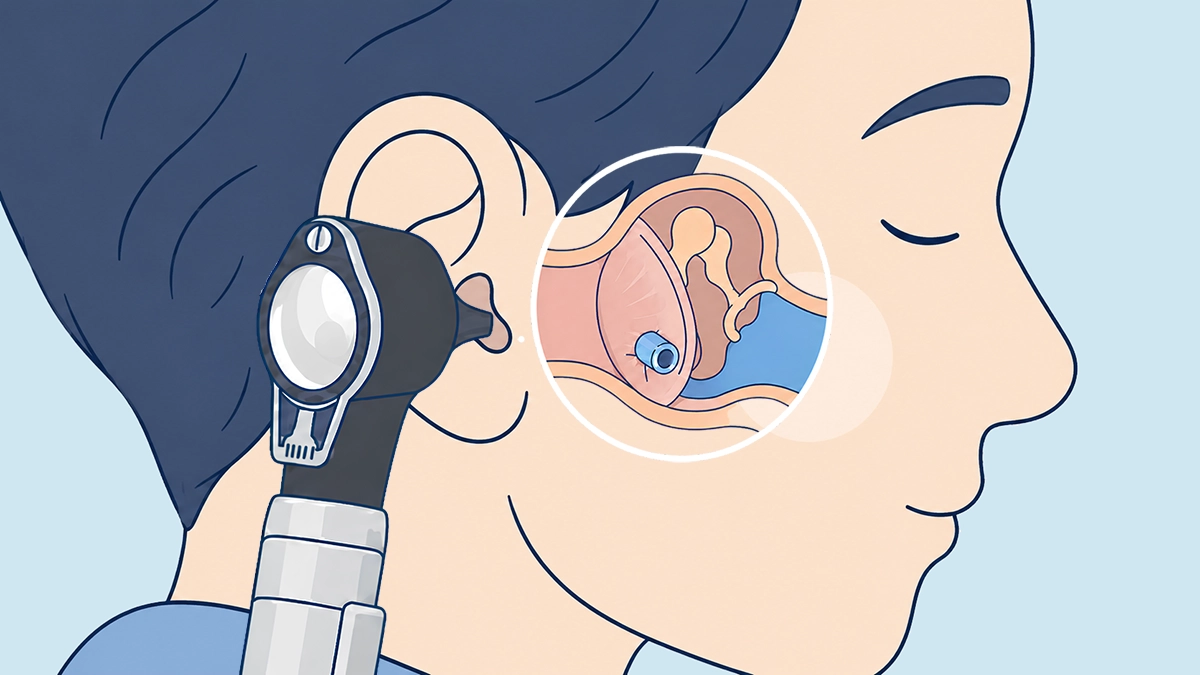
Most parents do not begin by worrying about grommet surgery. The concern usually starts much earlier, and in much smaller ways.
A child may begin asking for things to be repeated. A teacher may mention that the child seems less attentive in class than usual. At home, the television volume may creep up, or conversations may need to be repeated more often, especially when there is background noise. In some families, the concern begins after repeated ear infections. In others, it begins with blocked ears after a cold that never seem to settle properly.
These signs can be difficult to interpret. Children do not always have the words to explain that their hearing feels different. Some describe their ears as blocked. Others say nothing at all. Instead, the change is noticed in behaviour, frustration, speech, sleep, or school performance.
At Melbourne ENT in St Kilda East, Victoria, children with these kinds of symptoms are assessed carefully so that families can better understand what may be happening and what options may be appropriate. Dr Simon Braham, ENT and Head & Neck Surgeon, sees children with glue ear, recurrent ear infections, hearing concerns, and related nose and throat problems. In many cases, the discussion is not simply about the ears themselves. As Dr Simon Braham explains during consultation, it is also about how the child is functioning overall and whether the ear problem is beginning to affect day-to-day life.
For some children, the most appropriate plan is continued monitoring. For others, a more detailed discussion about treatment may be needed. This guide explains where grommet surgery may fit into that picture, what parents may wish to understand about the procedure, and why a balanced approach matters.
What Grommets Are and What They Actually Do
The word “grommet” is familiar to many parents, but it is not always clear what a grommet actually is.
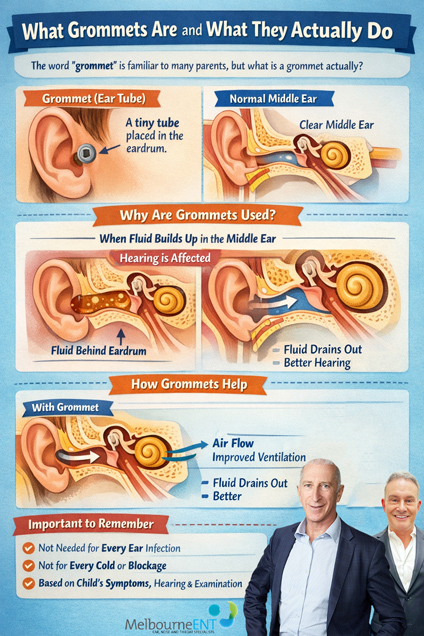
A grommet is a very small tube placed into the eardrum. Its purpose is to allow air to enter the middle ear and help manage ongoing fluid build-up behind the eardrum. Parents may also hear terms such as ventilation tubes or ear tubes, but in everyday discussion the term grommets is the one most families recognise.
To understand why they are used, it helps to understand the middle ear. The middle ear is the air-filled space behind the eardrum. When it is working normally, sound travels through this space and hearing remains clear. When fluid fills that space instead of air, sound becomes dulled. For a child, that can mean speech sounds are less sharp, background noise is harder to filter out, and listening becomes more tiring.
This is where grommet surgery may be considered. The procedure is designed to assist ventilation of the middle ear in selected cases where fluid has remained present and is affecting hearing or causing ongoing symptoms.
What grommets do not do is solve every ear problem in every child. They are not routinely needed for every ear infection, every cold, or every short-term blockage. At Melbourne ENT, this distinction is explained clearly by Dr Simon Braham because treatment decisions should be based on the child’s pattern of symptoms, hearing, and examination findings, not on the presence of fluid alone.
Why Children Commonly Develop Glue Ear
One of the most common reasons parents hear about grommet surgery is glue ear.
Glue ear refers to fluid sitting in the middle ear behind the eardrum. The fluid may be thin or thick, and it can remain there for weeks or months. In many cases, it appears after a viral illness or repeated inflammation. Some children develop it after a series of colds. Others seem to have ongoing problems with blocked ears that do not fully settle between illnesses.
Children are especially prone to this because the Eustachian tube, which connects the middle ear to the back of the nose, is still developing. In younger children, it is shorter, narrower, and less efficient at equalising pressure. That means fluid can become trapped more easily and may take longer to clear.
There are a number of reasons this may happen:
- repeated upper respiratory infections
- nasal congestion
- enlarged adenoids
- a tendency toward middle ear inflammation
- immature Eustachian tube function in younger children
For parents, the difficult part is that glue ear often fluctuates. A child may seem better for a while, then become less responsive again after another cold. Hearing may appear normal in one setting but less clear in another. This changing pattern can make it hard to know whether the problem is minor or persistent.
At Melbourne ENT, Dr Simon Braham takes this pattern seriously because ear disease in children is often not a one-day issue. It is something that needs to be understood over time.
Signs Parents May Notice at Home, at School, and in Daily Routines
One of the challenges with childhood ear problems is that the symptoms are not always dramatic. Some children complain of ear pain. Many do not. Some simply begin to function differently.
Parents may notice changes such as:
- asking “what?” more often
- not responding unless spoken to directly
- turning the television or tablet volume up
- seeming more tired or frustrated
- difficulty hearing in noisy rooms
- blocked ears after colds
- unsettled sleep
- less clear speech or delayed speech concerns
Teachers and educators may notice a different pattern. A child may seem distracted in a group environment but more responsive one-to-one. They may miss verbal instructions, lose track during activities, or appear less settled by the end of the day. Sometimes the issue is not obvious hearing loss, but rather the effort required to keep up when sound is muffled.
This is often an important turning point for families. The concern becomes less about a single ear infection and more about the broader effect on the child’s life. Listening effort can affect school participation, confidence, communication, and behaviour. When a child is working harder simply to hear, that effort can show up in many indirect ways.
That does not mean every child with these signs needs grommet surgery. It does mean the signs are worth assessing properly.
When a Specialist ENT Review May Be Helpful
Parents often ask when they should continue monitoring and when they should consider an ENT review.
There is no single rule that suits every child. However, a specialist assessment may be helpful when symptoms are ongoing, recurrent, or beginning to affect hearing or daily function. At Melbourne ENT, the goal of assessment is not to move automatically toward treatment. The goal is to understand the cause of the symptoms and whether continued observation, further review, or discussion of a procedure is appropriate.
An ENT consultation may be useful when a child has:
- recurrent ear infections
- persistent glue ear
- ongoing hearing concerns
- speech or listening issues that may be linked to hearing
- blocked ears that do not seem to settle
- snoring, mouth breathing, or chronic nasal blockage along with ear problems
During consultation, Dr Simon Braham, ENT and Head & Neck Surgeon, generally considers several factors together. These include the history of symptoms, the frequency of infections, the duration of fluid in the ear, hearing results where relevant, and the overall effect on the child’s routine, learning, and wellbeing.
This broader assessment matters because ear problems in children are not always isolated. The ears, nose, adenoids, throat, and sleep pattern can overlap. A child with glue ear may also have nasal obstruction. A child with repeated infections may also have enlarged adenoids. Looking only at one part of the problem can miss the bigger picture.
How the Decision About Grommet Surgery Is Usually Made
For many parents, the biggest concern is not just what grommet surgery involves, but how the decision is made in the first place.
A measured approach is important. Surgery should not be presented as a routine next step every time ear fluid is found. At Melbourne ENT, the decision about whether to discuss grommets further is based on a combination of factors rather than any one sign alone.
These factors may include:
- how long the fluid has been present
- whether hearing appears to be affected
- whether infections are recurring
- how much the symptoms are interfering with school, speech, sleep, or comfort
- whether related issues such as adenoids may be contributing
This kind of individual assessment can be reassuring for families. Many parents arrive worried that the appointment will lead straight to an operation being booked. In practice, what is often more helpful is clarity. Some children need monitoring only. Some need hearing review and follow-up. Some may benefit from a more detailed discussion about grommet surgery because the pattern of symptoms has become persistent enough to justify it.
That is one of the strengths of a thorough ENT consultation. It allows parents to understand not just what the treatment is, but why it is or is not being considered. This is also where Dr Simon Braham brings together the child’s history, examination findings, and hearing concerns to guide the discussion in a measured way.
What Happens Before Surgery Is Considered in Detail
Before moving toward any procedure, families usually need a clear understanding of what the assessment shows. That often includes an examination of the eardrum and, where appropriate, hearing testing.
Parents are often surprised by how much can be learned from these early steps. Hearing tests can help show whether middle ear fluid is affecting sound transmission in a meaningful way. Examination of the eardrum can give useful information about pressure, movement, and the possible presence of fluid.
At Melbourne ENT, this stage of care is also when questions can be addressed properly. Parents commonly want to know:
- whether their child may grow out of the problem
- whether surgery is being considered too early
- what alternatives exist
- whether another issue may be contributing
- what the likely next steps may be
This is also the stage where related nose and throat issues may be considered. Dr Simon Braham often reviews whether enlarged adenoids, chronic congestion, or mouth breathing may be affecting the way the ears ventilate. In children, these issues can be closely connected.
Importantly, this conversation is not about creating pressure to proceed. It is about helping families understand the findings, the possible role of treatment, and the reasons continued observation may still be appropriate in some cases.
What Grommet Surgery Usually Involves
Once parents understand why grommet surgery is being discussed, the next question is usually what the procedure actually involves.
For most children, grommet insertion is performed as a day procedure under general anaesthetic. Once the child is asleep, a very small opening is made in the eardrum. If fluid is present in the middle ear, it may be removed. A tiny grommet is then placed into the eardrum so that the middle ear can ventilate more effectively.
The procedure itself is usually brief, but the hospital day involves more than the operation alone. There is admission, fasting beforehand, anaesthetic care, recovery time, and discharge advice. For some children, the part they find most unsettling is not the ear itself but being in an unfamiliar environment and waking after anaesthetic.
Parents often find it helpful to think of the day in stages:
- admission and preparation
- the procedure itself
- recovery from anaesthetic
- going home with post-operative instructions
At Melbourne ENT, the aim is to make sure families understand the process clearly before the day arrives. That preparation can make the whole experience feel more manageable. During this stage, Dr Simon Braham also explains what parents may expect on the day and how recovery is usually monitored afterwards.
Recovery, Hearing, and the Early Weeks After Surgery
Recovery after grommet surgery varies from child to child, but many families are keen to know what the first few days are usually like.
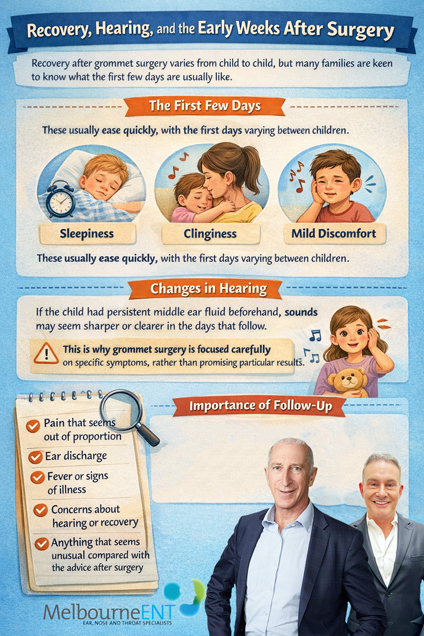
Some children are sleepy or clingy after anaesthetic. Some are a little irritable. Mild discomfort may occur, although the ears themselves are not usually the main cause of distress. Many children return to their usual routines within a short period, depending on their individual recovery and the advice given after surgery.
In the days that follow, parents may notice changes in hearing, especially if the child has had persistent middle ear fluid beforehand. In some cases, sounds may seem sharper or clearer. That possibility needs to be explained with care. Treatment aims to address the specific issue of middle ear fluid and related symptoms identified on assessment. It should not be presented as a guarantee of a particular outcome for every child.
Parents are generally advised to keep an eye on:
- pain that seems out of proportion
- ear discharge
- fever or signs of illness
- concerns about hearing or recovery
- anything that seems unusual compared with the advice given after surgery
Follow-up remains an important part of care. At Melbourne ENT, review allows Dr Simon Braham to check the position of the grommets, discuss the child’s recovery, and consider whether hearing and symptoms are progressing as expected.
What Grommets May Help With, and What They Do Not Promise
When parents hear about grommet surgery, it is natural to focus on what the procedure may change. A balanced explanation is important here.
Where persistent middle ear fluid has been affecting hearing or pressure, treatment may assist ventilation of the middle ear and may help manage the effects of ongoing fluid. In some children, that may be reflected in listening, hearing, or day-to-day comfort. However, it is important not to describe the procedure as a cure-all.
Grommets do not guarantee that a child will never have another ear infection. They do not remove the need for follow-up. They do not automatically resolve speech or behavioural concerns that may have more than one cause. They are one part of treatment for a specific ear problem in selected children.
Parents often find this balanced explanation more useful than broad claims. At Melbourne ENT, the discussion is centred on what the procedure may reasonably contribute to in an individual child, rather than on promises. That approach helps families make decisions with clearer expectations. Dr Simon Braham also makes sure parents understand that treatment recommendations depend on the child’s symptoms, hearing results, and overall pattern of ear disease.
Risks, Limitations, and Why Honest Discussion Matters
Even a commonly performed procedure should be discussed honestly. Parents need clear information about possible risks and limitations so they can make informed decisions.
Possible considerations with grommet surgery may include:
- ear discharge
- blockage of the grommet
- the grommet coming out earlier than expected
- ongoing review if symptoms return
- a small perforation in the eardrum that persists after the grommet comes out
- the usual considerations associated with general anaesthetic
Providing this information does not make the procedure sound alarming. It simply recognises that good medical communication should be balanced. At Melbourne ENT, this forms part of the overall conversation about whether surgery is proportionate to the child’s symptoms, hearing findings, and clinical history.
Families usually appreciate honest, calm explanations. Clear information can make it easier to weigh the likely role of treatment against the fact that some children improve with time alone.
When More Than One Set of Grommets May Be Discussed
Another question parents often ask is whether one set of grommets will be enough.
In many children, the answer is yes. Grommets usually remain in place for a period of time and often come out on their own. As children grow, the Eustachian tubes mature, and middle ear ventilation may improve. For some families, that is the end of the story.
For other children, the pattern is less straightforward. Fluid or related symptoms may return after the grommets come out. If that happens, the next step depends on the child’s age, hearing, overall symptoms, and examination findings at the time. Sometimes further monitoring is appropriate. Sometimes another discussion about management is needed.
This does not necessarily mean the first procedure has failed. Rather, it reflects the fact that children outgrow ear ventilation problems at different rates.
The Role of Adenoids and Other Related Issues
In children, ear concerns do not always sit alone. Enlarged adenoids can contribute to poor ventilation of the middle ear as well as nasal blockage, mouth breathing, restless sleep, and snoring. Where these issues occur together, they can influence the overall management plan.
That is why Dr Simon Braham often considers the broader ENT picture rather than focusing on the ears only. At Melbourne ENT, a child with persistent glue ear may also be assessed for adenoid-related symptoms and other upper airway concerns. Whether treatment of the adenoids is relevant depends on the child’s history, age, and examination findings. It is not something that should be assumed for every child undergoing grommet surgery.
This wider perspective is often valuable for families because it helps explain why one child may need monitoring only, while another may need a more detailed treatment discussion.

Grommet Surgery FAQs
Can a child still need grommets even if ear infections are not happening all the time?
Yes. In some children, the main issue is persistent middle ear fluid rather than repeated painful infections. If that fluid is affecting hearing or daily function, grommet surgery may still be discussed.
Why does a child seem to hear well one day and poorly the next?
Middle ear fluid can fluctuate, especially around colds, congestion, or changes in pressure. That is one reason hearing concerns are sometimes noticed gradually rather than all at once.
Can glue ear affect behaviour even when a child does not complain about their ears?
It can. When hearing is reduced or muffled, some children appear tired, frustrated, distracted, or less responsive, particularly in noisy settings such as classrooms or group activities.
Is it possible for one ear to need more attention than the other?
Yes. Some children have more persistent fluid or pressure problems on one side, even though both ears are examined carefully. The treatment plan is based on the overall findings rather than assuming both ears are affected in the same way.
Do grommets change how a child’s voice sounds?
Not directly. However, if hearing has been affected by persistent middle ear fluid, a child may sound different over time simply because they are hearing themselves more clearly.
Can a child be too young to be assessed for grommet surgery?
Children can still be assessed when symptoms suggest persistent ear problems, even at a young age. The decision about treatment depends on the child’s hearing, symptoms, development, and clinical findings rather than age alone.
Why might an ENT surgeon ask about snoring when the problem seems to be the ears?
Ear problems in children can sometimes sit alongside enlarged adenoids, nasal blockage, or mouth breathing. These related issues may affect how the middle ear ventilates and can influence the overall assessment.
Can a child still get a cold soon after grommet surgery?
Yes. Grommets do not prevent ordinary viral illnesses. Their role is more specific, which is to assist ventilation of the middle ear in selected children where fluid or pressure problems have been identified.
What happens if a grommet falls out earlier than expected?
That can happen, and the next step depends on the child’s symptoms and hearing at the time. Some children do not need any further treatment, while others may need review if the original problem returns.
Does needing grommets mean a child will always have ear trouble?
Not necessarily. Many children outgrow middle ear ventilation problems as they get older and the Eustachian tubes mature. Ongoing care is based on the child’s progress over time rather than assuming the issue will continue long term.
Medical References:
- Rosenfeld RM, Tunkel DE, Schwartz SR, et al. Clinical Practice Guideline: Tympanostomy Tubes in Children (Update). Otolaryngology–Head and Neck Surgery. 2022.
https://aao-hnsfjournals.onlinelibrary.wiley.com/doi/epdf/10.1177/01945998211065662 - Rosenfeld RM, Shin JJ, Schwartz SR, et al. Clinical Practice Guideline: Otitis Media with Effusion (Update). Otolaryngology–Head and Neck Surgery. 2016.
https://aao-hnsfjournals.onlinelibrary.wiley.com/doi/epdf/10.1177/0194599815623467 - MacKeith S, Mulvaney CA, Galbraith K, et al. Adenoidectomy for otitis media with effusion (OME) in children. Cochrane Database of Systematic Reviews. 2023.
https://pmc.ncbi.nlm.nih.gov/articles/PMC10591285
A Clearer Path for Families in Melbourne
For families across Melbourne and surrounding areas, one of the most helpful parts of specialist review is often clarity. Parents want to understand whether the ear problem is likely to settle, whether hearing is being affected, and whether it is reasonable to continue monitoring or to discuss treatment in more depth.
At Melbourne ENT in St Kilda East, Victoria, the emphasis is on careful assessment and clear explanation. Dr Simon Braham, ENT and Head & Neck Surgeon, discusses the likely cause of symptoms, the current findings, and the options that may be considered, including when continued observation remains appropriate.
That approach matters because families do not simply need information about an operation. They need help understanding the full picture around their child’s ear health.
When Parents May Wish to Seek Advice
If a child has ongoing hearing difficulty, repeated ear infections, persistent glue ear, blocked ears that do not seem to settle, or listening and speech concerns that may be linked to ear symptoms, parents may wish to seek medical advice. Where appropriate, an ENT assessment can help clarify the likely cause of symptoms, the current ear findings, and the available management options.
For children seen at Melbourne ENT, that process is intended to support informed decisions rather than rushed ones. In some cases, the result is continued monitoring. In others, it is a clearer discussion about whether grommet surgery may have a role in management. The next step depends on the individual child, the history, the examination findings, and any hearing assessment that has been performed.
For families in Melbourne, St Kilda East, and surrounding parts of Victoria, understanding the reason behind a recommendation is often just as important as the recommendation itself. When parents feel properly informed, decisions about treatment become clearer, calmer, and more manageable.
Further Reading
- Read more about Ear Concerns In Children Melbourne
- Read more about Ear Ache
- Read more about Middle Ear Infection (AOM)
- Read Melbourne ENT’s Blog on Middle Ear Aeration Methods: How Can They Help?
- Read Melbourne ENT’s Blog on How to Use Hydrogen Peroxide Ear Drops
- Read Melbourne ENT’s Blog on Using the NOSE Scale Score to assess Nasal Obstruction

Complete Guide to Grommet Surgery in Melbourne for Parents
Most parents do not begin by worrying about grommet surgery. The concern usually starts much…

Decision-Making for Grommet Surgery – Factors ENT Surgeons Consider
When is grommet surgery recommended? Grommet surgery may be considered when fluid in the middle…

Coping With Recurrent Glue Ear Even After Grommets
Why does glue ear come back after grommets? Glue ear can return after a grommet…