

Why does glue ear come back after grommets?
Glue ear can return after a grommet because the underlying cause of fluid build-up, such as Eustachian tube dysfunction, adenoids, or recurrent infections, may still be present. While a grommet helps ventilate the ear temporarily, it does not always resolve the underlying issue permanently.
For many families, there is a real sense of relief when a child has a grommet inserted and hearing begins to improve. Everyday conversation can become easier, school participation may improve, and the constant feeling of blockage often settles. Adults can feel the same relief when a long period of muffled hearing or pressure finally starts to lift.
That is why the return of symptoms can feel disappointing.
At Melbourne ENT in St Kilda East, Dr Simon Braham, ENT and Head & Neck Surgeon and Facial Plastic Surgeon, consults with children and adults who experience recurrent glue ear after a previous grommet. In many cases, this does not mean the original treatment was inappropriate. More often, it suggests that the middle ear is still vulnerable to fluid build-up, or that the underlying cause has not fully settled.
For patients and parents, the more useful question is not simply why symptoms have come back. The better question is what the recurrence means, whether hearing is being affected again, and what options may need to be considered now. In this setting, Dr Simon Braham may assess not only the ear itself, but also hearing, infections, nasal symptoms, sleep concerns, and whether there may be ongoing issues involving the Eustachian tube or adenoids.
Why This Happens More Often Than People Expect
Many parents assume that once a grommet has been inserted, the problem should be finished. It is understandable to think that way, especially when the improvement after surgery has been obvious. A child may hear more clearly, seem more engaged, and stop asking for repetition. Adults may notice that conversations feel easier again and that the blocked sensation has eased.
Even so, recurrence is not unusual.
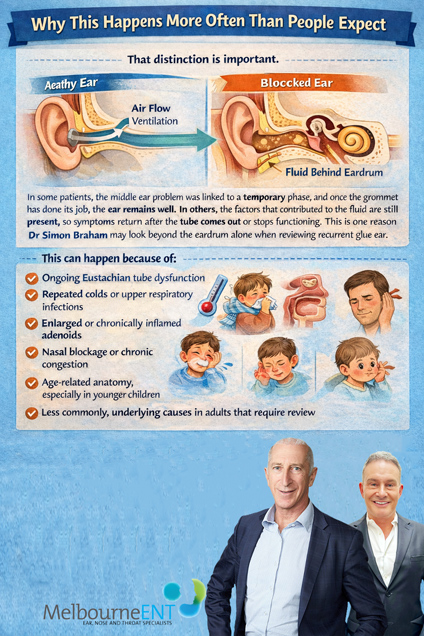
A grommet is designed to ventilate the middle ear by allowing air to enter through the eardrum. It can assist with drainage of fluid and support hearing while it remains in place. What it does not always do is permanently correct the reason the fluid built up in the first place.
That distinction is important.
In some patients, the middle ear problem was linked to a temporary phase, and once the grommet has done its job, the ear remains well. In others, the factors that contributed to the fluid are still present, so symptoms return after the tube comes out or stops functioning. This is one reason Dr Simon Braham may look beyond the eardrum alone when reviewing recurrent glue ear.
This can happen because of:
- ongoing Eustachian tube dysfunction
- repeated colds or upper respiratory infections
- enlarged or chronically inflamed adenoids
- nasal blockage or chronic congestion
- age-related anatomy, especially in younger children
- less commonly, underlying causes in adults that require review
For many families, simply understanding that recurrence can happen for sensible medical reasons can make the situation feel less discouraging. The focus then shifts from frustration towards assessment and management.
What Glue Ear Actually Means
Glue ear refers to fluid in the middle ear, which is the space behind the eardrum. This fluid is not always associated with an acute ear infection. That is why the symptoms may be quieter and more gradual than people expect.
Instead of pain and fever, the more common signs are:
- reduced hearing
- a blocked or full sensation in the ear
- pressure or crackling
- difficulty hearing clearly in noisy places
- a feeling that sounds are muffled or distant
In children, the changes are often noticed in behaviour before they are described as a hearing problem. A parent may notice that a child seems less responsive, turns the television up louder, or asks “what?” more often. A teacher may notice that classroom listening has become harder, especially when there is background noise.
Some children become tired or frustrated because they are working harder to hear. Others may seem distracted when they are actually missing parts of conversation.
Adults tend to describe glue ear differently. The ear may feel dull, heavy, or pressurised. Hearing may fluctuate from day to day. There may be popping, crackling, or the sense that one ear is not hearing as clearly as the other.
Although glue ear is common in children, it can also affect adults. When it does, it usually calls for careful review because the causes may be broader and sometimes different from the typical childhood pattern.
What a Grommet Can and Cannot Do
A grommet is a small tube placed in the eardrum. Its role is to allow air into the middle ear and support drainage of trapped fluid. In many patients, this can improve hearing and reduce the blocked sensation.
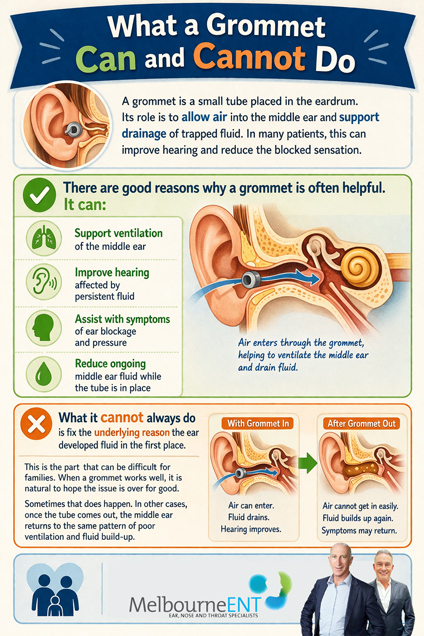
There are good reasons why a grommet is often helpful. It can:
- support ventilation of the middle ear
- improve hearing affected by persistent fluid
- assist with symptoms of ear blockage and pressure
- reduce ongoing middle ear fluid while the tube is in place
What it cannot always do is fix the underlying reason the ear developed fluid in the first place.
This is the part that can be difficult for families. When a grommet works well, it is natural to hope the issue is over for good. Sometimes that does happen. In other cases, once the tube comes out, the middle ear returns to the same pattern of poor ventilation and fluid build-up.
That does not necessarily mean the first procedure was unsuccessful. It usually means the ear remains prone to the same problem.
At Melbourne ENT, Dr Simon Braham may explain that the aim of reassessment is to understand whether the recurrence reflects a short-term setback, a continuing developmental pattern, or another factor that needs attention.
Why Children Are Especially Prone to Recurrent Glue Ear
Children are more likely than adults to develop glue ear, and there are practical reasons for that.
The Eustachian tube, which connects the middle ear to the back of the nose, is narrower, shorter, and more horizontal in childhood. This makes it less efficient at equalising pressure and clearing fluid. Young children are also exposed to frequent viral infections, particularly in childcare, kindergarten, and the early years of school.
Each cold can contribute to swelling in the nose, throat, and middle ear. For some children, the cycle repeats often enough that glue ear becomes an ongoing pattern rather than a single episode.
A child may be more likely to experience recurrent glue ear if there is:
- frequent exposure to colds
- ongoing nasal congestion
- mouth breathing or snoring
- enlarged adenoids
- a history of repeated ear infections
- fluctuating hearing over several months
This does not mean every child with a previous grommet will need more treatment. Many improve as they grow and as the Eustachian tube matures. Still, in the younger years, recurrence is common enough that it should be understood as part of the condition rather than as something unusual.
For parents, this can be reassuring in a practical sense. It helps explain why symptoms may have improved for a time and then returned later, particularly after winter illnesses or repeated colds.
The Role of the Adenoids and Nose
When glue ear keeps returning, the ears are only part of the picture.
The adenoids sit at the back of the nose near the opening of the Eustachian tubes. When they are enlarged or chronically inflamed, they may interfere with normal middle ear ventilation. Some children with adenoid-related problems also have snoring, mouth breathing, restless sleep, or persistent nasal blockage.
This is why recurrent glue ear can sometimes be associated with other symptoms that may not seem related at first.
Parents may notice:
- a blocked nose most of the time
- breathing through the mouth
- snoring or noisy sleep
- restless sleep or disrupted sleep
- recurrent colds that seem slow to clear
Nasal congestion can also play a role even when the adenoids are not the main issue. In some children and adults, inflammation in the nose affects the function of the Eustachian tube and contributes to repeated fluid build-up behind the eardrum.
At Melbourne ENT, Dr Simon Braham may assess the nose, throat, and ear together when reviewing recurrent glue ear. This broader ENT assessment helps identify whether the recurrence is mainly an ear problem or whether upper airway factors may also be contributing.
What Recurrent Glue Ear Can Look Like in Real Life
One reason recurrent glue ear can be missed is that it does not always present dramatically. The effects may build slowly.
In children, families may notice a gradual return of the same signs that were present before the first grommet. These can include unclear hearing, difficulty following conversation, speaking more loudly than usual, or seeming less engaged at school or home.
Sometimes the changes are subtle. A child may not complain at all. Instead, the clues come from everyday life:
- they ask for instructions to be repeated
- they sit closer to the television
- they seem more tired after school
- they cope poorly in noisy environments
- they mishear words more often
- they appear inattentive in groups
Adults may experience a different pattern. The symptoms may include a blocked ear that will not settle, fluctuating hearing, or pressure after a cold that seems to linger longer than expected. Some adults notice difficulty on the phone or find that one-sided hearing changes affect confidence in social settings or at work.
The effect on quality of life should not be overlooked. Even mild hearing change can become tiring when it continues over time. In children, that may affect classroom listening, communication, and confidence. In adults, it may interfere with work meetings, conversation, and day-to-day comfort.
When Reassessment May Be Worthwhile
Not every recurrence needs urgent intervention, but there are situations where reassessment may be appropriate.
This is often the case when symptoms persist, keep returning, or begin to affect communication or hearing again. Parents usually know when something feels familiar. If the same pattern that led to the first grommet starts to reappear, that can be a reasonable time to organise review.
Reassessment may be helpful when:
- hearing seems reduced again
- there is a return of ear blockage or pressure
- a child is asking for repetition more often
- teachers have concerns about hearing or attention
- speech seems affected
- ear infections continue to recur
- there is persistent snoring or nasal blockage
- one-sided symptoms occur in an adult
- symptoms are not settling after a cold or illness
The aim of reassessment is not to assume another procedure is needed. It is to clarify what is happening now and whether the current pattern is likely to settle, needs monitoring, or warrants further treatment. In this setting, Dr Simon Braham may consider the hearing impact, the duration of symptoms, and whether other ENT factors appear relevant.
What Happens During Assessment
Assessment of recurrent glue ear usually starts with the history. Timing matters. The specialist will usually want to know when the first grommet was inserted, how long it seemed to help, whether there have been further infections, and how hearing or symptoms have changed since then.
For children, the discussion may also cover:
- speech and language concerns
- school or childcare observations
- sleep quality
- mouth breathing or snoring
- how often colds occur
- whether symptoms affect one ear or both
For adults, assessment may include questions about:
- sinus symptoms
- nasal blockage
- recent infections
- changes with flying or pressure
- whether one ear is more affected than the other
- how much the symptoms affect work or daily communication
The ears are examined, but the review often goes beyond the ear alone. Hearing testing may help clarify whether fluid is causing a meaningful hearing change. Where relevant, the nose and throat may also be assessed.
At Melbourne ENT, Dr Simon Braham assesses recurrent glue ear in the context of the broader ear, nose, and throat picture so that management can reflect the likely cause of recurrence as well as the symptoms themselves.
When Monitoring May Be a Sensible Option
A return of glue ear after a grommet does not automatically mean another procedure is required.
This is an important point, because many families expect recurrence to lead straight back to surgery. In reality, some episodes of fluid settle gradually, especially when they follow a recent upper respiratory infection. Some children continue to function well despite mild hearing change, and some adults notice that the blocked feeling improves over time.
Monitoring may be appropriate when:
- symptoms are mild
- hearing impact appears limited
- the fluid developed after a recent cold
- school or speech is not being affected significantly
- there are signs that the problem may still improve
Monitoring is not the same as ignoring the problem. It means the symptoms, hearing, and day-to-day function are followed over time. This approach can be appropriate when the clinical picture suggests that immediate intervention is not necessary.
For some families, this is reassuring because it avoids treatment that may not be needed. For others, it provides time to see whether the recurrence is part of a short-term cycle rather than a longer-term pattern.
When Another Grommet May Be Considered
There are also situations where another grommet may be considered. This is usually discussed when the recurrence is persistent, hearing loss is ongoing, infections continue, or daily life is clearly being affected.
For children, that may involve:
- difficulty hearing at school
- persistent fluid with hearing loss
- repeated ear infections
- speech or communication concerns
- poor listening in groups or noisy places
For adults, it may relate to:
- ongoing hearing reduction
- a blocked ear that does not settle
- persistent middle ear fluid
- recurrent symptoms interfering with daily activities
A repeat grommet is usually considered in the context of the whole clinical picture. The decision is not based on fluid alone. Hearing results, symptom duration, examination findings, prior response to treatment, and any related nasal or adenoid issues may all influence management.
Where appropriate, Dr Simon Braham may discuss whether repeat grommet treatment should form part of ongoing management.
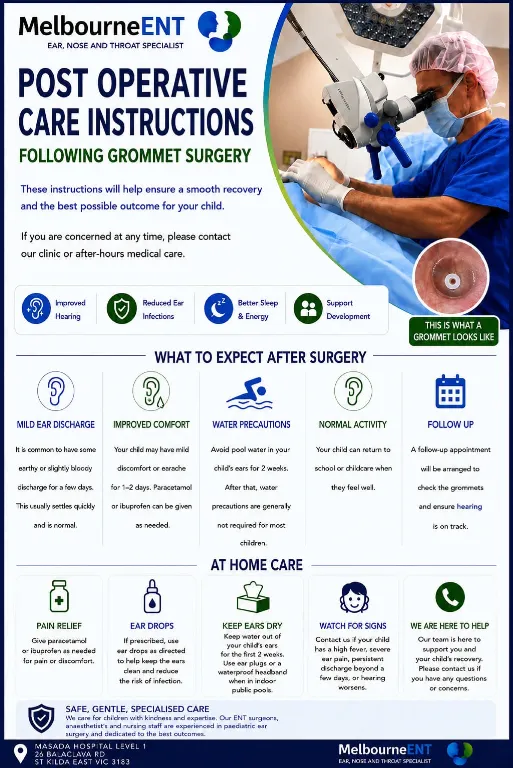
Download Post Operative Care Instructions
When the Adenoids May Need to Be Part of the Discussion
In some children, recurrent glue ear is not just about the ear itself. The adenoids may also be contributing to the problem, particularly if there are ongoing nasal or sleep-related symptoms.
This may be more relevant where there is:
- snoring
- mouth breathing
- nasal obstruction
- restless sleep
- repeated upper respiratory symptoms
- recurrent glue ear after earlier treatment
Not every child with recurrent glue ear will need discussion about the adenoids, but where these symptoms sit alongside repeated middle ear fluid, it can become an important part of the assessment.
The role of the adenoids depends on the child’s age, hearing, infection pattern, and overall symptom history. During specialist review, these factors can be considered together so that management reflects the child’s wider ENT picture. This is another area Dr Simon Braham may review when recurrent glue ear continues after a previous grommet.
Recurrent Glue Ear in Adults
Although glue ear is often seen as a childhood issue, adults can also experience recurrent middle ear fluid and blocked ears. When this happens, it deserves careful attention.
Adults may describe:
- muffled hearing
- a blocked sensation in one or both ears
- pressure or fullness
- popping or crackling
- hearing that changes after a cold or sinus episode
Because adult glue ear is less common, the assessment often focuses on whether there is an underlying issue affecting ventilation of the middle ear. Nasal obstruction, sinus problems, inflammation, or Eustachian tube dysfunction may all need consideration.
Persistent one-sided symptoms are particularly important to review properly rather than leaving them to settle without assessment.
At Melbourne ENT, Dr Simon Braham consults with adults who have recurrent ear blockage, hearing changes, and glue ear, particularly where symptoms continue after previous grommet treatment or where the cause is not immediately clear.

Recurrent Glue Ear After a Grommet FAQs
Can glue ear come back even while a grommet is still in place?
Yes, it can, although the pattern may be different. In some cases the tube may become blocked, stop functioning as expected, or the ear may still develop symptoms that need review.
Why does one child seem to need more than one grommet while another does not?
Children develop differently, and some remain more prone to middle ear fluid for longer than others. Factors such as age, frequent colds, adenoids, and Eustachian tube function can all influence whether glue ear returns.
Can recurrent glue ear affect behaviour before anyone notices hearing loss?
Yes, that can happen. Some children become tired, frustrated, quieter, or seem inattentive because they are missing parts of conversation rather than because of a behavioural issue.
Is it possible for glue ear to be worse in winter and better in summer?
Yes, some families notice that pattern. Recurrent colds and upper respiratory infections during colder months can contribute to fluid build-up and make symptoms more noticeable.
Can a child hear normally in a quiet room but still struggle with glue ear?
Yes. Mild hearing changes often become more obvious in noisy places such as classrooms, playgrounds, or family gatherings where listening takes more effort.
Does recurrent glue ear always cause pain?
No, not always. Many patients have reduced hearing, pressure, or a blocked sensation without the obvious pain that is more typical of an acute ear infection.
Can swimming or water exposure cause glue ear to come back after a grommet?
Glue ear itself is usually related to middle ear ventilation rather than swimming. Even so, water precautions may sometimes be discussed depending on the patient’s history and symptoms.
Why might a child with recurrent glue ear also snore or breathe through the mouth?
These symptoms can sometimes point to enlarged adenoids or ongoing nasal blockage, which may affect the Eustachian tube and middle ear. That is one reason the nose and throat may be assessed as part of ENT review.
Can adults get glue ear again years after childhood grommets?
Yes, adults can develop glue ear, but the reason may be different from childhood patterns. Persistent or one-sided symptoms in adults should be assessed properly rather than assumed to be temporary.
If symptoms improve on their own, is review still needed?
Sometimes symptoms do settle without further treatment, especially after a cold. Review may still be helpful if the problem keeps returning, hearing seems affected, or there is uncertainty about the cause.
Medical References:
- Clinical Practice Guideline: Otitis Media with Effusion (Update). Rosenfeld RM, Shin JJ, Schwartz SR, et al. Otolaryngology–Head and Neck Surgery. 2016. This is one of the main evidence-based guideline papers for OME management.
https://aao-hnsfjournals.onlinelibrary.wiley.com/doi/epdf/10.1177/0194599815623467 - Otitis media with effusion in children. Williamson I. BMJ Clinical Evidence. 2007. A broad evidence review covering ventilation tubes, autoinflation, adenoidectomy, antibiotics, and steroids.
https://pmc.ncbi.nlm.nih.gov/articles/PMC2943809 - Adenoidectomy for otitis media with effusion (OME) in children. MacKeith S, Mulvaney CA, Galbraith K, et al. Cochrane Database of Systematic Reviews. 2023. Open-access Cochrane review focused on adenoidectomy for glue ear.
https://pmc.ncbi.nlm.nih.gov/articles/PMC10591285/
Practical Support While Waiting for Review
While waiting for review, some practical steps may help reduce the day-to-day impact of hearing changes.
For children, it may help to:
- sit closer to the teacher
- reduce background noise where possible
- speak face-to-face
- check that instructions have been heard clearly
- keep a note of symptoms, infections, and hearing concerns
For adults, it may help to:
- note whether symptoms change with colds or congestion
- track whether one ear is more affected
- avoid assuming a persistent blocked ear will always settle on its own
- arrange hearing review if symptoms continue
These measures do not replace assessment, but they may make communication easier while symptoms are being monitored or investigated.
A Clearer Way Forward
When glue ear returns after a grommet, the next step depends on the individual patient. Some children and adults improve with time and monitoring. Some benefit from hearing assessment and review of contributing factors such as the nose or adenoids. Some may need discussion about further treatment.
What matters most is understanding why the recurrence has happened and how much it is affecting hearing, communication, and daily life.
At Melbourne ENT in St Kilda East, Dr Simon Braham, ENT and Head & Neck Surgeon and Facial Plastic Surgeon, consults with children and adults regarding recurrent glue ear, hearing concerns, and related ear, nose, and throat issues. Where symptoms return after a previous grommet, ENT review may help clarify the likely cause and discuss appropriate management options.
For many patients and families, clearer understanding is the most helpful place to begin.
Further Reading
- Read more about Ear Concerns In Children Melbourne
- Read more about Ear Ache
- Read more about Middle Ear Infection (AOM)
- Read Melbourne ENT’s Blog on Middle Ear Aeration Methods: How Can They Help?
- Read Melbourne ENT’s Blog on How to Use Hydrogen Peroxide Ear Drops
- Read Melbourne ENT’s Blog on Using the NOSE Scale Score to assess Nasal Obstruction
If you are considering whether grommet surgery may be appropriate, a detailed ENT assessment can help guide this decision. You can learn more about the procedure on our grommets surgery page.
Download Ear Tube Journey with Dr Braham

How Deviated Septum Symptoms Vary Between Adults and Teenagers
A deviated septum can affect both adults and teenagers, but the symptoms are not always…
Nasal Obstruction in Children – When ENT Assessment Is Needed
A blocked nose is common in childhood. Many children experience nasal congestion during colds, allergy…
How Past Nasal Trauma in Kids Impacts Breathing Later in Life
Childhood nose injuries are common. A fall in the playground, a knock during sport, a…