

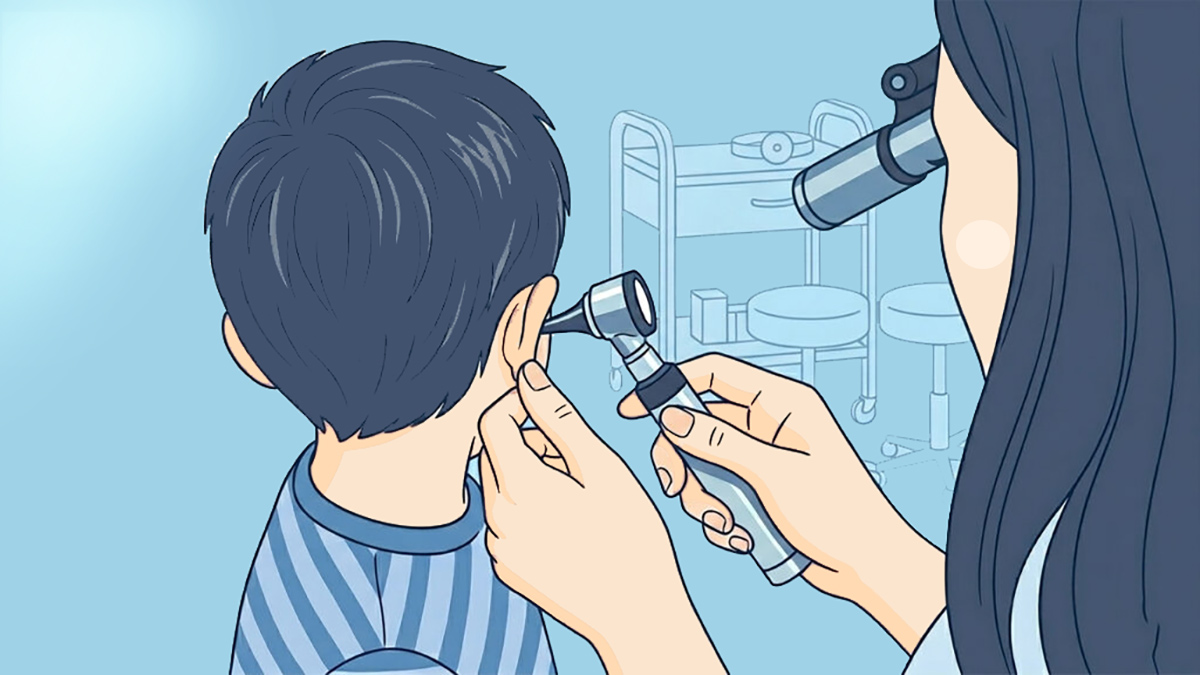
At Melbourne ENT, located in St Kilda East, Victoria, our surgeons provide evidence-based care for ear, nose, throat, and head and neck conditions. Leading our ear health consultations is Dr Simon Braham, ENT and Head and Neck Surgeon, Fellow of the Royal Australasian College of Surgeons (FRACS). Dr Braham’s approach is patient-centred and unhurried – every patient leaves a consultation with a clear understanding of their condition and a confident path forward.
If you or your child has been cycling through repeated ear infections and repeated courses of antibiotics without lasting relief, you are not alone. Recurring middle ear infections are one of the most common reasons families seek specialist care at Melbourne ENT. This article explains both treatment pathways – antibiotics and grommet surgery – clearly and honestly, so you can have an informed conversation with your specialist.
Understanding Middle Ear Infections
✓ What Is a Middle Ear Infection?
A middle ear infection, or acute otitis media (AOM), is an inflammation and infection of the space behind the eardrum. The middle ear connects to the back of the throat via the Eustachian tube, which equalises pressure and drains fluid. When this tube is blocked – most commonly after a cold or upper respiratory infection – fluid builds up in the middle ear, creating a warm, moist environment ideal for bacterial and viral growth.
Children with AOM typically experience ear pain, fever, and disturbed sleep. Infants may tug at their ear, become unusually unsettled, or have difficulty lying flat. In Australia, approximately four in five children will experience at least one middle ear infection before school age – and for many, infections recur repeatedly.
✓ Key Statistic
Around four in five Australian children will experience at least one middle ear infection before starting school. For a significant proportion, infections will recur – and it is this pattern of recurrence that brings the question of grommets into focus.
✓ What Is Glue Ear?
Glue ear, or otitis media with effusion (OME), is a condition in which thick, sticky fluid accumulates in the middle ear without the acute signs of infection. Because it is painless, it often goes undetected for months. The primary consequence is hearing impairment – a muffled, underwater quality to sound that makes it difficult for children to follow conversation, engage in the classroom, or participate socially. Adults can develop glue ear too, particularly after a significant respiratory illness or in association with chronic allergic rhinitis.
Antibiotics: When They Work – and When They Don’t

✓ The Appropriate Role of Antibiotics
Antibiotics remain a valuable and sometimes essential tool for middle ear infections. For a first-time, isolated episode in a child over two years of age with mild-to-moderate symptoms, current Australian guidelines – including RACGP recommendations – support a 48 to 72 hour observation period before prescribing. Many infections resolve on their own within this window. When symptoms are severe, the child is under two, or improvement has not occurred after watchful waiting, antibiotics are clearly indicated and effective for the current episode.
✓ Why Antibiotics Alone Are Not a Long-Term Solution
The clinical problem with antibiotics for recurrent infections is structural. Antibiotics treat the bacterial component of the current episode but do nothing to correct the Eustachian tube dysfunction that caused the problem in the first place. Once the course ends, the same underlying conditions that enabled the last infection will enable the next one. Each new prescription resets the infection counter without resetting the risk.
There is also the matter of antimicrobial resistance. Recurrent acute otitis media is one of the leading drivers of antibiotic prescribing in Australian children. Repeated oral antibiotic courses – particularly amoxicillin and amoxicillin-clavulanate – carry a real risk of selecting for resistant bacteria. This has practical consequences for how effectively the next infection can be treated, and contributes to Australia’s broader antimicrobial stewardship challenge.
A Note for Parents
If your child has received four or more courses of antibiotics for ear infections in the past twelve months, it is worth requesting a referral to an ENT specialist. Not because antibiotics have failed, but because the pattern of recurrence suggests an underlying problem that antibiotics are not designed to address.
What Are Grommets and How Do They Work?
✓ The Anatomy Behind the Solution
Grommets – also known as ventilation tubes or tympanostomy tubes – are tiny cylindrical devices, typically made from medical-grade plastic or silicone, inserted into the eardrum through a small surgical incision. Their purpose is elegant in its simplicity: they do the job the Eustachian tube is failing to do. By creating a direct passage through the eardrum, a grommet allows air to flow freely into the middle ear, equalising pressure, enabling fluid to drain, and restoring the eardrum’s ability to transmit sound normally.
✓ The Grommet Insertion Procedure
Grommet insertion – formally known as myringotomy with ventilation tube insertion – is one of the most commonly performed surgical procedures in Australia. Dr Simon Braham performs the procedure at Masada Private Hospital in St Kilda East, and also holds operating privileges at the Royal Victorian Eye and Ear Hospital. In children, the procedure is performed under a brief general anaesthetic and takes around 10 to 15 minutes. Children are discharged home the same day. In adults, the procedure can be performed under local anaesthetic in a clinic setting. Short-stay grommets remain in place for six to twelve months on average before being naturally extruded; the eardrum heals spontaneously in approximately 95 percent of cases.
The Real Benefits of Grommets
✓ Hearing, Development, and Quality of Life
The most immediate benefit of grommet insertion is restored hearing – and the speed of this improvement often surprises families. Within days to weeks of the procedure, the muffled quality that had characterised everyday sound simply disappears. For children in the critical window of speech and language development, this restoration of clear auditory input can have a profound effect on vocabulary growth, phonological processing, and classroom engagement. A child who had been labelled inattentive or slow to respond may simply have been unable to hear clearly enough to follow what was happening around them.
Beyond hearing, the quality-of-life benefits extend across the family. Recurrent ear infections mean disrupted nights, missed childcare and school days, repeated GP appointments, and the ongoing anxiety of watching a child in pain. Families frequently describe the period after grommet surgery as transformative – not just clinically, but in terms of the daily rhythm of family life.
✓ Fewer Oral Antibiotics and Easier Infection Management
With grommets in situ, any future middle ear infection typically presents as painless discharge from the ear rather than the severe pain and fever of classic AOM. Because the infection can drain freely through the grommet, it tends to be less severe and can almost always be managed with topical antibiotic ear drops rather than a course of oral antibiotics. This significantly reduces cumulative antibiotic exposure and addresses the antimicrobial resistance concern directly.
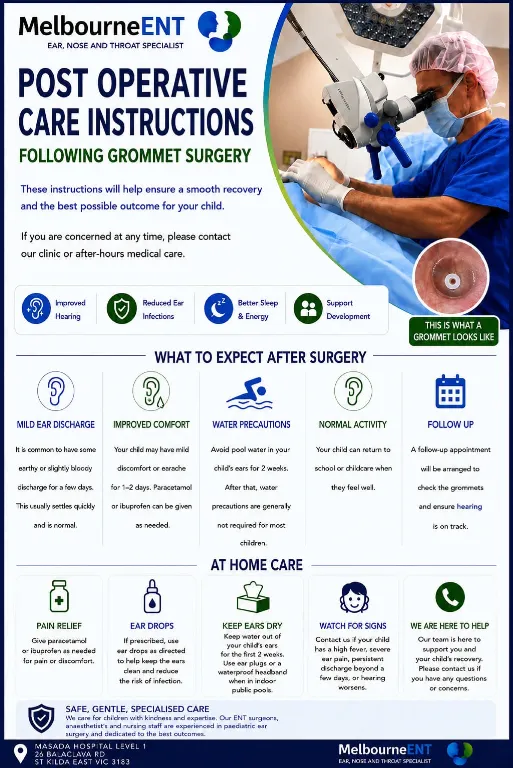
Download Post Operative Care Instructions
Grommets vs Antibiotics: A Balanced Comparison
The table below offers a clear side-by-side summary of how both approaches compare. It is designed to support the conversation you will have with Dr Simon Braham at Melbourne ENT – not to replace it.
| DIMENSION | ANTIBIOTICS VS GROMMETS |
|---|---|
| Mechanism | Antibiotics target bacteria in the active infection. Grommets restore middle ear ventilation and drainage, addressing the conditions that allow infection to occur. |
| Duration of benefit | Antibiotics are effective for the current course only. Grommets provide continuous ventilation for 6 to 12 months or longer. |
| Impact on hearing | Antibiotics reduce inflammation but do not drain fluid or restore hearing. Grommets restore hearing within days to weeks. |
| Recurrence risk | Antibiotics have no impact on recurrence risk once the course ends. Grommets significantly reduce the frequency and severity of future infections. |
| Antibiotic exposure | Each oral course adds to cumulative antibiotic burden. Post-grommet infections are typically managed with targeted ear drops only. |
| Infection presentation | Without grommets: severe ear pain, fever, systemically unwell. With grommets: painless discharge, less severe, more easily managed. |
| Best suited for | Antibiotics: isolated or first-time acute infections. Grommets: recurrent infections, persistent glue ear, documented hearing loss, developmental concerns. |
When Is It Time to See an ENT Specialist?

There is no single moment at which the answer becomes obvious, but clear clinical signals exist. The most widely cited threshold is three or more documented ear infections within six months, or four or more within twelve months. Persistent glue ear that has not resolved after three months of watchful waiting – particularly with associated hearing loss or speech concerns – also warrants specialist review. Other important signals include a child who seems consistently inattentive at school, mishears frequently, or has had teacher or maternal child health nurse concerns raised about language development. Adults who have completed multiple antibiotic courses without lasting resolution, or who experience a persistent blocked or hearing sensation, should also seek specialist assessment.
A first consultation with Dr Simon Braham at Melbourne ENT is a thorough and unhurried appointment. It includes detailed examination of both ears under a microscope, assessment of the eardrum’s movement, a full review of the infection history, and formal hearing assessment where indicated. Patients and families consistently describe the experience as clarifying. Melbourne ENT sees patients from across metropolitan Melbourne, including Brighton, Caulfield, Prahran, South Yarra, Glen Eira, Stonnington, Port Phillip, and the broader eastern and southern suburbs. GP referrals from across Victoria are welcomed.
Making the Right Decision for Your Family
Ear infections are among the most common health concerns affecting Australian children – but common does not mean inevitable, and recurrent does not mean untreatable. Antibiotics and grommets serve genuinely different purposes: antibiotics are a valuable first response to an isolated acute infection, while grommets address the structural and physiological problem that allows infections to keep recurring. When the pattern of recurrence, the persistence of glue ear, or the impact on hearing and development has made it clear that conservative management alone is no longer serving the patient well, grommet surgery offers a well-evidenced, safe, and often transformative path forward.
Dr Simon Braham, ENT and Head and Neck Surgeon and Fellow of the Royal Australasian College of Surgeons, brings a careful, individualised approach to every patient. The goal is always the same: to give patients and families the clearest possible understanding of their situation and their options. If recurring ear infections are affecting your child’s hearing, development, or your family’s quality of life – or if you are an adult with persistent ear concerns that have not resolved with conventional management – it is time to seek a specialist opinion. Melbourne ENT, located in St Kilda East, Victoria, is here to help.

FAQs About Grommets and Ear Infections
My child passed their newborn hearing screen – does that mean glue ear cannot be affecting their hearing now?
This reflects a genuinely common misunderstanding. The newborn hearing screen is designed to detect congenital sensorineural hearing loss – a permanent, structural deficit in the inner ear or auditory nerve. It is a one-time snapshot taken in the first days of life, and it tests the inner ear’s response to sound, not the middle ear’s ability to conduct it. Glue ear develops over time, typically in response to repeated upper respiratory infections and Eustachian tube dysfunction – it has nothing to do with the newborn screen result. A child who passed their newborn hearing check can absolutely develop significant conductive hearing loss from glue ear at age two, three, or four. Any concern about hearing after the newborn period warrants fresh assessment.
If glue ear often resolves on its own, why would I consider surgery rather than simply waiting?
Watchful waiting is the right first step for most cases of glue ear, and around 80 to 90 percent of cases do resolve spontaneously within three months. The question is not whether to wait, but what the cost of waiting is for this child at this stage of development. For a three-year-old experiencing four to six months of significantly reduced hearing during a period of rapid language acquisition, the developmental opportunity cost is real. When a specialist recommends grommets rather than continued observation, it is because the balance of risks has shifted – the potential harm of ongoing hearing impairment outweighs the modest surgical risk involved.
Can a middle ear infection spread to the brain or cause permanent damage if it is not treated promptly?
Serious complications of acute otitis media – including mastoiditis, meningitis, or intracranial abscess – do exist but are rare with accessible antibiotic treatment and modern paediatric care. Warning signs that require urgent medical attention include: redness, swelling or tenderness over the bone behind the ear; a child who is extremely unwell, lethargic, or stiff-necked; sudden worsening of symptoms after apparent improvement; or one-sided facial weakness. If any of these features are present, seek urgent medical care rather than a scheduled appointment. For routine recurrent infections without these features, the risk of serious complications is very low.
My child has had grommets before and they did not seem to help – why would a second set be any more effective?
This is an important clinical question that requires looking carefully at what happened the first time. Short-stay grommets can extrude earlier than expected – sometimes within three to four months – before Eustachian tube dysfunction has had time to resolve. A longer-stay grommet design may be more appropriate for a second insertion. In other cases, the grommet may have become blocked, or an unaddressed contributor – such as adenoid hypertrophy obstructing the Eustachian tube opening – may have undermined the outcome. Adenoidectomy performed alongside grommet insertion is shown in clinical studies to reduce repeat insertions. A specialist review by Dr Braham at Melbourne ENT will assess the full picture and determine whether a revised surgical approach is warranted.
Will my child still be able to hear properly between infections even without grommets, or is the hearing loss constant?
The answer varies considerably depending on the nature of the problem. In acute otitis media, hearing between episodes is often relatively normal – impairment occurs primarily during the active infection. In glue ear, however, the hearing loss tends to be more persistent and less clearly episodic. The thick fluid behind the eardrum does not clear quickly between episodes, and the child may be living with a constant, low-grade hearing reduction that parents and teachers have gradually come to accept as their baseline. This silent, continuous impairment is often more developmentally significant than the acute painful episodes precisely because it generates no obvious distress. A formal hearing assessment through Melbourne ENT will clarify what is happening between as well as during infections.
Is there anything we can do at home to reduce how often ear infections occur, or does it all come down to anatomy?
Anatomy and Eustachian tube immaturity are the primary drivers of recurrent otitis media, and no supplement or remedy reliably alters the structural basis of the problem. However, there are evidence-supported modifiable risk factors. Breastfeeding, where possible, has a well-established protective effect on middle ear health in infancy. Avoiding cigarette smoke in the household significantly reduces respiratory infection frequency and severity. Minimising dummy use beyond six months of age is associated with a modest reduction in recurrence risk. Keeping children up to date with the pneumococcal conjugate vaccine and annual influenza vaccine reduces the burden of the pathogens most commonly responsible for triggering AOM. These measures will not eliminate the problem for a child with significant Eustachian tube dysfunction, but they can meaningfully reduce infection frequency.
How do I explain a grommet operation to my child so they are not frightened?
Children respond remarkably well to simple, honest, age-appropriate explanations – and they sense when something is being minimised. For younger children, the key messages are straightforward: a tiny helper is going in the ear to help it feel better, it happens during a special sleep, and mum or dad will be right there when they wake up. Most children are disoriented for only a few minutes after the brief anaesthetic and are asking for a snack within the hour. For older children, you can describe the grommet as a tiny tube – no bigger than a sesame seed – that lets air into the ear so nasty fluid cannot build up. Being honest about what it will not feel like also helps: there is no needle near the ear, they will not feel or hear the procedure, and they will not feel the grommet once it is in place. The Melbourne ENT team, including Dr Simon Braham, is experienced in supporting children through this process and will always take time to answer any questions your child has.
Medical References:
- Reduction of Antibiotic‐Associated Conditions After Tympanostomy Tube Placement in Children – The Laryngoscope / NIH
https://pmc.ncbi.nlm.nih.gov/articles/PMC11635148/ - Topical or oral antibiotics in childhood acute otitis media and ear discharge: a randomized controlled non-inferiority trial – Family Practice (Oxford Academic) / University of Oxford
https://academic.oup.com/fampra/article/41/5/857/7697760 - Grommets (ventilation tubes) for recurrent acute otitis media in children – Cochrane Database of Systematic Reviews / NIH
https://pmc.ncbi.nlm.nih.gov/articles/PMC6494623/ - Ventilation tubes (grommets) for otitis media with effusion (OME) in children – Cochrane Database of Systematic Reviews / NIH
https://pmc.ncbi.nlm.nih.gov/articles/PMC10646987/ - Grommets (ventilation tubes) for recurrent acute otitis media in children – Cochrane Database / PubMed NIH
https://pubmed.ncbi.nlm.nih.gov/29624209/ - Antibiotics versus non‐antibiotic treatments for acute otitis media in children – Clinical Otolaryngology / Wiley Medical Journal
https://onlinelibrary.wiley.com/doi/10.1111/coa.14084 - Ventilation tubes (grommets) for otitis media with effusion (OME or ‘glue ear’) in children – Cochrane Library
https://www.cochrane.org/CD015215_ENT_ventilation-tubes-grommets-otitis-media-effusion-ome-or-glue-ear-children
Take The Next Step
Book a Consultation with Dr Simon Braham at Melbourne ENT
To book a consultation, contact Melbourne ENT directly by phone or visit the contact us page to request an appointment online. GP referrals are welcome, and patients are seen from across Melbourne and Victoria.
Melbourne ENT – St Kilda East, Victoria
Dr Simon Braham Enquiries: (03) 9038 1311
Further Reading
- Read more about Ear Concerns In Children Melbourne
- Read more about Sudden Hearing Loss – An Otologic Emergency
- Read more about Ear Ache
- Read Melbourne ENT’s Blog on Do you have Ear Pain when Flying? – Effects of Barotrauma
- Read Melbourne ENT’s Blog on Middle Ear Aeration Methods: How Can They Help?
- Read Melbourne ENT’s Blog on How to Use Hydrogen Peroxide Ear Drops
- Read Melbourne ENT’s Blog on Using the NOSE Scale Score to assess Nasal Obstruction
Download Ear Tube Journey with Dr Braham

What is Otitis Externa? (Swimmer’s Ear)
Otitis externa, more commonly referred to as swimmer’s ear, is one of the most frequent…

Summer Ear Health Tips for Children Who Swim
Summer in Melbourne often means long days by the pool, swimming lessons, and family trips…

Why Ear Infections Spike In Summer And How To Prevent Swimmer’s Ear
Summer in Melbourne usually means warm evenings at St Kilda Beach, endless laps at local…