

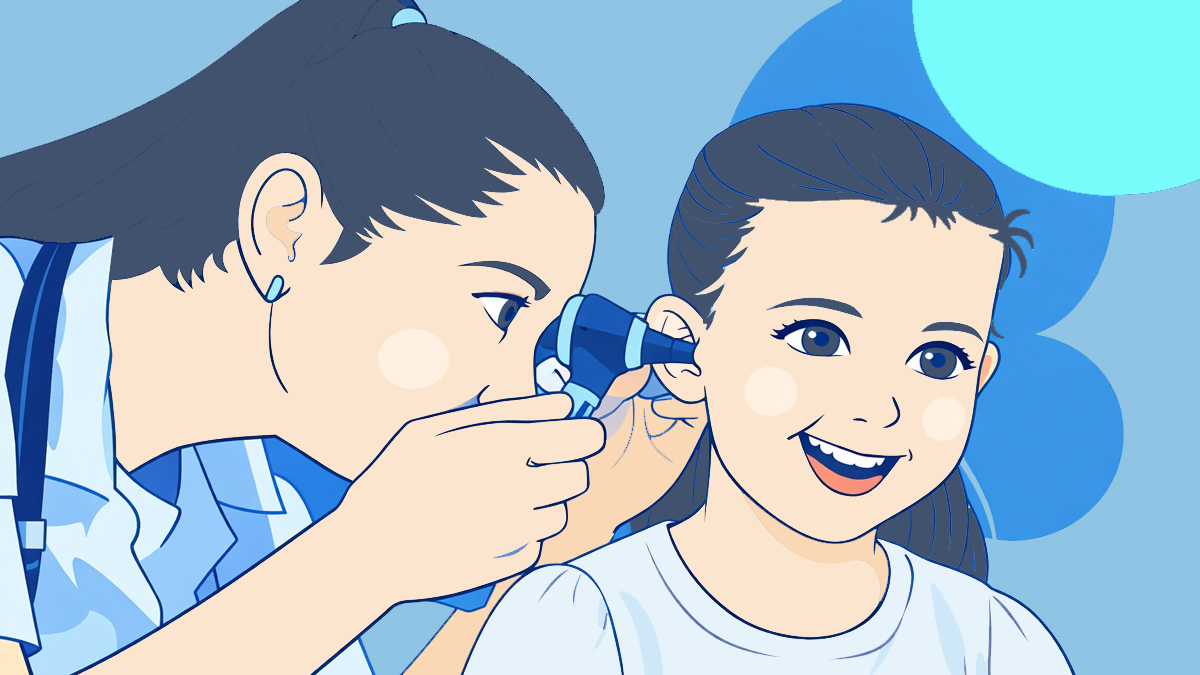
At Melbourne ENT, located in St Kilda East, Victoria, Dr Simon Braham – ENT and Head and Neck Surgeon (FRACS) – provides specialist care for glue ear and hearing loss in children and adults across Melbourne, regional Victoria and surrounding areas.
This article is general information only and does not replace advice from your own doctor or specialist. Glue ear is one of the most common conditions seen by ear, nose and throat surgeons, yet it often goes undetected for months because it develops silently and without pain. For children in the critical early years of language development, that silent period of reduced hearing can affect speech, literacy and confidence in ways that extend well beyond the ear itself. This guide explains what glue ear is, how it is diagnosed and treated, and how grommet surgery may be considered when persistent glue ear is affecting hearing.
What Is Glue Ear?
✓ Understanding Otitis Media with Effusion
Glue ear – known medically as otitis media with effusion (OME) – is a build-up of thick, sticky fluid in the middle ear. The middle ear is normally an air-filled space that contains three tiny bones responsible for transmitting sound vibrations to the inner ear. It stays ventilated through the Eustachian tube, a narrow channel connecting the middle ear to the back of the nose and throat. When this tube fails to open and close properly, negative pressure builds and fluid accumulates behind the eardrum. Over time that fluid becomes progressively thicker and more viscous, which is how the condition earned its descriptive name.
Unlike an acute ear infection, glue ear is usually painless, which is precisely why it so often goes unnoticed. There is no fever, no obvious distress and no clear signal that anything is wrong. Studies suggest that up to 80 per cent of children will experience at least one episode of glue ear before they begin primary school, making it the most common cause of hearing loss in Australian children. The condition can affect one ear or both, it can fluctuate over weeks and months, and it can resolve spontaneously – or persist and cause lasting harm if left unmanaged.
Why Glue Ear Causes Hearing Loss
Sound reaches the inner ear through a carefully coordinated mechanical process. Vibrations travel from the eardrum through the three ossicles – the malleus, incus and stapes – before being converted into electrical signals by the cochlea. For this chain to work efficiently, the middle ear must be filled with air. When fluid is present, the eardrum loses its freedom of movement and the ossicles are dampened. The result is a conductive hearing loss that typically falls between 25 and 40 decibels – roughly equivalent to listening through cotton wool or with soft earplugs in place.
For young children, this level of hearing reduction during the preschool years is far more consequential than the same loss would be in an adult. The developing brain is dependent on rich, clear auditory input to build vocabulary, acquire grammar, develop phonological awareness and establish the foundations of early literacy. A child who spends the critical period between ages one and five hearing a muffled, impoverished version of spoken language may arrive at school already behind their peers in ways that are difficult to attribute and harder still to remedy quickly. When clinically appropriate, treatment may improve hearing while middle-ear ventilation is restored.
Recognising the Symptoms of Glue Ear
✓ Signs in Children
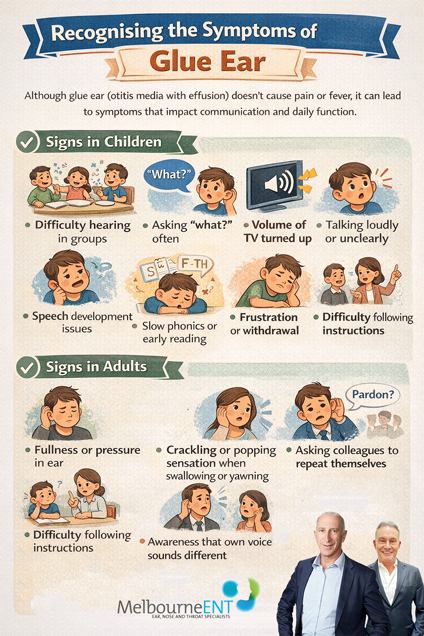
Because glue ear does not cause pain, its symptoms are behavioural and developmental rather than obviously medical. Parents and teachers are frequently the first to raise a concern. Children with glue ear commonly ask for things to be repeated, turn the television up louder than others find comfortable, appear not to respond when called from another room, or consistently mishear words and phrases. They may speak unusually loudly, watch faces carefully to compensate for what they cannot hear, or seem vague and disengaged in group settings where background noise makes listening especially difficult.
Speech development that plateaus or regresses, difficulty producing quieter consonants such as s, f and th, slow progress in phonics and early reading, and frustration or withdrawal in social situations are all potential signs of a persistent hearing reduction. Many parents first hear a concern raised by a teacher rather than noticing it at home, particularly in children who have adapted well in quiet one-on-one environments. This makes it all the more important that any concern from a school setting is followed up with a formal hearing assessment promptly.
✓ Signs in Adults
Adults with glue ear typically describe a sensation of fullness or pressure in the affected ear, muffled hearing and a crackling or popping sensation when swallowing or yawning. Difficulty following conversations in noisy environments, a need to ask colleagues to repeat themselves and an awareness that their own voice sounds different are also common. Unilateral OME in an adult – fluid in one ear only – warrants careful specialist assessment, as it can occasionally be associated with an underlying structural cause near the Eustachian tube opening that requires investigation.
What Causes Glue Ear? Common Risk Factors
Glue ear arises from Eustachian tube dysfunction, which prevents adequate ventilation of the middle ear. In young children, the tube is shorter, narrower and more horizontal than in adults, making it far more susceptible to obstruction by mucus, inflammation and adenoid tissue. This is the primary reason why glue ear is so much more common in early childhood than in later life. Recurrent upper respiratory infections, which are an inevitable part of the early years for children in childcare and school settings, are a major driver. Each viral illness inflames the Eustachian tube lining and disrupts drainage, and when infections follow one another closely the middle ear may never fully recover its normal air pressure between episodes.
Enlarged adenoids, allergic rhinitis and chronic sinusitis all contribute to persistent Eustachian tube dysfunction. Melbourne’s spring pollen season and winter respiratory season are both associated with higher rates of glue ear presentation across Victoria. Passive smoke exposure is a well-documented and preventable risk factor. Structural differences associated with conditions such as cleft palate and Down syndrome carry a significantly higher risk and may warrant a more proactive approach to management from an earlier stage.
How Glue Ear Is Diagnosed at Melbourne ENT
✓ Otoscopy, Tympanometry and Audiometry
At Melbourne ENT in St Kilda East, Dr Simon Braham uses a structured diagnostic approach that combines clinical history, direct examination and objective testing. A careful history is taken first, covering the duration and pattern of hearing concerns, any previous ear infections or grommet insertions, speech and language development, school performance and associated conditions such as nasal allergies or recurrent colds.
Otoscopy – direct visualisation of the eardrum – reveals the characteristic changes of glue ear: a dull, amber-tinged or retracted eardrum rather than the normal pearlescent, mobile membrane. Tympanometry follows, measuring how the eardrum responds to controlled changes in air pressure. The flat type B tympanogram is one of the most reliable objective signs of middle ear fluid and can be obtained in very young children without requiring active cooperation.
Audiometry – formal hearing testing – is then tailored to the child’s age, using visual reinforcement audiometry for infants, play audiometry for toddlers and preschoolers, and pure-tone audiometry for older children and adults. Together, these three tests provide a thorough and accurate picture of both the presence of glue ear and its impact on hearing. Dr Simon Braham holds public appointments at the Royal Victorian Eye and Ear Hospital in East Melbourne and brings the clinical standards of that institution to his practice at Melbourne ENT.
Treatment Options for Glue Ear and Hearing Loss in Melbourne
✓ Watchful Waiting
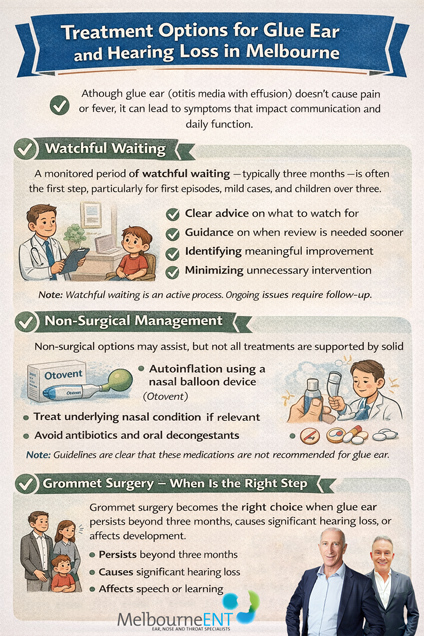
Many episodes of glue ear resolve without intervention, particularly first episodes in children over three years of age where hearing loss is mild and development is not being affected. A monitored period of watchful waiting – typically three months – is a clinically appropriate first step in these circumstances. Dr Braham provides clear guidance during this period, including what signs to watch for and what would prompt an earlier review. Watchful waiting is an active clinical decision, not a passive approach.
✓ Non-Surgical Management
Autoinflation using a nasal balloon device such as the Otovent has evidence for short-term hearing improvement in children old enough to use the technique reliably, generally from around four to five years of age. Where allergic rhinitis or chronic sinusitis is contributing to Eustachian tube dysfunction, treating the underlying nasal condition with topical corticosteroid sprays or appropriate allergy management may assist in clearing the effusion. It is important to note that antibiotics, oral decongestants and oral corticosteroids are not recommended treatments for glue ear itself. Current guidelines are clear that their potential benefits do not outweigh their risks in this condition.
✓ When Grommet Surgery May Be Considered
When fluid persists beyond three months, affects both ears, causes significant hearing loss or is clearly impacting a child’s speech or learning, grommet surgery becomes the most appropriate and evidence-based course of action. Continuing to observe while development is being compromised carries its own risks. At this point, the goal is to restore normal hearing as promptly and reliably as possible.
Grommet Surgery in Melbourne: What to Expect
✓ What Are Grommets?
Grommets are tiny hollow tubes – typically 1 to 2 millimetres in diameter and made from medical-grade silicone, Teflon or titanium – that are inserted through a small incision in the eardrum to provide a direct airway between the ear canal and the middle ear. They bypass the dysfunctional Eustachian tube, immediately equalise pressure, allow accumulated fluid to drain and maintain ventilation for as long as the tube remains in position. Hearing may improve after the procedure, and many families describe a striking change in their child’s responsiveness and engagement within days of surgery.
✓ The Surgical Procedure
Grommet insertion is performed as a day procedure under a brief general anaesthetic at Masada Private Hospital in St Kilda East. Dr Simon Braham uses a microscope for precise visualisation of the eardrum. A small myringotomy incision is made, any middle ear fluid is gently aspirated, and the grommet is placed. Both ears can be treated in the same session. The procedure takes approximately 15 to 20 minutes. Most children are alert and ready to go home within a few hours of waking from the anaesthetic, and the vast majority return to school or childcare the following day.
✓ How Long Do Grommets Last?
Standard grommets are designed to extrude naturally as the eardrum heals, usually within 6 to 18 months. By the time extrusion occurs in most children, Eustachian tube function has matured sufficiently to maintain the middle ear independently. Approximately 20 to 30 percent of children require a second set if glue ear recurs. For children requiring multiple sets, longer-lasting T-tube grommets may be considered. Dr Braham discusses the likelihood of recurrence with each family at their consultation.
✓ Grommets and Adenoidectomy – When Both Are Recommended
For children being considered for a second set of grommets, the addition of adenoidectomy is frequently recommended. The adenoids sit in close proximity to the Eustachian tube openings and are a significant contributor to persistent dysfunction. Evidence supports the combined approach: adenoidectomy alongside grommet insertion reduces the likelihood of further OME recurrence and decreases the need for additional procedures. Both operations are performed together under the same single anaesthetic as a day procedure.
Recovery After Grommet Surgery: What Parents Need to Know
✓ Water Precautions
Current evidence does not support the routine use of earplugs for everyday bathing, hair washing or showering. Normal bathing can resume promptly after surgery in most children. Swimming in clean, well-chlorinated pools is generally acceptable, though diving and swimming in natural waterways should be avoided for as long as the grommets are in place. Dr Braham provides individualised water precaution guidance at the post-operative review, taking into account the type of tube inserted and the child’s specific activities.
✓ Follow-Up Care
A post-operative hearing test is scheduled at six weeks after surgery at Melbourne ENT to confirm the grommets are functioning and that hearing has been restored. Subsequent reviews monitor grommet position, check for any ear discharge and assess middle ear health. At the point of grommet extrusion, hearing is formally reassessed to confirm that middle ear function has been maintained. Children who have experienced glue ear-related speech or language delays often catch up quickly once hearing is fully restored, and Dr Simon Braham considers a referral to a speech pathologist where there is evidence of ongoing developmental impact.
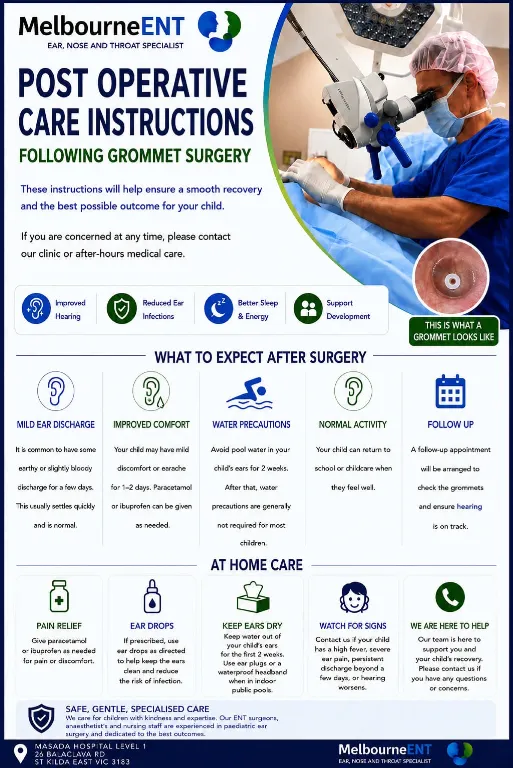
Download Post Operative Care Instructions
What Happens If Glue Ear Is Left Untreated?
For most children, glue ear is a self-limiting condition that resolves without lasting harm. However, when it persists without appropriate management during the preschool years, the consequences can extend across speech, language, literacy and social development in ways that take considerable time and specialist support to address. Structurally, prolonged negative middle ear pressure can cause the eardrum to retract inward, and in rare cases these retraction pockets can progress to cholesteatoma – an abnormal accumulation of skin tissue in the middle ear that erodes surrounding bone and requires surgical treatment. Tympanosclerosis, the deposition of calcium in the eardrum in response to chronic inflammation, may also develop. In adults, persistent unilateral glue ear without a clear reversible cause warrants specialist assessment to exclude an underlying structural cause near the Eustachian tube opening.
Medicare and Your Coverage for Grommet Surgery
Medicare provides a rebate for grommet insertion when it is performed as a medically necessary procedure for otitis media with effusion or recurrent middle ear infections. The relevant Medicare Benefits Schedule item number for myringotomy with ventilation tube insertion is 41632. Adenoidectomy, when performed in conjunction with grommet surgery, is covered under MBS item 41789 or the applicable combination item. Specialist consultation fees with Dr Simon Braham attract a Medicare rebate under the relevant attendance item numbers, and a valid GP or specialist referral is required.
Patients with private health insurance that includes hospital cover can generally access grommet surgery and adenoidectomy with the hospital component largely or fully covered, subject to any applicable excess or co-payment. The surgeon’s fee may include a gap above the Medicare schedule rate, and this is communicated clearly to families before any procedure is scheduled. Melbourne ENT provides written financial information in advance of surgery so there are no unexpected costs. Patients without private insurance can access grommet surgery through the public system via a referral to the ENT outpatient service at hospitals including the Royal Victorian Eye and Ear Hospital, though waiting times in the public system are often considerably longer than in the private setting.
Why Choose Melbourne ENT for Glue Ear and Grommet Surgery?
At Melbourne ENT in St Kilda East, Dr Simon Braham – ENT and Head and Neck Surgeon, FRACS (Fellow of the Royal Australasian College of Surgeons) – brings fellowship-level training, a special interest in paediatric ear surgery and a genuinely child-friendly clinical manner to every consultation. Dr Braham completed his medical degree with honours at Monash University and undertook advanced training in New York and Boston before returning to Melbourne. He holds appointments at Masada Private Hospital in St Kilda East, the Royal Victorian Eye and Ear Hospital in East Melbourne and Kyneton Hospital in regional Victoria, and his approach to care is grounded in the most current international clinical guidelines.
Melbourne ENT is committed to thorough, clear and compassionate care tailored to each patient. Conservative management is always considered before surgery is recommended, and all decisions are made with full transparency and genuine patient input. Families consulting from across Melbourne and regional Victoria can expect an unhurried, evidence-based assessment and a clear plan that places the well-being of their child or themselves at the centre of every clinical decision.

FAQs About Glue Ear and Hearing Loss
My child passed their newborn hearing screen but now seems to be struggling to hear. Could glue ear develop after a normal result at birth?
Yes, and this is a very common source of confusion. The newborn hearing screen tests for sensorineural hearing loss – a problem arising from the inner ear or auditory nerve – that is present from birth. Glue ear is a conductive hearing loss that develops later in childhood in response to Eustachian tube dysfunction and respiratory infections. A completely normal newborn screen provides no protection against glue ear in the years that follow. A child who heard perfectly well at birth can develop significant hearing loss from glue ear by the age of two or three, which is why any new concern about hearing at any age deserves formal assessment regardless of earlier results.
Can glue ear affect only one ear, and does that still matter if the other ear seems to be working normally?
Unilateral glue ear is entirely possible and is frequently underestimated. When one ear is normal, it is tempting to assume the child will compensate. In practice, the brain relies on input from both ears to accurately locate where sounds are coming from. When one ear is impaired, this binaural hearing ability is compromised, making it harder to follow a single voice against background noise. A child with unilateral glue ear may perform well in a quiet one-on-one setting yet struggle significantly in a noisy classroom. Assessment is worthwhile for unilateral cases, particularly when the effusion has persisted for more than three months.
How can I tell the difference between my child being inattentive and a hearing problem caused by glue ear?
This is one of the most important questions parents can ask, because the two conditions can present almost identically. Both can produce a child who appears to ignore instructions, drift in group activities and struggle to concentrate. The key distinction is context. A child with glue ear will typically respond much better in quiet, one-on-one settings where visual cues are available, and will struggle specifically in noisy, reverberant environments like classrooms and playgrounds. They may also lip-read without awareness of doing so. Any child who is being assessed for attention or learning difficulties should have a formal hearing test and tympanometry before other diagnoses are pursued, as addressing an underlying hearing loss can sometimes resolve the apparent behavioural concerns entirely.
If my child has already had grommets and the glue ear has come back, does that mean the first surgery did not work?
Not at all. The return of glue ear after natural grommet extrusion is not a sign that the first surgery failed. The grommets achieved exactly what they were designed to do: they restored hearing, maintained middle ear health and protected a critical developmental window for the duration they were in place. The recurrence of fluid after extrusion reflects the fact that the underlying Eustachian tube dysfunction has not yet fully resolved, which is a maturational process that continues throughout childhood. A second set of grommets is a well-established clinical response, and at this stage the addition of adenoidectomy is frequently recommended to address one of the most common contributors to recurrent dysfunction and reduce the need for further procedures.
Can diet, feeding practices or environmental changes reduce the risk of glue ear developing or coming back?
There is genuine evidence supporting certain preventive strategies, though none guarantees immunity. Eliminating passive smoke exposure in the home and car is one of the most evidence-supported steps parents can take. Breastfeeding in infancy is associated with lower rates of middle ear disease. Managing nasal allergies appropriately reduces the chronic inflammation that impairs Eustachian tube function. Keeping immunisations current reduces the frequency and severity of the respiratory infections that trigger episodes. Nasal saline rinses help keep the nasal passages clear and reduce the inflammatory burden on the Eustachian tube. None of these steps will prevent every episode, but collectively they represent a meaningful and evidence-informed approach for children known to be susceptible.
After grommets are inserted, will hearing restoration automatically fix my child’s speech delay, or is speech therapy still needed?
Grommet surgery removes the physical barrier to further language development and restores access to clear auditory input from that point onwards. However, for children who have experienced a prolonged period of hearing loss during a critical developmental window, the gaps that have accumulated in vocabulary, phonological awareness and speech sound production do not automatically close the moment hearing returns. The brain needs time and quality auditory experience to consolidate what was missed, and some children benefit considerably from targeted speech and language therapy to accelerate that catch-up process. Dr Braham routinely considers a referral to a speech pathologist for children who show signs of speech or language delay related to their glue ear, and families are encouraged to raise communication concerns directly at their Melbourne ENT consultation.
At what age do most children grow out of glue ear, and is there a point at which it stops being a concern?
The peak incidence of glue ear is between the ages of one and five years. As children grow and their facial skeleton matures, the Eustachian tube gradually lengthens, becomes more vertically oriented and begins to function more efficiently. By the age of seven or eight, the majority of children with a history of glue ear no longer require ongoing intervention. However, waiting for this natural resolution is not always the right approach. The years between birth and school entry are the most sensitive period for language and learning development, and allowing hearing loss to persist untreated throughout this window in the hope of eventual spontaneous resolution can have consequences that are far harder to address later. The question of when to treat and when to watch is best answered through an individualised assessment with Dr Simon Braham at Melbourne ENT.
Medical References:
- Blood Inflammatory Markers as Predictors of Effusion Characteristics and Postoperative Hearing Outcomes in Children with Otitis Media with Effusion: A Retrospective Study / Medicina
https://pmc.ncbi.nlm.nih.gov/articles/PMC12471527/ - The wicked problem of otitis media: summary of recent systematic reviews on otitis media with effusion / Paediatric Respiratory Reviews
https://pubmed.ncbi.nlm.nih.gov/40441925/ - Otitis Media With Effusion in Children: Guidelines From NICE / American Family Physician
https://www.aafp.org/pubs/afp/issues/2024/0900/practice-guidelines-otitis-media-with-effusion.pdf - Ventilation tubes (grommets) for otitis media with effusion (OME) in children / Cochrane Database of Systematic Reviews
https://pmc.ncbi.nlm.nih.gov/articles/PMC10646987/ - Clinical manifestations and outcomes of otitis media with effusion in adult patients with COVID-19: a retrospective study / Scientific Reports
https://pmc.ncbi.nlm.nih.gov/articles/PMC11293243/ - Acute and Chronic Otitis Media/Glue Ear and Indications for Grommets / Hertfordshire and West Essex NHS
https://www.hweclinicalguidance.nhs.uk/clinical-pathways/acute-and-chronic-otitis-mediaglue-ear-and-indications-for-grommets/ - A Sticky Situation: Case Series of Successful Treatment of Glue Ear With Dupilumab / Annals of Otology, Rhinology & Laryngology
https://pubmed.ncbi.nlm.nih.gov/40360240/
Concerned About Glue Ear or Hearing Loss? Take the Next Step
If you are worried about your child’s hearing, have noticed signs that may be related to glue ear, or are an adult experiencing persistent ear fullness or muffled hearing, early specialist assessment is the most important step you can take. Glue ear and hearing loss identified and treated promptly carries a far better developmental prognosis than the same condition left unaddressed. The team at Melbourne ENT in St Kilda East is ready to help patients from across Melbourne and regional Victoria.
To arrange a consultation with Dr Simon Braham, ENT and Head and Neck Surgeon at Melbourne ENT, please visit the website or contact the rooms directly. A referral from your GP or specialist is required to book an appointment and to access Medicare rebates for the consultation and any associated procedures. Early action makes a meaningful difference, and quality of life – for a child who can finally hear clearly in the classroom, or an adult no longer feeling cut off from conversation – is the outcome that drives everything at Melbourne ENT.
Further Reading
- Read more about Swimmer’s Ear (Otitis Externa)
- Read more about Middle Ear Infection (AOM)
- Read more about Ear Ache
- Read Melbourne ENT’s Blog on Do you have Ear Pain when Flying? – Effects of Barotrauma
- Read Melbourne ENT’s Blog on Middle Ear Aeration Methods: How Can They Help?
- Read Melbourne ENT’s Blog on Summer Ear Health Tips for Children Who Swim
- Read Melbourne ENT’s Blog on Flying This Summer? Protecting Your Ears And Sinuses From Barotrauma
Download Ear Tube Journey with Dr Braham

How to Use Hydrogen Peroxide Ear Drops
Ear health is often something people do not think about until there is a problem….

Middle Ear Aeration Methods: How Can They Help?
Hearing is one of the most important senses for both children and adults. From a…
What is Otitis Externa? (Swimmer’s Ear)
Otitis externa, more commonly referred to as swimmer’s ear, is one of the most frequent…