


When is grommet surgery recommended?
Grommet surgery may be considered when fluid in the middle ear persists, hearing is affected, or recurrent infections impact quality of life. The decision depends on factors such as duration of symptoms, severity, and response to previous treatment.
Ear problems can affect far more than the ears alone. In children, they may influence hearing, listening, sleep, classroom participation, or day-to-day communication at home. In adults, they may lead to blocked ears, fluctuating hearing, discomfort during flights, or a persistent sense that the ears never fully clear. When these symptoms continue, one of the questions that may arise is whether grommet surgery should be considered.
At Melbourne ENT in St Kilda East, Victoria, Dr Simon Braham, ENT and Head & Neck Surgeon, assesses children and adults with a range of ear concerns, including middle ear fluid, recurrent ear infections, hearing changes, and ongoing pressure-related symptoms. The decision to consider grommet surgery is based on the individual clinical picture. It is not determined by one symptom alone, and it is not appropriate for every patient with ear complaints. A specialist consultation with Dr Simon Braham is usually focused on understanding the cause of the problem, how long it has been present, what effect it is having, and whether a procedure may be a reasonable part of management.
This is one of the reasons the topic is often more complex than patients first expect. Some people assume that recurrent ear infections automatically mean grommets are needed. Others assume that persistent fluid behind the eardrum will always settle on its own. In practice, the answer is often somewhere in between. Good ENT care is not about choosing the quickest answer. It is about making a measured assessment based on symptoms, examination findings, hearing, medical history, and the effect on daily life.
What Grommet Surgery Is and Why It May Be Discussed
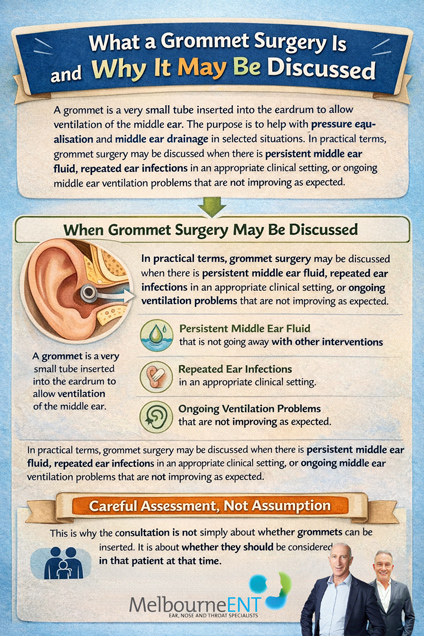
A grommet is a very small tube inserted into the eardrum to allow ventilation of the middle ear. The purpose is to help with pressure equalisation and middle ear drainage in selected situations. In practical terms, grommet surgery may be discussed when there is persistent middle ear fluid, repeated ear infections in an appropriate clinical setting, or ongoing middle ear ventilation problems that are not improving as expected.
Although grommets are commonly associated with children, they may also be considered in adults in selected circumstances. The reasons can differ from one age group to another, but the principle is the same. The question is whether the condition is likely to benefit from improved middle ear ventilation, and whether a procedure is appropriate after considering other options and the natural course of the problem.
This is why the consultation is not simply about whether grommets can be inserted. It is about whether they should be considered in that patient at that time. At Melbourne ENT, Dr Simon Braham approaches this discussion through careful assessment rather than assumption, with attention to the patient’s symptoms, hearing, examination findings, and overall clinical history.
Why Different Ear Problems Can Feel Similar
From a patient’s point of view, many ear conditions sound alike. A child may not seem to hear clearly. An adult may complain of pressure, crackling, popping, or blocked ears. A parent may describe repeated infections, irritability, poor sleep, or difficulty hearing in the car. These symptoms can overlap, but the underlying causes are not always the same.
Some of the common situations that may lead to discussion about grommet surgery include:
- persistent middle ear fluid, often called glue ear
- recurrent acute ear infections
- Eustachian tube dysfunction
- ongoing pressure problems in the middle ear
- hearing changes associated with fluid or poor ventilation
Because these problems can present in similar ways, the first task in a specialist consultation is usually to work out what is actually happening. That means looking beyond the symptom of a blocked ear and asking more specific questions. Is there fluid behind the eardrum? Has hearing changed? Are infections continuing to recur? Has the problem started recently, or has it been present for months?
Without that level of detail, it is difficult to make a sound recommendation. This is one reason patients seeing Dr Simon Braham at Melbourne ENT are assessed with a broader ENT perspective rather than having treatment decisions based on a single symptom in isolation.
Understanding The Full History
At Melbourne ENT, assessment begins with a careful history. This often provides as much useful information as the examination itself. In children, parents may describe how often ear problems have occurred, whether hearing seems reduced, whether speech or classroom participation has changed, and how much the issue is affecting family life. In adults, the discussion may centre on ear pressure, hearing fluctuation, difficulty during air travel, or repeated symptoms after colds and sinus infections.
A specialist history often explores questions such as these:
- How long have the symptoms been present?
- Did the problem begin after a cold or infection?
- Are symptoms constant or do they come and go?
- Is there a history of repeated infections?
- Has hearing seemed muffled or inconsistent?
- Are school, work, sleep, or communication being affected?
- Has the patient already had hearing tests or previous treatment?
These details matter because not every short-term ear problem needs intervention. Some conditions settle with time. Others persist and begin to affect function more clearly. The role of the consultation is to distinguish between those patterns as carefully as possible. When Dr Simon Braham reviews this history, the aim is to understand not only the medical details, but also how the problem is affecting the patient or family in practical terms.
Why Time Is Such an Important Factor
One of the most important parts of decision-making is duration. Many patients are surprised by how much weight is placed on how long the problem has been present, but this is central to safe and appropriate management.
Middle ear fluid can appear after an upper respiratory infection or an ear infection and may settle without a procedure. If symptoms are recent, immediate surgery may not be the most appropriate next step. Monitoring and review may be advised first, particularly when the issue has only been present for a short time and there is a reasonable chance that it will improve spontaneously.
That does not mean the symptoms are being dismissed. It means the natural course of the condition is being taken into account. Recommending surgery too early may expose a patient to a procedure that may not have been necessary. On the other hand, if fluid or symptoms continue over a longer period, and especially if hearing or communication is being affected, further discussion about treatment may become more relevant.
This balance is often one of the most important parts of ENT care. The question is not only whether the ear looks abnormal today. It is whether the pattern over time suggests that the problem is resolving or persisting. Dr Simon Braham considers this timing carefully when assessing whether continued review or discussion of grommet surgery is more appropriate.
Hearing Is Often Central To The Discussion
For many families, hearing is the issue that leads them to seek specialist advice. A child may not say, “I cannot hear properly”, but parents may notice other clues. Instructions may need repeating. The television volume may increase. The child may seem less responsive, particularly in noisy environments. Teachers may notice that classroom listening has become more difficult.
In adults, the concerns may be different but no less significant. There may be fluctuating hearing, the feeling that one ear is always blocked, or difficulty following conversation in meetings, restaurants, or busy settings.
This is one of the reasons hearing tests can be so helpful. A hearing assessment can provide objective information that adds context to the history and examination. It helps clarify whether middle ear fluid or poor ventilation is affecting hearing and whether that effect is mild, moderate, or more significant in practical terms.
Signs That Hearing May Be Affected
In children, families sometimes notice:
- frequent requests for repetition
- turning up the television or tablet volume
- reduced response when spoken to from another room
- appearing tired or distracted in noisy environments
- difficulty following group conversations
- concern from teachers about listening in class
In adults, the signs may include:
- one or both ears feeling blocked
- sound seeming dull or muffled
- intermittent hearing changes after colds
- difficulty hearing during work or conversation
- greater discomfort when flying or changing altitude
A hearing test is not the only factor in the decision, but it often provides an important part of the picture. At Melbourne ENT, Dr Simon Braham considers hearing results alongside examination findings and symptom history, rather than relying on one measure alone.
The Effect on Speech, Learning, and Communication
In younger children, hearing concerns may lead to a broader discussion about speech and language development. This should be approached carefully. It is not appropriate to suggest that every child with middle ear fluid will develop a speech delay or learning difficulty. Many do not. However, when hearing appears to be affected over time, the possible effect on communication and development may be relevant to the overall assessment.
For preschool children, the discussion may focus on whether speech sounds are developing as expected, whether the child is engaging comfortably in conversation, and whether there are signs that hearing inconsistency is making communication more difficult. For older children, the concern may be less about early speech and more about listening effort, attention in class, and the day-to-day challenge of hearing in busy environments.
This is where the consultation often moves beyond the ear itself. The question is not only whether fluid is present, but whether the ear problem is influencing how the child functions in everyday life. That broader view is important because treatment decisions in ENT are rarely based on anatomy alone. In this context, Dr Simon Braham may consider whether further observation, hearing review, or discussion of grommet surgery is warranted.
Recurrent Infections Are Assessed Carefully
A common assumption is that repeated ear infections automatically lead to grommet surgery. In practice, the decision is often more nuanced than that.
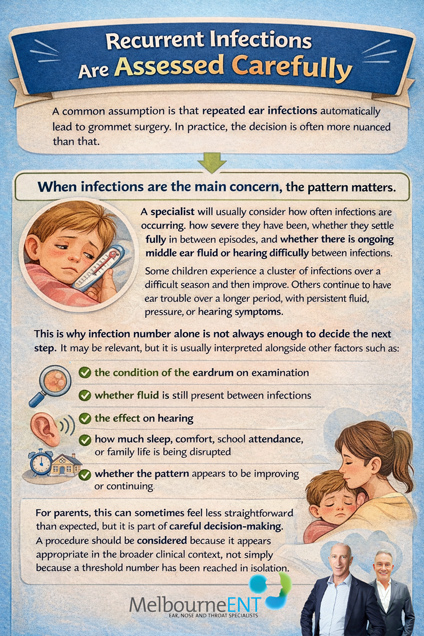
When infections are the main concern, the pattern matters. A specialist will usually consider how often infections are occurring, how severe they have been, whether they settle fully in between episodes, and whether there is ongoing middle ear fluid or hearing difficulty between infections. Some children experience a cluster of infections over a difficult season and then improve. Others continue to have ear trouble over a longer period, with persistent fluid, pressure, or hearing symptoms.
This is why infection number alone is not always enough to decide the next step. It may be relevant, but it is usually interpreted alongside other factors such as:
- the condition of the eardrum on examination
- whether fluid is still present between infections
- the effect on hearing
- how much sleep, comfort, school attendance, or family life is being disrupted
- whether the pattern appears to be improving or continuing
For parents, this can sometimes feel less straightforward than expected, but it is part of careful decision-making. A procedure should be considered because it appears appropriate in the broader clinical context, not simply because a threshold number has been reached in isolation.
What The Examination May Show
The physical examination remains a key part of the consultation. In many cases, it helps confirm whether the history fits with what is being seen in the ear.
An ENT examination may look for:
- fluid behind the eardrum
- retraction of the drum
- reduced mobility of the eardrum
- signs of ongoing pressure imbalance
- changes related to repeated infections
- the broader ear, nose, and throat picture
These findings do not stand alone. A single examination provides a snapshot. The history and, when relevant, hearing results help explain how much that snapshot matters. A small amount of fluid in a patient who has been unwell for only a short time may be approached differently from the same finding in a patient who has had symptoms for months.
This is one reason why specialist assessment can be valuable. It allows the examination to be interpreted in context rather than viewed as an isolated finding. At Melbourne ENT, Dr Simon Braham uses the examination as one part of a broader clinical assessment rather than as the sole basis for treatment decisions.
Adults May Also Be Considered For Grommet Surgery
Although grommet surgery is often associated with children, adults may also be assessed for it in selected cases. The reasons are not always identical to those seen in paediatric ENT.
Adults may present with:
- persistent middle ear pressure
- repeated fluid build-up
- fluctuating hearing
- blocked ears after respiratory infections
- Eustachian tube dysfunction
- ongoing difficulty equalising pressure, including during flights
For some adults, symptoms are intermittent but recurring. For others, the problem becomes chronic enough to affect work, comfort, communication, or travel. As in children, the decision is based on the specific clinical picture rather than the presence of one symptom alone.
A consultation may also consider whether other conditions are contributing. Nasal inflammation, sinus problems, or long-standing ventilation issues may sometimes be relevant. This is one reason the broader ENT assessment matters, rather than focusing only on the ear in isolation. Dr Simon Braham assesses these wider factors when considering whether grommet surgery may be relevant for an adult patient.
Other ENT Factors May Influence The Plan
Ear symptoms do not always occur on their own. In some children, adenoid enlargement may contribute to middle ear problems. In adults, nasal or sinus conditions may affect pressure regulation and Eustachian tube function. Mouth breathing, snoring, chronic nasal blockage, and recurrent upper airway symptoms may all provide useful context.
This does not mean that every patient with ear symptoms has a larger ENT issue that needs treatment. It simply means that ear problems sometimes sit within a broader pattern. A specialist consultation can help identify whether the concern appears isolated or whether other parts of the ENT examination are relevant.
This broader view often gives patients and families a clearer understanding of why symptoms are happening and what management options may be reasonable. At Melbourne ENT, this whole-patient approach is part of how Dr Simon Braham assesses both children and adults with ongoing ear concerns.
Why Not Every Patient Is Advised To Have Surgery
One of the most important parts of AHPRA-conscious health information is making it clear that surgery is not appropriate for everyone. Not every patient with fluid, ear pressure, or previous infections will be advised to proceed with a grommet.
In some situations, monitoring may be the most appropriate next step. This can be particularly relevant when:
- symptoms have been present for a relatively short period
- hearing is not significantly affected
- the examination suggests a recent process that may settle
- there is a reasonable possibility of spontaneous improvement
- further review or hearing assessment would provide a clearer picture before deciding on treatment
Monitoring should not be mistaken for inaction. It is often an active management plan that involves reassessment, observation of symptoms over time, and sometimes hearing review. For many patients, this may be the most appropriate path at that stage.
This is an important part of how Dr Simon Braham discusses treatment options with patients and families. The purpose of review is not to delay care unnecessarily, but to determine whether a procedure is likely to be appropriate, or whether continued observation is the better course at that time.
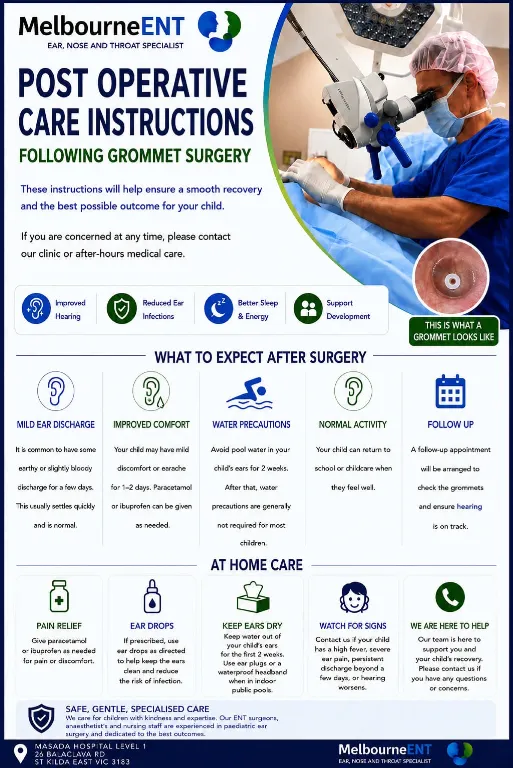
Download Post Operative Care Instructions
What is Usually Discussed If Grommet Surgery Is Being Considered
If grommet surgery is discussed, the consultation generally includes more than the procedure itself. Patients and families usually need clear information about why the operation is being considered, what issue it is intended to address, and what limitations and risks should be kept in mind.
Topics often discussed include:
- the reason the procedure is being considered
- whether the problem may still settle without surgery
- hearing findings, if relevant
- what the procedure involves
- what follow-up may be required
- possible limitations of treatment
- possible risks and complications
As with any procedure, there are issues that should be part of informed consent. These may include anaesthetic considerations, ear discharge, blockage of the tube, early extrusion, the grommet remaining in place longer than expected, or a small risk of a persistent perforation after the tube is no longer in place. The significance of these issues varies from patient to patient and is best discussed in relation to the individual case.
Presenting surgery in this balanced way is important. A procedure should not be described as routine in a way that downplays the need for proper assessment and informed decision-making.
A Step-By-Step Way To Think About The Decision
Many patients feel more comfortable when the consultation is approached in stages rather than as a simple yes or no answer. Ear problems can be frustrating, especially when they affect sleep, communication, school, work, or travel. When families have been dealing with repeated symptoms for months, they often want clarity.
A step-by-step approach can help because it separates the different parts of the decision:
- identifying the likely cause
- understanding how long it has been present
- assessing hearing where needed
- examining the ears carefully
- considering the impact on daily life
- discussing whether monitoring or a procedure is more appropriate
This approach can make the process feel more manageable and more transparent. It also reflects the way ENT decisions are often made in practice. In many cases, the right answer becomes clear only after several pieces of information are considered together.

FAQs About Grommet Surgery
Can a child still need grommet surgery even if ear infections have settled down?
Yes. In some cases, the main issue is no longer infection itself, but persistent middle ear fluid and its effect on hearing or day-to-day communication. This is one reason the decision is based on the broader clinical picture, not only on whether recent infections are still occurring.
Why might one ear need more attention than the other?
It is possible for one ear to be more affected by fluid, pressure, or poor ventilation than the other. Examination and hearing results can help clarify whether both ears are behaving similarly or whether one side is contributing more to symptoms.
Can grommets be discussed even when a child is not complaining of pain?
Yes. Pain is not always the main issue. Some children are referred because of hearing concerns, persistent fluid, or listening difficulties rather than earache.
Does swimming always become a problem after grommet surgery?
Not always. Advice can vary depending on the patient, the type of water exposure, and whether there have been previous issues with ear discharge. This is best discussed with the treating surgeon based on the individual situation.
Why do some children seem worse in noisy places than in quiet rooms?
When hearing is affected by middle ear fluid, background noise can make listening more difficult. A child may seem to hear reasonably well one-to-one at home, but struggle more in classrooms, childcare settings, or group activities.
Can seasonal colds make it look like a longer-term ear problem?
Yes. Repeated colds and upper respiratory infections can contribute to ongoing middle ear symptoms, especially in children. This is one reason ENT assessment often considers the timing and pattern of symptoms over months rather than relying on one isolated episode.
If hearing changes come and go, can grommet surgery still be discussed?
It can be, depending on the cause and how often symptoms recur. Fluctuating hearing may still warrant assessment if it is affecting school, work, communication, or everyday comfort.
Do enlarged adenoids sometimes play a role in ear problems?
Yes. In some children, adenoids may contribute to poor middle ear ventilation and ongoing ear symptoms. This is why ENT review sometimes looks beyond the ears alone and considers the broader nose and throat picture.
Can adults be considered for grommet surgery even though it is often seen as a children’s procedure?
Yes. Adults may also be assessed for grommets in selected situations, particularly where there are persistent pressure problems, fluid build-up, or ventilation issues in the middle ear. The reasons are often different from paediatric cases, so assessment is individual.
Why might an ENT surgeon recommend waiting before deciding on surgery?
Because some ear problems improve with time, especially if symptoms have only been present for a short period. Monitoring can be an appropriate part of care when it helps clarify whether the problem is settling or becoming more persistent.
Medical References:
- Adenoidectomy for otitis media with effusion (OME) in children
https://pmc.ncbi.nlm.nih.gov/articles/PMC10591285 - Interventions for the prevention of postoperative ear discharge after insertion of ventilation tubes (grommets) in children
https://pmc.ncbi.nlm.nih.gov/articles/PMC11612853 - Parent-Reported Otorrhea in Children with Tympanostomy Tubes: Incidence and Predictors
https://journals.plos.org/plosone/article?id=10.1371%2Fjournal.pone.0069062
How Melbourne ENT Approaches This Discussion
At Melbourne ENT, Dr Simon Braham assesses children and adults with ear conditions as part of a broader ENT practice. For patients in Melbourne and surrounding areas, a consultation may help clarify the nature of the ear problem, whether the pattern is likely to settle, whether further review is needed, and whether grommet surgery should be considered as part of management.
That discussion is usually centred on the individual patient rather than a standard formula. Some children and adults who attend for review may ultimately be advised that a procedure is reasonable to consider. Others may be advised that continued monitoring is more appropriate at that stage. Neither approach should be viewed as lesser care. Both may reflect careful clinical judgment based on symptoms, examination, hearing, and the broader effect of the problem.
A Clearer Way To Think About The Next Step
For patients and parents, it can help to think of grommet surgery as one possible management option rather than an automatic solution. The purpose of specialist assessment is to clarify whether the problem is likely to improve with time, whether it is having a meaningful effect on hearing or daily life, and whether a procedure may be appropriate in the circumstances.
In many cases, the key questions are these:
- What is causing the ear problem?
- How long has it been present?
- Is hearing affected?
- Are school, work, sleep, or communication being disrupted?
- Does the examination suggest a persistent issue?
- Is monitoring reasonable, or is it time to discuss a procedure?
When those questions are considered together, the next step often becomes easier to understand.
Final Thoughts
Ear symptoms can be common, but that does not mean the decision about treatment is simple. In both children and adults, the question of whether grommet surgery should be considered usually depends on more than one factor. Duration, hearing, infection pattern, examination findings, age, communication needs, and the overall effect on daily life may all be relevant.
A specialist consultation can assist by bringing those factors together in a structured way. For patients seeing Dr Simon Braham at Melbourne ENT, the purpose of assessment is to understand the problem clearly and discuss the management options that may be appropriate to the individual situation. If ear symptoms are ongoing, further assessment may help clarify whether review, hearing testing, or discussion of grommet surgery is warranted.
Further Reading
- Read more about Sinusitis Melbourne
- Read more about Otitis Media With Effusion (OME)
- Read more about Sudden Hearing Loss – An Otologic Emergency
- Read Melbourne ENT’s Blog on Do you have Ear Pain when Flying? – Effects of Barotrauma
- Read Melbourne ENT’s Blog on Middle Ear Aeration Methods: How Can They Help?
- Read Melbourne ENT’s Blog on Summer Ear Health Tips for Children Who Swim
- Read Melbourne ENT’s Blog on Flying This Summer? Protecting Your Ears And Sinuses From Barotrauma
If you are considering whether grommet surgery may be appropriate, a detailed ENT assessment can help guide this decision. You can learn more about the procedure on our grommets surgery page.
Download Ear Tube Journey with Dr Braham

Does My Child Need Tonsils and Adenoids Removed Together?
Parents often start asking about tonsils and adenoids after weeks or months of disrupted sleep,…

Do Tonsils Grow Back After Tonsillectomy?
Tonsillectomy is often spoken about as though it is the final chapter in a long…

Best Foods for Recovery After Tonsil Surgery
After tonsil surgery, eating and drinking can feel very different to usual. A sore throat,…