


Tonsil surgery, or tonsillectomy, is a common procedure for both children and adults in Melbourne. The tonsils are small glands at the back of the throat that can sometimes cause ongoing problems such as recurrent tonsil infections, tonsil stones, bad breath or disturbed sleep. When these issues become frequent or severe, an ENT surgeon may recommend removing the tonsils to improve health and quality of life.
Tonsillectomy is usually performed under a general anaesthetic in a hospital setting. Your ENT surgeon removes the tonsils through the mouth so there are no cuts on the outside of the neck. The throat surface is left to heal gradually over about two weeks, and this healing period is when most of the discomfort occurs.
Why Patients Worry About Recovery
Many patients and parents feel more anxious about the recovery period than about the operation itself. You might have heard stories about severe pain, difficulty eating or the risk of bleeding. It is natural to worry about how your child will cope, or how you will manage time off work and family responsibilities in Melbourne or regional Victoria.
Knowing what typically happens day by day after tonsil surgery can make the process less stressful. While every person heals differently, there is a fairly predictable pattern of pain, energy levels and throat changes. Understanding this pattern helps you recognise what is usually normal and what needs medical attention.
Who This Guide Is For
This guide is written for adults having tonsillectomy and for parents or carers of children undergoing tonsil removal surgery. It is especially relevant if you are planning surgery with Melbourne ENT in St Kilda East or another ENT service in Victoria. It aims to explain recovery in clear, practical language without medical jargon.
If you live outside Melbourne and are travelling in for surgery, this guide can help you plan your stay and your return home. It outlines what you may expect during the first two weeks and when you are often ready to resume school, work and everyday activities.
Melbourne ENT And Your Care Team
Melbourne ENT is a specialist ear, nose and throat clinic based in St Kilda East, Victoria. The practice cares for adults and children with a wide range of ENT and head and neck conditions. Tonsil surgery is one of the common procedures performed for patients from Melbourne and regional Victoria.
At Melbourne ENT, many patients are treated by Dr Simon Braham, an ENT surgeon and Fellow of the Royal Australasian College of Surgeons (FRACS). He works in both public and private hospitals and has extensive experience in paediatric and adult ENT surgery, including tonsillectomy. This article provides general information only and does not replace advice from your own GP, ENT specialist or anaesthetist.
Tonsil Surgery in Melbourne: The Basics
✓ What Happens During Tonsillectomy
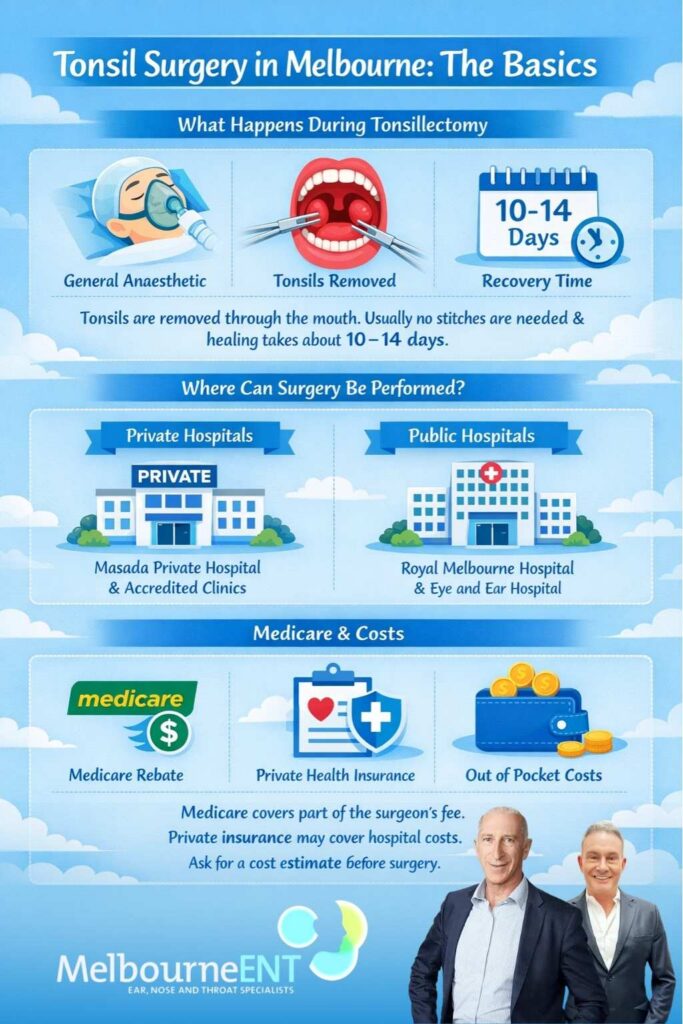
During tonsillectomy you are given a general anaesthetic so you are fully asleep and feel no pain. The ENT surgeon gently holds the mouth open and removes the tonsils through the mouth using specialised instruments. The tonsil areas are then checked carefully and any bleeding is controlled. No stitches are usually required, and the raw surface in the tonsil beds gradually forms a whitish coating before new tissue grows underneath. The operation itself is relatively short, but the throat takes about 10 to 14 days to heal. Children may go home the same day or after one night in hospital, and adults may need an overnight stay depending on their medical history and how they recover from anaesthetic.
✓ Where Tonsil Surgery Is Performed And How Medicare Fits In
In Melbourne, tonsil surgery is performed in both private and public hospitals. Patients of Melbourne ENT may have their procedure at Masada Private Hospital in St Kilda East or at other accredited facilities. Some patients who meet specific criteria may have surgery in public hospitals such as the Royal Melbourne Hospital or the Royal Victorian Eye and Ear Hospital.
Tonsillectomy is generally considered a medically necessary procedure when it is recommended for frequent infection, sleep disordered breathing or other significant health problems. When you have a valid referral from your GP or another specialist, Medicare usually pays a rebate toward the surgeon’s professional fee. If you are a private patient, there may still be out of pocket costs depending on the surgeon’s fees, the anaesthetist’s fees and the terms of your private health insurance. Hospital charges in private facilities are often partly or fully covered by private health insurance if you hold the right level of cover. It is important to ask Melbourne ENT, the hospital and your health fund for a written estimate of costs and expected Medicare rebates before your operation so that you understand any likely gap payments.
Expected Overall Recovery Time
Most children and adults need about 10 to 14 days to recover from tonsillectomy. Some people feel much better after one week, while others take the full two weeks or slightly longer to feel comfortable and regain normal energy levels. Adults usually find recovery more painful and prolonged than children because adult tonsils tend to be larger and more fibrous.
Your ENT surgeon will suggest how much time to plan away from school or work. Children are usually advised to stay home for at least one full week and often two weeks. Adults are commonly advised to allow about two weeks off work, especially if their job involves heavy physical work, constant talking or exposure to dust and infections.
Important Safety Reminders
All surgery carries risks and tonsillectomy is no exception. The main concerns after tonsil removal surgery are bleeding, infection, uncontrolled pain and dehydration. A small amount of blood stained saliva can be normal, but bright red bleeding or repeated spitting of blood is not and needs urgent care.
Your surgeon and anaesthetist will explain the possible risks and how they are managed in your situation. They will also provide written instructions about what to expect at home and when to seek help. At Melbourne ENT, the focus is on clear communication so that patients and families can make informed decisions about surgery and feel supported throughout recovery.
What Can Affect Your Day By Day Recovery
✓ Age And General Health
Age and general health have a big impact on recovery. Younger children often bounce back quickly but may struggle to explain their pain. They may show distress by refusing food or becoming clingy. Teenagers and adults typically experience more intense and longer lasting pain, particularly mid way through the first week.
If you have other health conditions such as asthma, reflux, heart or lung disease, these can influence how you respond to anaesthetic and how quickly you heal. It is important that your ENT surgeon and anaesthetist know your full medical history, including all medications and allergies, so that they can plan safely.
✓ Reason For Surgery
The reason for tonsillectomy also affects expectations. Patients who have had years of recurrent tonsillitis may have scarring and chronic inflammation around the tonsils, which can make both surgery and recovery feel more challenging. Those who have surgery mainly for obstructive sleep apnoea or snoring may be focused on long term breathing and sleep improvements.
In the short term, everyone goes through a similar healing process in the throat. In the longer term, patients often notice fewer sore throats, fewer antibiotics and, in some cases, better sleep and daytime energy. Your surgeon will go through the expected benefits and limitations of surgery for your particular situation.
✓ Surgical And Anaesthetic Factors
Different surgical techniques and energy devices can affect how much pain you feel and how the throat heals. Your ENT surgeon will choose the most appropriate method based on your anatomy and health. During surgery, the anaesthetist gives pain relief and other medicines through a drip, often including a steroid to reduce swelling.
Before you go home, you receive a written pain relief plan. This usually includes regular paracetamol and, if suitable for you, other medicines. Following this plan closely is one of the best ways to make your day by day recovery after tonsil operation more manageable.
✓ Home Environment And Support
Your home setup and support network matter more than many people realise. It is best if an adult can be present to supervise a child closely for the first few days after tonsillectomy. Adults having surgery should also avoid being alone at home immediately after discharge, as they may need help with medications, food, transport or caring for children.
Planning ahead makes tonsil surgery recovery smoother. Many families in Melbourne plan time off work, prepare soft foods, arrange school notes and create a quiet, calm environment for the first week. If you live far from the hospital, your surgeon may suggest staying in Melbourne overnight so that you can return easily if a problem arises.
Advice From Your Melbourne ENT Surgeon
Your ENT surgeon will discuss recovery in detail at your preoperative consultation. At Melbourne ENT, Dr Simon Braham considers your age, health, job, family situation and reason for surgery when explaining what to expect. This includes an honest discussion of discomfort, time off work or school and activity restrictions.
You are encouraged to ask questions about pain control, diet, travel, driving and returning to exercise. Writing down questions before your appointment can help. The more you understand beforehand, the more confident and prepared you are likely to feel once you get home.
Day 0: Tonsil Surgery Day in Melbourne
✓ Before Your Operation
On the day of tonsil surgery you arrive at the hospital after following fasting instructions. You complete admission paperwork and meet the nursing staff. Children need to be accompanied by a parent who can come into the operating theatre with their child.
Before the operation, you meet the anaesthetist who checks your health, medications and allergies and answers any questions about going to sleep and waking up. You also see your ENT surgeon again, for example Dr Simon Braham if you are a Melbourne ENT patient, to confirm the plan and ensure everything is understood.
✓ In Theatre And The Recovery Room
Once you are in theatre, the anaesthetist gives medicines so you drift off to sleep. You are continuously monitored while the surgeon removes the tonsils. You will not be aware of the procedure and will have no memory of it.
After surgery you wake up in the recovery room. Nurses check your breathing, pulse, blood pressure and pain level. Children may cry or seem disoriented at first, which usually settles when they see a familiar face. Adults often feel groggy, with a sore throat and dry mouth. Pain relief and treatment for nausea are available if needed. Parents can come into the recovery room as soon as their child starts to wake up.
✓ Going Home On The Same Day Or Staying Overnight
Some patients go home on the day of surgery, while others stay overnight. This decision is based on age, health, distance from the hospital, the time of day the surgery finishes and how you recover from anaesthetic. Young children, patients with medical issues or those who have late afternoon operations are more likely to stay in hospital overnight.
Before discharge you need to be drinking, passing urine and have pain at a manageable level with oral medications. You receive written instructions about medications, eating, drinking and activity, and you must have a responsible adult to drive you home and stay with you for at least the first night.
✓ The First Evening At Home
The first evening is usually quiet. The throat is sore but may still be partly numb from local anaesthetic used during surgery. Many patients manage small amounts of cool fluids and soft foods such as jelly or yogurt. It is important to start drinking early to avoid dehydration.
You should commence your prescribed pain relief schedule even if the pain still feels mild. Regular pain relief works best when you stay ahead of the pain rather than waiting for it to become severe. Following the instructions from the hospital and Melbourne ENT team helps set you up for the days ahead.
Days 1 to 3: Settling Into Recovery at Home
✓ Typical Pain Pattern In The First Few Days
During the first three days most patients have a sore throat that is noticeable but may be less severe than expected. Swallowing is uncomfortable and you may feel pain that spreads to the ears, jaw or neck. Some patients have a mild fever or feel generally tired and flat.
Symptoms can vary through the day, often worse at night or first thing in the morning when the throat is dry. Children may refuse certain foods or drinks, while adults may find themselves eating more slowly and speaking less. These early days are still part of the normal recovery pattern.
✓ Medications And Pain Relief Routine
Keeping to the pain relief schedule is essential in this phase. Most patients are advised to take paracetamol regularly and may also use other medicines if they are suitable for their age and health. The doses and timing will be clearly written on your discharge sheet.
You should not change doses or add over the counter medicines without medical advice. If pain seems poorly controlled even when you follow the plan, contact the hospital, your GP or, if you are a Melbourne ENT patient, the rooms of Dr Simon Braham for guidance. It is much safer to seek advice early than to struggle at home.
✓ Eating And Drinking
Hydration is more important than solid food at this stage. Small, frequent sips of water, diluted cordial or ice blocks can be easier to manage than large drinks. Soft, cool foods such as yogurt, custard and ice cream are often well accepted by children and adults. As comfort allows, you can introduce soft pasta, mashed potato or scrambled eggs.
Even if swallowing is uncomfortable, making regular efforts to drink helps the throat stay moist and reduces the risk of complications. If you or your child are drinking very little, not passing urine regularly or seem unusually sleepy, you should contact your medical team promptly.
✓ Sleep, Rest And Positioning
Rest is vital for healing. Many patients sleep more than usual in the first few days, partly due to the effects of anaesthetic and pain medicines. It is helpful to rest with the head slightly elevated on pillows, which can reduce swelling and make breathing more comfortable.
Children may feel safer sleeping near a parent so that any changes in breathing or distress can be noticed quickly. Adults should avoid lying completely flat or sleeping on their stomach. Short naps during the day are normal and allow the body to recover.
✓ When To Contact Your Care Team
If pain worsens quickly, if you notice a high fever or if you are worried about any symptoms, it is appropriate to contact your care team. During business hours, your GP or the Melbourne ENT rooms can usually assist. After hours, the hospital where surgery was performed will provide contact numbers for advice.
There is no need to feel you must cope alone. Recovery can feel different from what you expected, and early reassurance or adjustments to your plan can make a big difference.
Days 4 to 7: The Peak Discomfort Phase
✓ Why Pain Often Worsens In The Middle Of The First Week
For many children and adults, days 4 to 7 are the hardest part of tonsil surgery recovery. The initial numbness has worn off, swelling is often at its peak and the throat has developed a white or yellow coating. This coating is a normal healing layer, not pus, but it can look alarming if you are not expecting it.
Ear pain is often more intense at this stage because the same nerves supply both the throat and ears. Bad breath is also extremely common due to the healing tissue at the back of the throat. These symptoms are usually temporary and do not mean that the operation has gone wrong.
✓ Staying On Top Of Pain Relief
Because discomfort can peak in this time frame, it is crucial to keep taking pain relief as prescribed. Skipping doses can allow pain to build up to a level that is harder to control. You should continue the regular schedule even if pain occasionally seems less severe.
If medications cause side effects such as nausea or constipation, or if pain still feels unmanageable, contact your anaesthetist, GP or ENT surgeon. Patients treated at Melbourne ENT can contact the practice for advice on whether changes are needed or whether review is recommended.
✓ Eating, Drinking And Avoiding Dehydration
Many patients eat less during this stage because swallowing is more painful. However, drinking remains essential. Dehydration can increase pain and make you feel significantly worse. Aim for frequent sips of fluid through the day. Solid food can be as simple and soft as you need it to be.
If you or your child cannot maintain fluid intake, are not passing urine regularly or show signs of dehydration such as dry lips, sunken eyes or marked lethargy, you should seek medical assessment. Sometimes admission to hospital for intravenous fluids is needed to get recovery back on track.
✓ Activity Restrictions
Most people are still at home and resting during days 4 to 7. It is generally not recommended to return to school, childcare or work at this stage. Being in crowded environments increases the risk of exposure to viruses and can make recovery more difficult.
Strenuous activity, running, heavy lifting and gym workouts should be avoided. These can increase blood pressure and may contribute to bleeding. Gentle walking around the house is usually fine and can help prevent stiffness and improve mood.
✓ What To Watch For Around Days 5 To 7
Around days 5 to 7, the throat coating may thicken or look patchy, and the smell from the mouth can seem stronger. These changes are usually part of the healing process. They do not automatically mean infection is present.
However, bright red bleeding, repeated spitting of blood or vomiting blood are not normal and should never be ignored. If this happens, you should go to your nearest emergency department in Melbourne or call 000 if you are concerned about the amount of bleeding or about breathing.
Days 8 to 10: Turning the Corner in Your Recovery
✓ Healing Changes In The Throat
By days 8 to 10, many patients notice that pain is easing. The white or yellow coating over the tonsil beds begins to break down and small pieces may come away. The tissue underneath becomes more pink and smooth as new lining forms.
As the scabs loosen, there may be a short period of increased discomfort or mild bleeding. An unpleasant taste in the mouth is also common. Knowing that this is a normal phase of healing can reduce anxiety.
✓ Ongoing Bleeding Risk And Safety Advice
Secondary bleeding after tonsillectomy most often occurs between days 7 and 10. Although the overall risk is low, you should remain cautious in this period. Avoid very hot drinks, spicy foods and rough or crunchy foods that could scratch the healing surface.
If you notice bright red blood in your saliva, or if bleeding continues rather than stopping quickly, seek urgent medical attention. In Melbourne this usually means attending a hospital emergency department. If at any time you are worried about the severity of bleeding or about breathing, call 000.
✓ Expanding Your Diet
As swallowing becomes easier, you can gradually expand your diet. Many people find they can tolerate soft bread, tender meats, cooked vegetables and other normal foods, as long as they eat slowly and chew carefully.
You should still be cautious with very sharp, crunchy or spicy foods until your surgeon confirms that the throat is fully healed. It is sensible to progress at your own pace rather than rushing, and to stop any food that causes sharp pain.
✓ Gentle Return To Light Activities
Energy usually improves around this time. Children may start playing more and feel ready to return to gentle activities. Adults may feel comfortable taking short walks outdoors or spending longer periods out of bed.
Even so, it is important to avoid heavy exercise, contact sports, swimming and activities that risk falls or injuries. Your surgeon will advise when it is safe to restart these, but they are often delayed until at least two weeks after surgery.
✓ Staying In Touch With Melbourne ENT
If you are uncertain whether your recovery is progressing normally, you can contact the Melbourne ENT rooms in St Kilda East for advice if you are a patient there. The team can discuss your symptoms and help you decide whether assessment is needed.
Many concerns can be addressed with reassurance and simple suggestions, while more serious symptoms can be identified early. Ongoing communication is encouraged and is considered an important part of your care.
Days 11 to 14 and the Weeks After: Getting Back to Normal
✓ Throat Comfort And Energy Levels
By the end of the second week, most patients feel a clear turning point. The throat is much less sore, swallowing is easier and the coating has largely disappeared. You may still have mild discomfort with yawning or eating very dry foods, but this usually continues to fade.
Energy levels generally improve, although some people feel unexpectedly tired. Surgery, disrupted sleep and reduced food intake all take a toll on the body. Allowing time for gradual rebuilding of strength is important and helps prevent setbacks.
✓ Returning To School Or Work In Melbourne
Children are often ready to return to school sometime between day 10 and day 14, depending on how they feel and your surgeon’s advice. It can help to let teachers know that your child has recently had surgery and may be more tired or still adjusting to normal eating.
Adults returning to work in Melbourne or regional Victoria should consider the physical and social demands of their job. Office based roles may be resumed earlier than heavy manual work or jobs that involve long shifts, public speaking or exposure to infections. Discussing this with your ENT surgeon at Melbourne ENT can help you choose an appropriate date.
✓ Resuming Sport, Gym And Social Activities
Resuming sport and gym activity should be gradual. Even if you feel well, the tissues in the throat continue to strengthen for some time. Many patients are advised to avoid contact sports and heavy gym work for at least two weeks and sometimes longer.
Social activities that involve late nights, loud talking, alcohol or smoke can also delay recovery or increase risks. Taking a careful approach, building up activities step by step and listening to your body are sensible strategies.
✓ Long Term Benefits Of Tonsil Surgery
Once healing is complete, many patients notice significant improvements. Those who previously had frequent tonsillitis may have fewer sore throats, fewer doctor visits and fewer courses of antibiotics. Children who had enlarged tonsils causing snoring or obstructive sleep apnoea may sleep more quietly and wake more refreshed.
Outcomes vary from person to person, and no operation can guarantee a particular result. Your ENT surgeon at Melbourne ENT recommended surgery because, in your situation, the potential benefits were felt to outweigh the risks.
Follow up with Dr Simon Braham and the Melbourne ENT team
After surgery you will normally have a follow up appointment with your ENT surgeon. Patients are reviewed by Dr Simon Braham to confirm that healing is on track, to examine the throat and to answer any remaining questions.
If you still have concerns about breathing, snoring, voice, swallowing or other ENT symptoms, this is a good time to discuss them. Further tests or treatments can be arranged if needed, or you may simply be advised to observe and return if concerns arise in the future.
When to Seek Urgent Medical Help During Recovery
✓ Bleeding That Needs Emergency Care
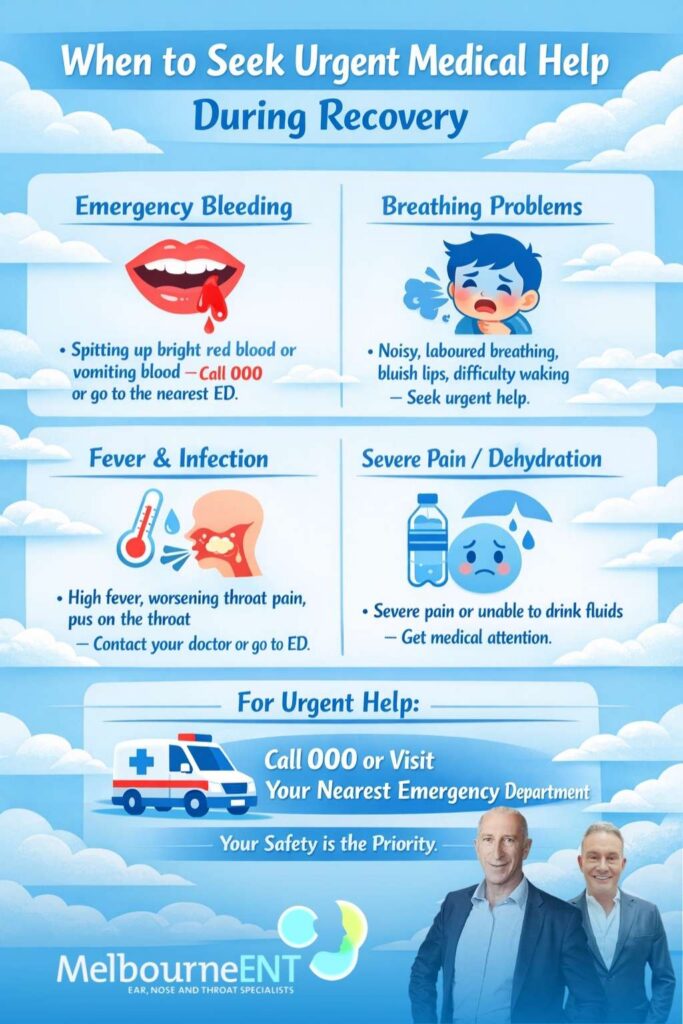
Significant bleeding after tonsillectomy is an emergency. If you or your child are spitting out bright red blood, if blood is running from the mouth or if you are vomiting blood rather than clear saliva with tiny streaks, you should seek urgent care.
Do not attempt to manage substantial bleeding at home. In Melbourne, go straight to your nearest emergency department or call 000 if bleeding is heavy or if you are worried about breathing or faintness. Hospital staff can treat bleeding promptly and contact your ENT surgeon if required.
✓ Breathing Concerns
Breathing problems are rare but serious. Noisy breathing at rest, obvious struggle for breath, a child who is very limp or difficult to wake or any bluish colour around the lips all require immediate attention.
Parents are encouraged to observe children closely during the first few nights after surgery. If you have any concern about breathing, do not wait to see if it improves. Call 000 or attend an emergency department for assessment.
✓ Fever And Signs Of Infection
A mild fever in the first day or two can be normal, but a high or persistent fever combined with feeling increasingly unwell, severe throat pain or a foul taste may suggest infection or another complication. Thick pus on the throat, rather than the usual smooth coating, can also be a concern.
If you are unsure whether a fever is significant, you can contact your GP, the hospital or, if you are a Melbourne ENT patient, the practice for advice. If you feel very unwell or cannot keep fluids down, it is safer to attend an emergency department.
✓ Pain And Hydration Red Flags
Severe pain that does not improve despite regular medication, or an inability to drink adequate fluid, are also warning signs. You should be passing urine regularly and be able to keep down drinks without constant vomiting.
Young children, older adults and people with other illnesses are particularly prone to dehydration. If you suspect dehydration or uncontrolled pain, seek medical review rather than hoping things will improve on their own.
✓ Who To Call
For non urgent questions during business hours, your GP is often a good first contact. If you are under the care of Melbourne ENT, the practice team can also provide guidance and help arrange review if required.
For urgent issues such as significant bleeding, breathing difficulty or severe collapse, emergency services are the correct contact. Call 000 or present to the nearest emergency department. Your safety is always the priority.
How Melbourne ENT Supports Your Tonsil Surgery Journey
✓ Pre Operative Consultation And Planning
Your tonsil surgery journey usually begins with a referral from your GP to Melbourne ENT. At your consultation in St Kilda East, your ENT surgeon, such as Dr Simon Braham, will take a detailed history, examine your throat, nose and ears and review any previous test results.
You will discuss the reasons tonsillectomy is being considered, what alternatives exist and what results you can realistically expect. This is a chance to talk through your symptoms, ask questions and share any worries you have about surgery or recovery.
✓ Shared Decision Making
Shared decision making means that you and your surgeon decide together whether surgery is the right choice. Tonsillectomy is not necessary for every sore throat, and non surgical management may be more suitable in some cases.
At Melbourne ENT, surgery is recommended only when the pattern of infections or breathing problems and your overall health suggest that the benefits are likely to outweigh the risks. Your surgeon will explain this reasoning so that you can make an informed choice.
✓ Personalised Recovery Information
Before surgery you receive written information about preparation, the hospital admission process and what to expect day by day afterwards. Instructions are tailored for adults or children and adapted to your medical conditions and medicines.
Your anaesthetist designs a pain management plan specifically for you, taking into account your age, weight and other health issues. The goal is to support a smoother recovery by preventing uncontrolled pain and managing side effects such as nausea.
✓ Ongoing Communication
Communication continues after you leave hospital. Your discharge paperwork lists phone numbers for the ward, after hours advice and, if you are a Melbourne ENT patient, the practice rooms. You are encouraged to call if you have concerns about pain, bleeding, eating or any unexpected symptom.
Melbourne ENT works closely with GPs and other specialists in Melbourne and regional Victoria. This cooperative approach aims to provide safe, coordinated care from the time of referral through surgery and recovery.

FAQs About Day by Day Recovery After Tonsil Surgery
Can my sense of taste or smell change after tonsil surgery, and will it go back to normal?
Some patients notice that food tastes different or that their sense of taste seems reduced in the first few weeks after tonsillectomy. This usually relates to swelling, the healing surface at the back of the throat and the temporary coating over the tonsil area. Bad breath during healing can also make everything smell and taste less pleasant. In most people, taste gradually returns to normal as the throat heals and the coating disappears. If you are worried about ongoing changes after several weeks, you can discuss this at your follow up visit with your ENT surgeon at Melbourne ENT.
Why does my voice sound different after tonsillectomy, and is that permanent?
Your tonsils sit in a space that helps shape how your voice sounds, so when they are removed, the way sound resonates in your throat and nose can change for a while. Swelling, pain and the healing surface can also make you speak more quietly or cautiously. Many people notice that their voice sounds blocked, nasal or slightly different in pitch for a short time. As the swelling settles and you feel more comfortable speaking, your voice usually returns to a natural pattern. In some patients who had very large tonsils, the long term voice may sound clearer once healing is complete.
Is it normal to feel pain in my tongue, teeth or jaw, not just my throat?
Yes, pain after tonsil surgery is not always limited to the throat. During the operation a device gently holds the mouth open so the surgeon can see the tonsils clearly. This can leave the tongue feeling bruised or numb for a few days, and the jaw or teeth may feel tender. Some patients also describe an ache in the ears or along the side of the face because of shared nerve pathways. These symptoms are usually temporary and improve as the tissues settle. If pain in the tongue, teeth or jaw is severe, worsening or accompanied by difficulty moving the jaw, you should contact your medical team or the Melbourne ENT rooms for advice.
My sleep feels worse right after surgery, even though I had it to help my breathing. Is that expected?
It can be frustrating if your sleep seems worse in the early recovery period, especially if you had tonsillectomy to help with snoring or obstructive sleep apnoea. In the first days and weeks there is significant swelling and healing in the throat, and you may be taking pain relief medicines that affect your normal sleep pattern. Pain, dryness and anxiety can also lead to frequent waking. For most patients, these issues gradually settle and the longer term breathing and sleep benefits become clearer once healing is complete. If you continue to have loud snoring, pauses in breathing or unrefreshing sleep several months after surgery, you can discuss this with your ENT surgeon at Melbourne ENT, who may recommend further assessment.
What happens if I accidentally cough or sneeze very hard during recovery?
Coughing or sneezing is a normal reflex and cannot be avoided completely after tonsil surgery. A strong cough or sneeze may cause a brief spike in throat pain and can sometimes lead to a small amount of blood stained saliva, especially during the period when the scabs are loosening. In most cases this settles quickly and does not cause harm. It can help to keep your mouth slightly open when you feel a sneeze coming to reduce pressure in the throat. However, if you notice ongoing bright red bleeding after coughing or sneezing, or if you feel that something has torn or changed suddenly, you should seek urgent medical assessment.
Can I travel or fly in the weeks after tonsil surgery?
Travel plans need careful thought after tonsillectomy. Short local car trips around Melbourne are usually fine once you feel steady on your feet and are no longer taking strong sedating pain relief. Longer car journeys, long distance driving or flights can be more challenging because you may be far from medical care if a problem arises, and the dry air in planes can irritate a healing throat. Many ENT surgeons suggest avoiding air travel for at least two weeks after tonsillectomy and sometimes longer. If you need to travel interstate or overseas, it is best to discuss timing with your surgeon at Melbourne ENT before you book.
How can I support my child emotionally through recovery, not just manage the physical pain?
The emotional side of recovery is just as important as physical healing, especially for children. Younger children may feel frightened by hospital, disrupted sleep and changes in routine. Older children may feel frustrated or isolated if they cannot attend school or activities around Melbourne with their friends. Simple strategies can help, such as using honest but reassuring explanations, choosing age appropriate language to describe what is happening in their throat and involving them in small decisions like which soft foods to eat. Providing extra comfort, planning quiet activities like reading, drawing or gentle screen time and keeping a calm atmosphere can make the days pass more easily. If your child seems very anxious or distressed, you can raise this with your GP or with the Melbourne ENT team, who can offer further guidance and suggest additional support if needed.
Medical References
- Long-term complications after tonsil surgery: an analysis of … – https://pmc.ncbi.nlm.nih.gov/articles/PMC10749945/
- Tonsillectomy compared with conservative management in … – https://pmc.ncbi.nlm.nih.gov/articles/PMC11017150/
- The Indications of Tonsillectomy Among Pediatric Patients – https://pmc.ncbi.nlm.nih.gov/articles/PMC10725620/
- Tonsillectomy or adenotonsillectomy versus non-surgical treatment for chronic/recurrent acute tonsillitis – https://www.ncbi.nlm.nih.gov/pmc/articles/PMC5804872/
- Tonsillectomy or adenotonsillectomy versus non‐surgical … – https://pmc.ncbi.nlm.nih.gov/articles/PMC7075105/
- Complications Following Lingual Tonsillectomy: Analysis of the … – https://pmc.ncbi.nlm.nih.gov/articles/PMC12753122/
- Trends and Practices in Tonsil Surgery—A National Survey for … – https://pmc.ncbi.nlm.nih.gov/articles/PMC12198428/
Taking the Next Step with Melbourne ENT
If you think you or your child might benefit from assessment for tonsil surgery, the best place to start is with your GP. They can review your symptoms, consider other possible causes for your throat or sleep problems and, if appropriate, provide a referral to an ENT surgeon at Melbourne ENT in St Kilda East.
With a referral in place, you can arrange a consultation to discuss whether tonsillectomy is suitable in your situation, what the likely benefits and risks are and how recovery would fit with your work, school and family life in Melbourne or regional Victoria. You will have the opportunity to ask questions, raise concerns and understand the expected day by day recovery in more detail.
To learn more about tonsil surgery, recovery timelines and other ENT services available at Melbourne ENT, you can ask your GP for a referral and visit the website for further information and patient resources.
Further Reading
- Read more about Tonsillectomy Melbourne
- Read more about Adult Tonsil Surgery Melbourne
- Read more about Tonsil Surgery for Kids in Melbourne
- Read more about Tonsil Stones Melbourne – Also Known As Tonsilloliths
- Read Melbourne ENT’s Blog on Cold Ablation Techniques for Tonsils
- Read Melbourne ENT’s Blog on What is Coblation Tonsillectomy?

Day by Day Recovery After Tonsil Surgery
Tonsil surgery, or tonsillectomy, is a common procedure for both children and adults in Melbourne….

Tonsillitis Myths: Why Ice Cream Is Not The Treatment
For many people who grew up in Melbourne and across Australia, and for many of…

Cold Ablation Techniques for Tonsils
At Melbourne ENT in St Kilda East, Victoria, patients benefit from the expertise of two…