

Snoring is often spoken about casually, but for many people, it becomes a persistent concern that affects far more than the sound heard at night. It can disturb sleep, affect partners and family members, contribute to mouth breathing, and raise questions about whether there may be a more significant airway issue behind it. Some patients seek review because the snoring has gradually worsened. Others are concerned because they wake feeling unrefreshed, notice ongoing nasal blockage, or have been told that their breathing seems unsettled during sleep. Parents may notice noisy breathing, restless sleep, or open-mouth breathing in a child and wonder whether enlarged adenoids or tonsils could be involved.
At Melbourne ENT, snoring is not approached as a one-size-fits-all complaint. Dr Simon Braham, ENT and Head & Neck Surgeon, sees adults and children with airway-related concerns and recognises that the cause of snoring is not always obvious from symptoms alone. A blocked nose may be part of the story, but it is not always the whole story. In other patients, the palate, tonsils, throat, or deeper parts of the airway may also be contributing. This is why a structured assessment is important.
One of the tools that may form part of this assessment is endoscopic airway assessment. This allows the upper airway to be examined more directly, helping the consultation move beyond guesswork and towards a clearer understanding of the anatomy. This can provide additional anatomical information to support the consultation. Instead of being told that snoring is simply something to put up with, or that there is one obvious cause, they can receive a more careful explanation of which parts of the airway appear relevant and what that may mean for further investigation or management.
This article explains what endoscopic airway assessment involves, why it may be used when investigating snoring, how it fits into a broader ENT consultation, and why adults and children may need slightly different approaches. The aim is not to suggest that every person who snores requires extensive investigation. Rather, it is to explain how ENT surgeons such as Dr Simon Braham use this type of assessment to better understand the airway and guide discussion in a measured, patient-centred way.
Why Snoring Deserves A Proper Assessment
Snoring is common, but common does not always mean simple. It is often the sound produced when airflow becomes turbulent as it passes through a narrowed part of the upper airway. What is less straightforward is identifying exactly where that narrowing is occurring. The source may be in the nose, the soft palate, the tonsils, the tongue base, or several areas at once.
That is one reason patients often feel frustrated before specialist review. They may have tried to work out the cause themselves by focusing on one symptom, such as a blocked nose or mouth breathing, only to find that this does not fully explain what is happening at night. Some may have tried simple measures without much change. Others are not sure whether the snoring is simply disruptive or whether it might sit alongside another sleep-related breathing issue.
In practice, snoring can present in different ways. A few common examples include:
- occasional snoring without other symptoms
- nightly snoring with poor-quality sleep
- snoring associated with nasal obstruction
- snoring with mouth breathing or waking with a dry mouth
- noisy sleep in a child with enlarged tonsils or adenoids
- snoring with symptoms that prompt consideration of sleep apnoea assessment
This range matters because snoring is a symptom rather than a final diagnosis. A proper assessment helps place that symptom in context. At Melbourne ENT, the focus is on understanding how the patient is affected, what the airway looks like, and whether further investigation is appropriate. This is often more helpful than jumping too quickly to assumptions about treatment.
For Dr Simon Braham, the aim of review is to understand the pattern of the problem before discussing what may come next. That begins with a careful history and examination, but in many patients, direct visual assessment of the airway can add important detail.
What Is Endoscopic Airway Assessment?
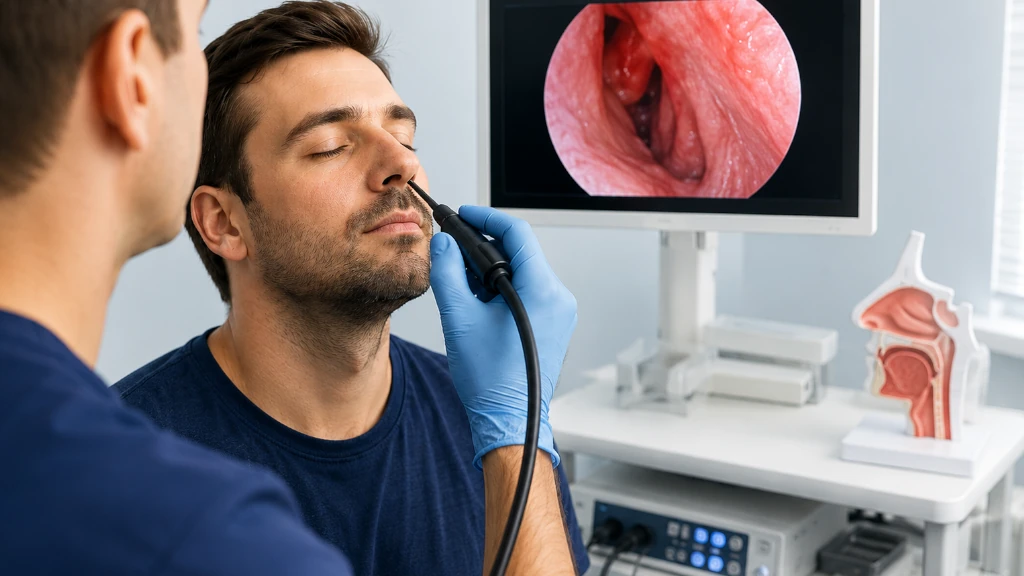
An endoscopic airway assessment is an examination of the upper airway using a thin flexible camera that is passed gently through the nose. It allows the ENT surgeon to inspect parts of the airway that are not easily seen during a routine examination from the front of the nose or mouth.
Depending on the patient and the reason for assessment, this may include:
- the nasal passages
- the septum
- the turbinates
- the back of the nose
- the adenoid region
- the soft palate
- the throat
- the area around the tongue base
- related upper airway structures
For patients, this can sound more confronting than it usually is in practice. The camera is slender, and the examination is usually brief. A topical spray may be used inside the nose when appropriate. Some people notice pressure or watering of the eyes. Others describe a strange sensation in the throat for a short time. Experiences vary, but the examination is commonly used in ENT practice because it provides information that cannot always be obtained from a standard external examination alone.
The value of endoscopic airway assessment lies in what it can show. In a patient with snoring, it may help identify whether the nasal airway appears narrow, whether the palate and throat seem crowded, whether enlarged adenoids or tonsils are likely to be contributing, or whether more than one level of the airway may be involved. In children, it can be particularly useful when adenoids are suspected to be part of the problem, as these are not easily assessed just by looking in the mouth.
At Melbourne ENT, this type of assessment may be used as part of the clinical work-up when it is relevant to the patient’s symptoms. Dr Simon Braham may use endoscopic airway assessment to support a clearer understanding of airway anatomy and how that anatomy may relate to snoring, mouth breathing, or sleep-related concerns.
The Consultation Comes First
Although endoscopic airway assessment can be very useful, it does not replace the clinical consultation. In many respects, the consultation remains the foundation of good care. Before any camera is used, the surgeon needs to understand what the patient is experiencing, how the symptoms behave over time, and whether there are clues that point towards one part of the airway more than another.
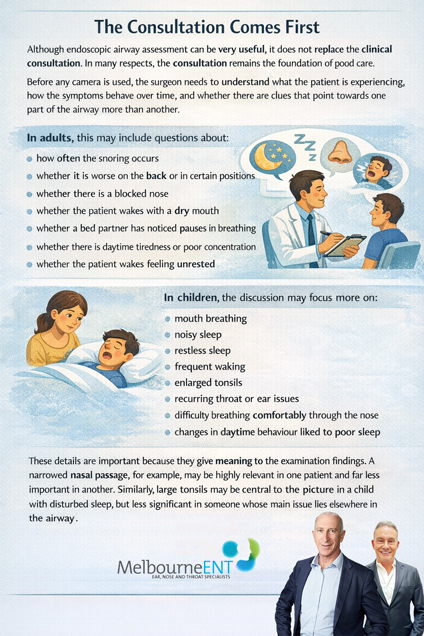
In adults, this may include questions about:
- how often the snoring occurs
- whether it is worse on the back or in certain positions
- whether there is a blocked nose
- whether the patient wakes with a dry mouth
- whether a bed partner has noticed pauses in breathing
- whether there is daytime tiredness or poor concentration
- whether the patient wakes feeling unrested
In children, the discussion may focus more on:
- mouth breathing
- noisy sleep
- restless sleep
- frequent waking
- enlarged tonsils
- recurring throat or ear issues
- difficulty breathing comfortably through the nose
- changes in daytime behaviour linked to poor sleep
These details are important because they give meaning to the examination findings. A narrowed nasal passage, for example, may be highly relevant in one patient and far less important in another. Similarly, large tonsils may be central to the picture in a child with disturbed sleep, but less significant in someone whose main issue lies elsewhere in the airway.
Dr Simon Braham’s approach at Melbourne ENT is based on relating symptoms to anatomy, not simply describing anatomy in isolation. That distinction matters. This can allow the discussion to move beyond a general statement that the airway is narrow and towards identifying which areas may be relevant to the symptoms.
Looking Beyond The Obvious Cause
A common theme in snoring assessment is that the most obvious symptom is not always the complete explanation. Many patients come to consultation convinced that the problem is entirely nasal because they feel blocked through the nose, especially at night. Others assume that visible tonsils must be the whole reason for snoring. While either of those may be relevant, airway narrowing can occur at several levels at once.
For example, an adult may have a deviated septum, enlarged turbinates, and a crowded palate. A child may have enlarged adenoids as well as tonsillar enlargement. Another patient may have relatively little visible on a simple mouth examination, but deeper crowding in the throat that becomes more important during sleep.
This is where endoscopic airway assessment often adds clarity. It gives the surgeon a more complete view of the upper airway and can help explain why a symptom has persisted or why one type of treatment has not addressed the issue fully.
Some of the more common findings that may be considered during airway assessment include:
- nasal narrowing, such as septal deviation or turbinate enlargement
- adenoid enlargement in children
- tonsillar enlargement in adults or children
- palatal crowding, where the soft palate contributes to narrowing
- throat crowding, where there appears to be reduced space in the airway
- multi-level narrowing, where several parts of the airway are involved
For patients, this information can help shift the discussion from a vague problem to a more specific explanation. It also supports a more balanced conversation about what may or may not be useful as the next step. At Melbourne ENT, Dr Simon Braham uses this type of structured assessment to help patients understand that snoring is often more complex than it first appears.
What Happens During The Assessment?
The practical side of endoscopic airway assessment is often easier than patients expect. In many cases, it is performed during the consultation. After discussing the symptoms and carrying out an initial examination, the surgeon may suggest a closer look at the airway using a flexible endoscope.
The camera is passed gently through the nostril. A topical spray may be used to make the inside of the nose more comfortable where appropriate. The surgeon then examines the internal nasal cavity and the upper airway structures in a systematic way.
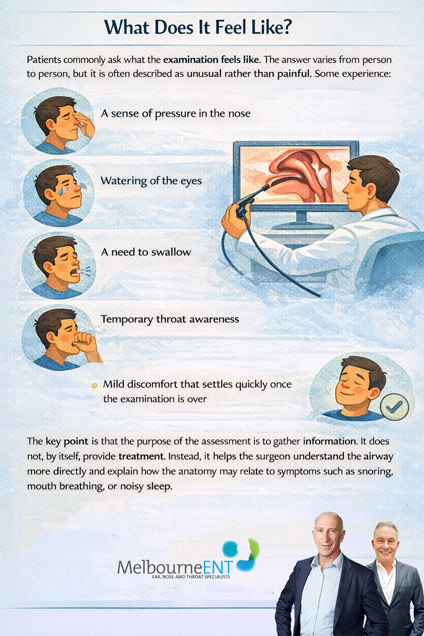
Patients commonly ask what the examination feels like. The answer varies from person to person, but it is often described as unusual rather than painful. Some experience:
- a sense of pressure in the nose
- watering of the eyes
- a need to swallow
- temporary throat awareness
- mild discomfort that settles quickly once the examination is over
The key point is that the purpose of the assessment is to gather information. It does not, by itself, provide treatment. Instead, it helps the surgeon understand the airway more directly and explain how the anatomy may relate to symptoms such as snoring, mouth breathing, or noisy sleep.
At Melbourne ENT, this type of examination is used to support clearer discussion. Patients often find it helpful because it gives structure to the consultation. Rather than feeling that snoring is an undefined problem, they can begin to understand which areas of the airway appear relevant and what that may mean in practical terms. Dr Simon Braham may then use those findings to determine whether further assessment or discussion is warranted.
When A Sleep Study May Still Be Needed
One important point in snoring assessment is that airway examination and sleep testing are not the same thing. Endoscopic airway assessment shows anatomy. It helps identify where the airway may be narrow or crowded. A sleep study, by contrast, provides information about breathing patterns during sleep over time.
This distinction is important because some patients assume that once the airway has been examined, there is no need for any further testing. In reality, if symptoms raise concern about obstructive sleep apnoea, a sleep study may still be appropriate.
A sleep study may be considered when symptoms include:
- witnessed pauses in breathing
- gasping or choking during sleep
- significant daytime tiredness
- waking unrefreshed
- unsettled sleep with concern about breathing quality
For some patients, the airway examination helps explain what the anatomy looks like, while the sleep study helps determine whether sleep-related breathing disturbance is present and how significant it may be. These two forms of assessment can complement each other rather than compete.
At Melbourne ENT, the role of endoscopic airway assessment is to contribute to the overall clinical picture. It does not replace other investigations when those are warranted. Instead, it helps ensure that discussion about further testing or management is grounded in a clearer understanding of the airway. Dr Simon Braham may recommend additional investigation when the history and examination suggest that this would be relevant.
Adults And Children Often Present Differently
Although snoring can affect both adults and children, the pattern is often different between the two groups. Adults may describe poor sleep, fatigue, a blocked nose, dry mouth, or concern from a partner. Their airway issues may involve long-standing nasal obstruction, palate-related narrowing, throat crowding, or other anatomical factors.
Children are often brought for review because parents have noticed mouth breathing, noisy sleep, restless sleep, snoring, or enlarged tonsils. In some cases, adenoids are suspected to be part of the problem. Because the symptoms and the likely anatomy can differ, the assessment needs to be tailored accordingly.
For adults, the consultation may focus more on how the symptoms affect rest, daily functioning, and whether there are signs suggesting further sleep assessment. For children, the conversation often includes sleep quality, breathing habits, recurrent infections, growth of tonsils or adenoids, and how comfortably the child breathes through the nose.
This difference is one reason specialist ENT review can be useful when symptoms persist. Dr Simon Braham consults on both adult and paediatric ENT presentations at Melbourne ENT in St Kilda East, and the assessment process is shaped around the age, symptoms, and airway findings of the individual patient.
When Sleep Endoscopy May Be Discussed
Most patients who present with snoring do not require complex testing beyond a standard consultation, examination, and where relevant, an endoscopic airway assessment. However, there are selected situations where the airway may need to be assessed in more detail.
One example is drug-induced sleep endoscopy, sometimes referred to as sleep endoscopy. This is a separate form of assessment in which the airway is examined in a sleep-like state. The reason it may sometimes be discussed is that the airway can behave differently during sleep than it does when the patient is awake, upright, and actively controlling muscle tone.
That said, sleep endoscopy is not a routine step for every person who snores. It is considered selectively, depending on the clinical situation. For example, it may be discussed when:
- symptoms are more complex
- the pattern of airway narrowing remains unclear
- further anatomical detail may help guide decision-making
- earlier assessment has not fully clarified the picture
A measured approach is important. At Melbourne ENT, the purpose of discussing any further investigation is to consider whether it would add meaningful information, not to suggest that more testing is always necessary. Dr Simon Braham may discuss this type of assessment only where it is clinically relevant to the patient’s presentation.
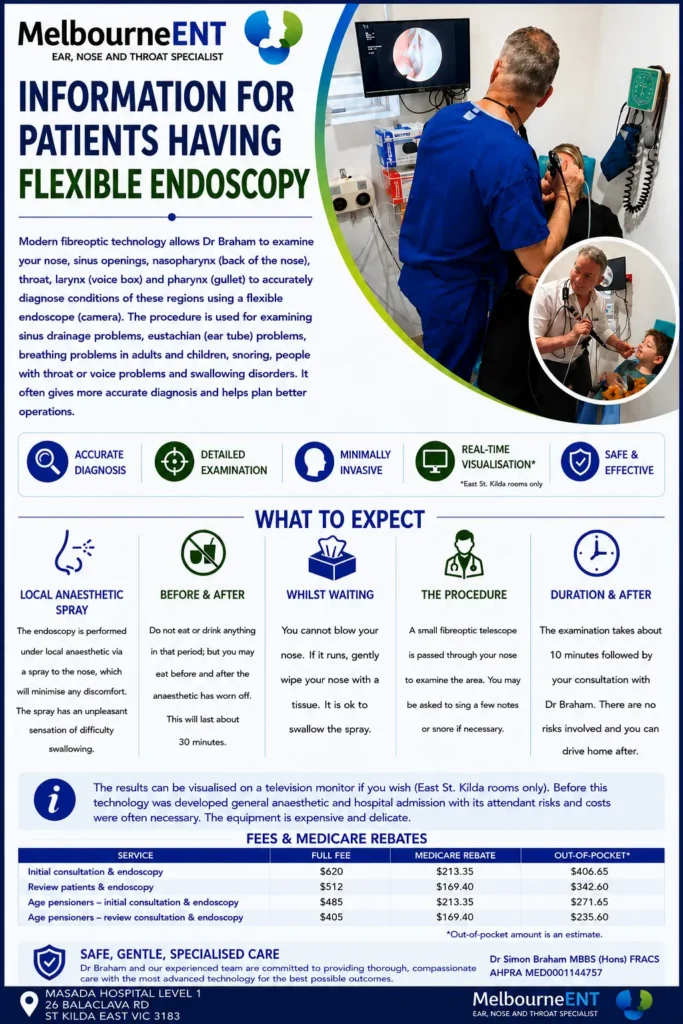
Download Information for Patients Having Flexible Endoscopy Brochure
How The Findings May Shape Discussion About Management
One of the main benefits of a careful airway assessment is that it supports a more individual discussion about what to do next. This does not mean that the examination automatically points to one management pathway. In fact, one of the most useful aspects of endoscopic airway assessment is that it can help avoid oversimplified decision-making.
Depending on the history, examination, and any other investigations, the next step may involve:
- no immediate intervention, with monitoring over time
- further investigation, such as sleep study testing
- discussion of nasal symptoms and airflow issues
- discussion of throat or adenoid-related factors
- consideration of non-surgical management pathways
- discussion of whether any procedural option is relevant in the individual case
This balanced approach is important from both a clinical and an ethical perspective. Snoring can be frustrating, and patients are understandably keen for answers. However, it is not appropriate to imply that every airway finding needs treatment or that one form of management suits everyone. Instead, the consultation should explain what has been found, how it may relate to symptoms, and whether further steps are warranted.
For Dr Simon Braham and Melbourne ENT, that means keeping the focus on clear explanation and appropriate decision-making. Patients often value not just the examination itself, but the opportunity to understand how the findings fit into the bigger picture. If the assessment shows crowding at the tongue base, coblation tongue channelling may be one of the options considered.

Endoscopic Airway Assessment FAQs
Can an endoscopic airway assessment show why someone snores more on some nights than others?
It may help identify anatomical factors that make snoring more likely, such as nasal narrowing or throat crowding. Night-to-night variation can still occur because sleep position, nasal congestion, illness, and sleep quality may also affect how the airway behaves.
If the nose feels clear during the day, can the airway still narrow at night?
Yes, it can. Some patients breathe reasonably well while awake but still have airway narrowing during sleep because tissue tone changes and the airway behaves differently overnight.
Can this assessment help if the main complaint is mouth breathing rather than snoring?
It can be relevant in that situation as well. Mouth breathing may be associated with reduced nasal airflow, enlarged adenoids, or other upper airway factors that an endoscopic assessment may help identify.
Does the camera only look at the nose, or can it assess the throat as well?
It can assess more than the nose. The examination may include the nasal passages, the back of the nose, the palate, the throat, and other upper airway structures depending on the patient’s symptoms.
Can a child have an endoscopic airway assessment even if they do not complain of poor sleep?
Yes, because children do not always describe sleep symptoms clearly. Parents may instead notice noisy breathing, restless sleep, mouth breathing, or persistent nasal blockage, which can still warrant assessment.
Will this assessment explain every cause of snoring on its own?
Not always. It provides useful anatomical information, but in some cases a sleep study or other investigations may still be needed to understand whether breathing is being disrupted during sleep.
Can enlarged adenoids be missed without an endoscopic assessment?
They can be difficult to assess properly on a routine mouth examination because they sit at the back of the nose. Endoscopic assessment may provide a clearer view when adenoids are suspected to be contributing to symptoms.
Is there any value in this assessment if the patient has already had nasal surgery in the past?
Yes, there may still be value in reassessing the airway. Previous nasal surgery does not rule out ongoing nasal narrowing, throat-related factors, or multi-level airway issues that may still be contributing to snoring.
Can this assessment be useful even when snoring is not especially loud?
It can be, depending on the symptoms. Some patients are more concerned about mouth breathing, poor-quality sleep, or possible airway obstruction than noise alone, and those issues may still justify closer assessment.
Does a normal-looking throat on routine examination mean the airway is normal?
Not necessarily. Some parts of the airway are not easily seen without a flexible camera, which is why endoscopic airway assessment may add useful information when symptoms persist.
Medical References:
- Upper Airway Evaluation in Patients with Obstructive Sleep Apnea.
https://sleepmedres.org/journal/view.php?doi=10.17241%2Fsmr.2015.00535 - Drug-Induced Sleep Endoscopy: Technique, Indications, Tips and Pitfalls.
https://pmc.ncbi.nlm.nih.gov/articles/PMC6787696 - The Role of Isolated Nasal Surgery in Obstructive Sleep Apnea Therapy. A Systematic Review.
https://www.mdpi.com/2076-3425/12/11/1446
Why This Assessment Can Still Be Reassuring Without Making Promises
Many patients seek specialist assessment because uncertainty is stressful. They may not know whether the snoring is coming from the nose, the throat, or both. They may be unsure whether the issue is minor, whether it is likely to persist, or whether another type of assessment should be considered. In children, parents often want to understand whether noisy breathing or mouth breathing might reflect enlarged adenoids or tonsils.
An endoscopic airway assessment can help reduce some of that uncertainty by providing a clearer visual understanding of the upper airway. It does not guarantee a simple answer, and it does not replace the need for judgement, history-taking, or other investigation when indicated. What it can do is support a more informed discussion.
Patients often find that helpful for several reasons:
- it provides a more direct look at the airway
- it can clarify whether more than one area appears involved
- it supports discussion about whether further testing is needed
- it helps place symptoms in context
- it can make the consultation feel more specific and less uncertain
That said, reassurance in ENT practice should come from explanation rather than promises. At Melbourne ENT, the emphasis remains on careful assessment and realistic discussion, rather than suggesting that any single examination provides every answer. This is consistent with the measured approach that Dr Simon Braham takes when discussing snoring and airway concerns with patients and families.
A Structured Approach For Patients in Melbourne
For patients in Melbourne and surrounding areas, persistent snoring can lead to months or even years of uncertainty before specialist review is sought. Some people adapt to the problem and only present when the symptoms worsen. Others are prompted by concerns raised by a partner, family member, or parent. In either case, what is often needed first is not an assumption about treatment, but a structured understanding of the airway.
That is where endoscopic airway assessment may form part of the consultation at Melbourne ENT. By examining the upper airway directly, Dr Simon Braham can assess whether particular areas appear relevant to the patient’s symptoms and whether any other investigation should be considered. In adults and children alike, this helps support a more careful discussion of what is happening and what the next step may be.
Key Points To Remember
- Snoring can come from different parts of the upper airway.
- A blocked nose is not always the only cause.
- Adults and children may present differently.
- Endoscopic airway assessment allows the airway to be examined more directly.
- A sleep study may still be needed if sleep apnoea is a concern.
- The findings help guide discussion, but do not automatically determine management.
- A balanced, individual assessment is important.
For patients attending Melbourne ENT in St Kilda East, the aim of assessment is to understand the symptoms, examine the airway appropriately, and decide whether further investigation or management discussion is warranted. In that setting, endoscopic airway assessment can be a useful part of investigating snoring and related airway concerns, while keeping the focus on careful diagnosis and patient-centred care.
Further Reading
- Read more about Fibreoptic Endoscopy with Dr Braham
- Read more about Snoring Surgery Melbourne
- Read Melbourne ENT’s Blog on Using the STOP-BANG Questionnaire to assess Sleep Apnoea & OSA
- Read Melbourne ENT’s Blog on Adult Snoring and Sleep Apnea – Role of Tonsils in Airway Obstruction
- Read Melbourne ENT’s Blog on Sleep Disturbed Breathing In Kids Melbourne – Also Known As Paediatric Sleep Disordered Breathing
Download Snoring Journey with Dr Braham

Bronchial or Nasal Surgery for Snoring – Which Is Right for You
Is nasal or throat surgery better for snoring? The most appropriate treatment depends on where…

Can Weight Loss Fix Snoring – What ENT Surgeons Want You To Know
Weight loss may help reduce snoring in some individuals, particularly where excess tissue contributes to…

Adult Snoring and Sleep Apnea – Role of Tonsils in Airway Obstruction
Snoring is extremely common, but it is not always something to shrug off as a…