

Parents often start asking about tonsils and adenoids after weeks or months of disrupted sleep, repeated infections, or constant mouth breathing. The question rarely begins with the operation itself. More often, it begins with a child who snores loudly, sleeps restlessly, wakes tired, or seems to be forever dealing with blocked noses, sore throats, or ear problems.
At Melbourne ENT, Dr Simon Braham often sees families who want to understand whether the tonsils, the adenoids, or both may be contributing to their child’s symptoms. For parents across Melbourne and surrounding areas, this can be an important discussion. In some children, both structures are involved. In others, only one is a significant factor. Some children may not require surgery at all.
That is why the discussion is never based on a simple rule. It is based on the child’s symptoms, history, examination findings, and the impact those symptoms are having on sleep, breathing, eating, hearing, and general well-being. Dr Simon Braham, ENT Surgeon at Melbourne ENT in St Kilda East, Victoria, assesses these concerns as part of a broader ear, nose and throat review, with the aim of helping families understand what may be going on and what management options may be appropriate.
This guide explains why tonsils and adenoids are often discussed together, when both may be considered for treatment, when only one may be relevant, and what parents may wish to understand before making a decision.
Why Tonsils and Adenoids Are Linked
Tonsils and adenoids are not the same structure, but they are closely connected in the way they can affect a child’s airway and general ENT health.
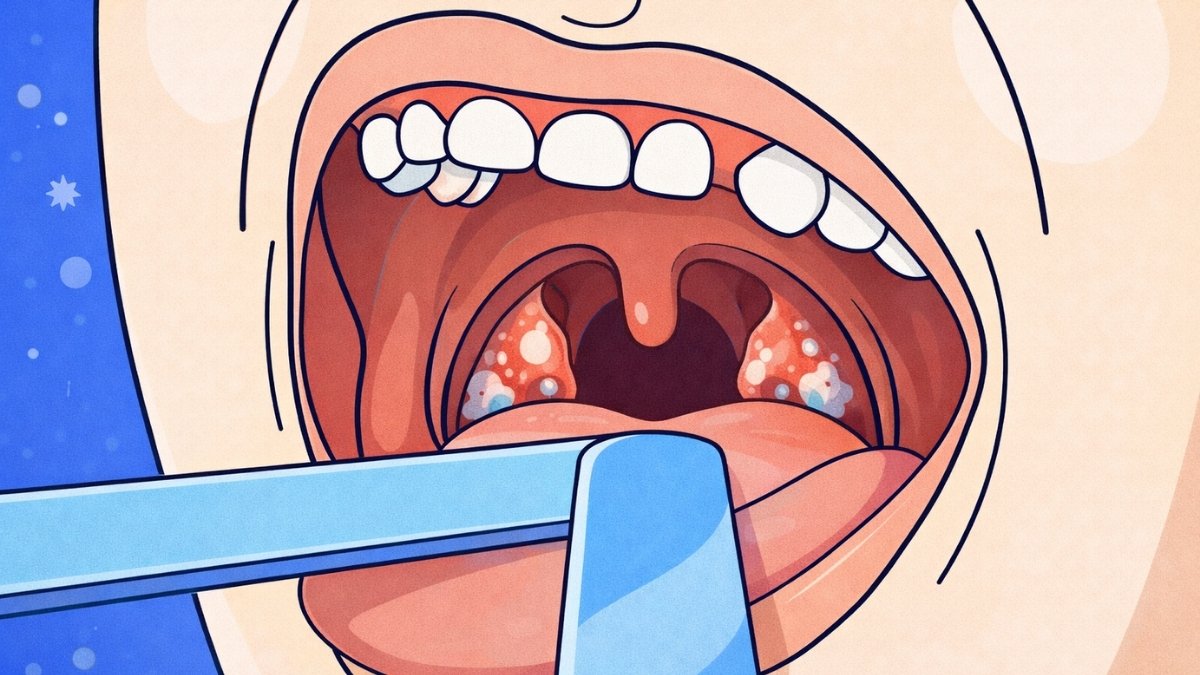
The tonsils are located at the back of the throat. They are often easy for parents or doctors to see when a child opens their mouth. The adenoids sit much higher, behind the nose, and cannot usually be seen in the same way. Both are made of lymphoid tissue and form part of the body’s immune system, particularly in early life.
In many children, these tissues do not cause any difficulty. In others, they may become enlarged or repeatedly inflamed. When that happens, problems can begin to overlap.
Large tonsils can narrow the airway at the level of the throat. Enlarged adenoids can reduce airflow through the nose. Together, they may make it harder for a child to breathe freely, especially during sleep when the muscles of the upper airway relax. This is why snoring, mouth breathing and unsettled sleep are so often part of the conversation.
Parents are sometimes surprised to learn how much the nose, throat and ears influence one another. The adenoids sit in an area that is closely related to the opening of the Eustachian tubes, which help regulate pressure in the middle ear. This means enlarged adenoids may also be associated with glue ear, recurrent ear infections, or hearing fluctuation in some children.
Because of this overlap, it is common for children to present with a combination of symptoms rather than one single complaint. A child may have throat infections as well as snoring. Another may have mouth breathing, blocked nose, poor sleep and ongoing ear concerns. As Dr Simon Braham explains during consultation, a proper ENT assessment helps determine which tissues are contributing and whether the pattern suggests treatment may be appropriate.
What Parents May Notice at Home
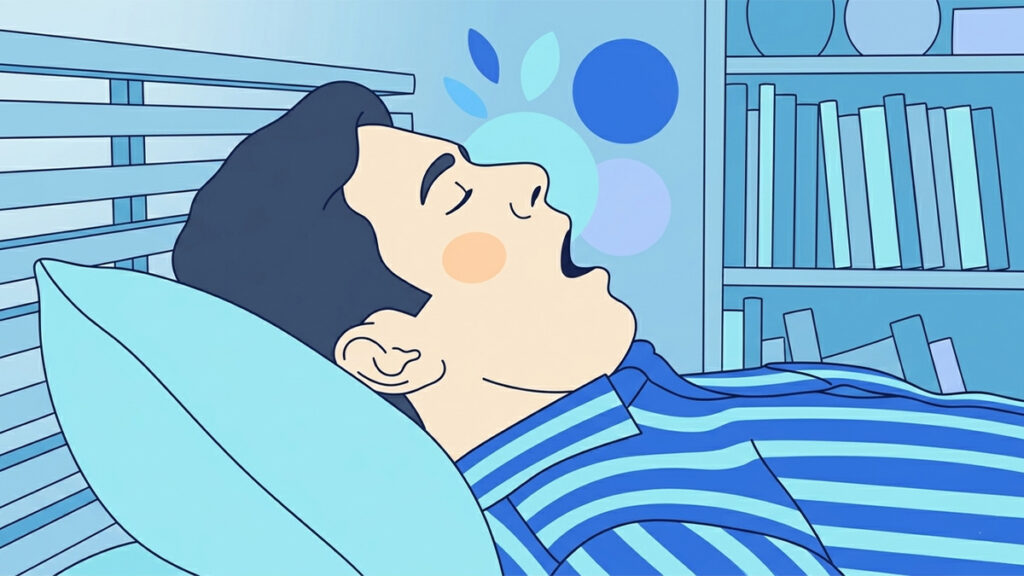
Many families first become concerned because everyday life starts to feel harder for their child. The changes may seem small at first. A child who once slept quietly may begin to snore. Mouth breathing becomes more noticeable. Sore throats become more frequent. Morning tiredness becomes part of the routine.
Some of the most common signs parents describe include:
- regular snoring
- sleeping with the mouth open
- restless or broken sleep
- noisy breathing at night
- persistent mouth breathing during the day
- a blocked-sounding nose even without a cold
- repeated tonsillitis
- frequent sore throats
- ear infections or glue ear
- hearing concerns
- tiredness, irritability or poor concentration during the day
Not every child with these symptoms will need surgery. Even so, these signs can be useful because they help build a picture of how the airway and ENT structures may be functioning.
A child with enlarged adenoids may look as though they always have a cold, even when they do not. They may breathe through the mouth much of the time, sleep with lips parted, and sound blocked in the nose. Some children also develop sleep that is light or broken because nasal airflow is reduced.
A child with enlarged tonsils may snore, gag on certain foods, speak with a muffled voice, or experience repeated episodes of tonsillitis. If the tonsils are very large, they may contribute to a crowded airway during sleep. If there is recurrent infection as well, symptoms can affect eating, school attendance and general comfort.
Parents often know something is not quite right long before a formal diagnosis is made. Their observations are valuable, especially when symptoms occur mostly at night or over long periods. Dr Simon Braham often uses these day-to-day observations to help build a clearer picture of what may be contributing to a child’s symptoms.
When Both Tonsils and Adenoids May Be Considered
One of the most common reasons both tonsils and adenoids may be discussed together is sleep disordered breathing. This term covers a range of breathing difficulties during sleep, from regular snoring through to more significant obstruction.
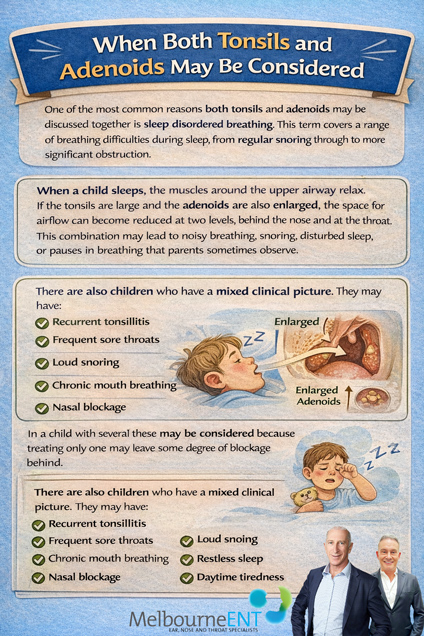
When a child sleeps, the muscles around the upper airway relax. If the tonsils are large and the adenoids are also enlarged, the space for airflow can become reduced at two levels, behind the nose and at the throat. This combination may lead to noisy breathing, snoring, disturbed sleep, or pauses in breathing that parents sometimes observe.
In this setting, both structures may be considered because treating only one may leave some degree of blockage behind.
There are also children who have a mixed clinical picture. They may have:
- recurrent tonsillitis
- frequent sore throats
- loud snoring
- chronic mouth breathing
- nasal blockage
- restless sleep
- daytime tiredness or behavioural change
In a child with several of these features, both tonsils and adenoids may be contributing. That does not automatically mean surgery is the next step, but it does mean both structures may need to be assessed as part of the discussion.
At Melbourne ENT, Dr Simon Braham focuses on whether the symptoms, taken together, suggest that the tonsils, the adenoids, or both are relevant to the child’s condition. The decision is based on the overall pattern rather than one symptom in isolation.
When Only One Structure May Need Treatment
Although tonsils and adenoids are often spoken about as a pair, they do not always need to be treated together.
If the main issue is recurrent tonsillitis, and there are no significant nasal symptoms, no habitual mouth breathing, and no sleep-related breathing concerns, then the discussion may centre on the tonsils alone. In these cases, the adenoids may not be a significant contributor.
Likewise, some children present with a pattern that points more strongly to enlarged adenoids. These children may have:
- chronic nasal obstruction
- mouth breathing
- recurrent ear infections
- glue ear
- hearing fluctuation
- a blocked or nasal-sounding voice
If the tonsils are not especially enlarged and there is little history of throat infection or throat obstruction, treatment may focus on the adenoids rather than both structures.
This is one of the most important messages for parents. Surgery is not a package deal. The operation considered should reflect the symptoms present in the child and the clinical findings at assessment.
That is why hearing that another child had both removed is not enough to guide the decision for a different family. One child’s symptoms may be driven by the throat. Another’s may be more related to the nasal airway and ears. Another may have overlap between both. Dr Simon Braham discusses this distinction carefully with families so they understand why one child may be managed differently from another.
Why The Assessment Matters So Much
Parents are often exposed to many opinions before they attend an ENT consultation. Family members may say a child definitely needs their tonsils removed. Friends may describe improvement after surgery. Online information may be helpful in some places and confusing in others.
A consultation gives families the opportunity to step back from assumptions and look carefully at the child’s actual symptoms.
Assessment usually begins with the history. This may include discussion of:
- how often the child snores
- whether the snoring is mild or loud
- whether mouth breathing occurs only during colds or all the time
- whether pauses in breathing have been noticed
- how often throat infections occur
- whether antibiotics have been needed
- whether there are ear infections, hearing concerns or glue ear
- whether symptoms are affecting daytime behaviour, concentration or sleep quality
These details matter because no single symptom tells the whole story. A child who snores occasionally during a cold is different from a child who snores every night and wakes unrefreshed. A child with one sore throat a year is different from a child with repeated tonsillitis affecting school attendance and eating.
Examination then adds further information. The size and appearance of the tonsils may be reviewed, along with the overall airway and related ENT findings. Adenoid enlargement is usually considered based on symptom pattern and clinical assessment, since adenoids are not easily seen during a routine mouth examination.
The purpose of the consultation is not simply to move towards surgery. It is to understand the child’s clinical picture and decide whether monitoring, further review, or treatment may be appropriate. At Melbourne ENT, Dr Simon Braham uses this process to help families understand the reasons behind any discussion about treatment.
Questions Many Parents Ask
Parents usually arrive with more than one concern. Even when they ask whether both tonsils and adenoids need to be removed, they are often also asking a series of related questions.
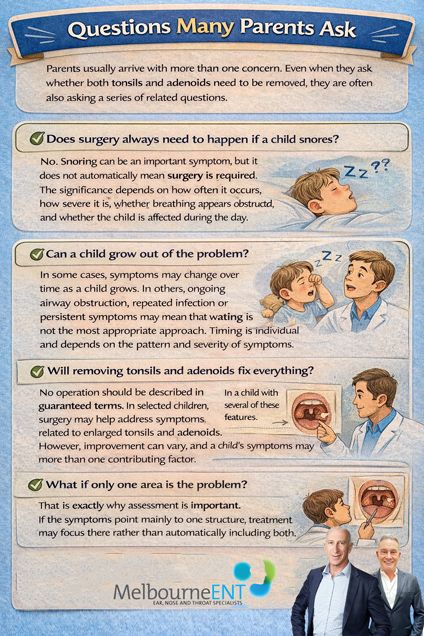
✓ Does surgery always need to happen if a child snores?
No. Snoring can be an important symptom, but it does not automatically mean surgery is required. The significance depends on how often it occurs, how severe it is, whether breathing appears obstructed, and whether the child is affected during the day.
✓ Can a child grow out of the problem?
In some cases, symptoms may change over time as a child grows. In others, ongoing airway obstruction, repeated infection or persistent symptoms may mean that waiting is not the most appropriate approach. Timing is individual and depends on the pattern and severity of symptoms.
✓ Will removing tonsils and adenoids fix everything?
No operation should be described in guaranteed terms. In selected children, surgery may help address symptoms related to enlarged tonsils and adenoids. However, improvement can vary, and a child’s symptoms may sometimes have more than one contributing factor.
✓ What if only one area is the problem?
That is exactly why assessment is important. If the symptoms point mainly to one structure, treatment may focus there rather than automatically including both.
These conversations are often helpful because they allow families to move away from general assumptions and towards a more individual understanding of their child’s situation. Dr Simon Braham discusses these questions regularly with parents at Melbourne ENT.
The Effect on Daily Life
Symptoms related to tonsils and adenoids are not always dramatic, but they can still affect a child in meaningful ways over time.
A child who sleeps poorly may not always say they are tired. Instead, the effect may show up as:
- irritability
- emotional ups and downs
- reduced concentration
- difficulty getting through the day
- unsettled behaviour
- heavy mouth breathing during quiet activities
- slower recovery after minor illnesses
Repeated tonsillitis can also place strain on families. Parents may need to manage frequent absences from school or childcare, repeated GP visits, courses of antibiotics, reduced appetite, and interrupted sleep.
Persistent mouth breathing and nasal blockage can affect comfort during the day as well as at night. Some parents feel that their child always seems congested, even when infections are not present. Others notice changes in speech or ongoing ear concerns that prompt hearing checks or repeated follow-up.
Looking at the broader effect on the child is part of a balanced assessment. The question is not only what the tonsils or adenoids look like, but how the child is functioning overall.
Understanding Recovery If Surgery Is Discussed
For many families, recovery is one of the biggest concerns. It is not enough to understand why surgery may be considered. Parents also want to know what comes afterwards.
Recovery after tonsil surgery often involves throat pain, reduced appetite, and a period where eating and drinking need encouragement. Children may be unsettled for a number of days, and families need clear instructions about pain relief, fluids, rest and when to seek review.
Adenoid surgery alone is often associated with a lighter recovery than tonsil surgery. When both are performed together, the tonsil part of the operation is usually what shapes the recovery period.
Parents usually want practical information such as:
- how long recovery may take
- what their child may find difficult
- when school or childcare may resume
- how to encourage fluid intake
- when to seek medical advice if recovery is not progressing as expected
This is an important part of informed decision-making. Understanding recovery helps families weigh the possible role of surgery against the current impact of symptoms. Dr Simon Braham explains recovery in practical terms so families know what to expect if surgery is discussed.
How Melbourne ENT Approaches The Discussion
At Melbourne ENT, families are usually looking for clarity rather than pressure. They want to understand why their child is snoring, why infections are recurring, or why mouth breathing and blocked nose symptoms are not improving.
Dr Simon Braham, ENT Surgeon, sees children with a broad range of ENT concerns, including tonsil and adenoid problems. At Melbourne ENT in St Kilda East, Victoria, assessment takes into account the child’s symptoms, clinical findings, and the way the problem is affecting day-to-day life.
For families from Melbourne and surrounding areas, this kind of consultation may help clarify:
- whether the tonsils are likely to be contributing
- whether the adenoids may also be involved
- whether the pattern is more suggestive of infection, obstruction, or both
- whether surgery may be discussed
- whether observation or follow-up may be more appropriate
Parents often find it helpful when the nose, throat and ears are considered together, because children’s symptoms rarely fit neatly into one category. A child with snoring may also have ear problems. A child with recurrent sore throats may also be breathing through the mouth at night. A broader ENT assessment helps place these symptoms into context.

Tonsil and Adenoid Removal in Children FAQs
Can a child still need both tonsils and adenoids removed even if throat infections are not the main problem?
Yes. In some children, the reason for considering both is more related to breathing, snoring, mouth breathing, or disrupted sleep than to repeated infections. Assessment looks at the overall pattern of symptoms, not just sore throats.
Why do some children sound constantly blocked up even when they do not have a cold?
Enlarged adenoids can reduce airflow through the nose and create a blocked or congested sound. This can sometimes be mistaken for repeated colds when the issue is actually ongoing nasal obstruction.
Can large adenoids affect a child’s ears as well as their breathing?
Yes. The adenoids sit close to the opening of the Eustachian tubes, so enlargement may contribute to middle ear problems in some children. This can be associated with fluid build-up, recurrent ear infections, or fluctuating hearing.
Is it possible for a child to sleep poorly without obviously waking up?
Yes. Some children with enlarged tonsils and adenoids do not fully wake during the night, but their sleep may still be disrupted by noisy or obstructed breathing. Over time, this can affect daytime energy, mood, or concentration.
Can mouth breathing during the day be linked to enlarged adenoids?
It can be. If the nasal airway is persistently blocked, a child may begin breathing through the mouth out of habit as well as necessity. This can continue even when parents are not noticing obvious cold symptoms.
Why might one child need surgery while another child with similar snoring does not?
Snoring on its own does not always mean the same thing in every child. The decision depends on factors such as how often it occurs, whether breathing seems obstructed, whether there are related throat or ear issues, and how much the symptoms are affecting the child overall.
Can enlarged tonsils affect eating as well as sleeping?
Yes. Some children with large tonsils may gag on certain foods, eat more slowly, or avoid particular textures. If throat infections are also occurring, swallowing may become even more uncomfortable during those episodes.
Do adenoids always need to be removed if the tonsils are being removed?
No. The adenoids are only considered if the child’s symptoms and clinical findings suggest they are contributing to the problem. Treatment is based on the individual child rather than a routine combination approach.
Could behaviour changes at school be related to tonsils or adenoids?
In some children, poor quality sleep linked to airway obstruction may show up as irritability, poor concentration, or changes in behaviour rather than obvious tiredness. This is one reason sleep history can be an important part of assessment.
Why do parents sometimes feel unsure even after hearing that surgery is common?
Because common does not mean automatic or appropriate for every child. Parents usually want to understand why surgery is being considered for their child specifically, what symptoms it is intended to address, and whether other options may also be reasonable.
Medical References:
- Adenotonsillectomy in Children with Obstructive Sleep Apnea Syndrome: Clinical and Functional Outcomes.
https://pmc.ncbi.nlm.nih.gov/articles/PMC10531828/ - PROSPECT guideline for tonsillectomy: systematic review and procedure-specific postoperative pain management recommendations.
https://pmc.ncbi.nlm.nih.gov/articles/PMC8247026/ - A Comprehensive Examination of the Immediate Recovery of Children Following Tonsillectomy and Adenoidectomy.
https://pmc.ncbi.nlm.nih.gov/articles/PMC7308207/
A Balanced Way to Think About The Decision
When parents ask whether tonsils and adenoids should be removed together, the most accurate answer is often that it depends on the individual child.
Some children may have symptoms and findings that suggest both are contributing to the problem. Some may have concerns that point mainly to one structure. Some may need time, observation and review rather than surgery.
A balanced approach usually involves thinking about three things at once:
- the pattern of symptoms
- the examination findings
- the effect on the child’s well-being
This helps shift the discussion away from assumptions and towards a more personalised plan.
For some families, the next step may simply be assessment and explanation. For others, it may be monitoring symptoms over time. For some children, treatment may be discussed if the clinical picture suggests that enlarged tonsils, enlarged adenoids, or both are having a significant effect.
The Key Message for Parents
Tonsils and adenoids are often discussed together because they can both influence breathing, sleep, throat symptoms and ear health. Even so, they do not always need to be removed together.
A child may require assessment when there is regular snoring, mouth breathing, repeated tonsillitis, persistent nasal blockage, ear problems, or signs that sleep quality may be affected. In some children, both tonsils and adenoids may be relevant. In others, only one structure may be contributing in a significant way.
The decision about treatment should be based on the child’s history, symptoms, examination findings and overall clinical picture. That is why a careful ENT review is often the most useful starting point.
At Melbourne ENT, Dr Simon Braham works with families to assess these concerns in children from Melbourne and surrounding areas. For parents who are trying to understand whether the tonsils, the adenoids, or both may be involved, a consultation can help explain the likely causes of symptoms and the management options that may be considered.
Further Reading
- Read more about Adenotonsillectomy Melbourne
- Read more about Tonsil Surgery for Children Procedure
- Read more about Adenotonsillectomy Melbourne
- Read more about Adult Tonsil Surgery Melbourne
- Read Melbourne ENT’s Blog on Cold Ablation Techniques for Tonsils
- Read Melbourne ENT’s Blog on What is Coblation Tonsillectomy ? – Cold-Ablative Tonsillectomy in Melbourne
Do Tonsils Grow Back After Tonsillectomy?
Tonsillectomy is often spoken about as though it is the final chapter in a long…

Best Foods for Recovery After Tonsil Surgery
After tonsil surgery, eating and drinking can feel very different to usual. A sore throat,…
Adult Snoring and Sleep Apnea – Role of Tonsils in Airway Obstruction
Snoring is extremely common, but it is not always something to shrug off as a…